Synthesia. HeyGen. D-ID. In the space of three years, these platforms turned a niche research concept, AI-generated talking avatars, into a multi-billion dollar commercial category. Today, AI-generated avatars appear in 36% of brand-produced videos. Over 69% of Fortune 500 companies use AI-generated video for brand storytelling and marketing. The AI avatar market, valued at $7.41 billion in 2024, is projected to reach $118.55 billion by 2034, growing at a CAGR of nearly 32%.
The demand is real, the infrastructure is accessible, and the market is still early enough that a well-built, differentiated product can carve out a defensible position. But building an AI avatar video generation platform is genuinely complex technically, ethically, and operationally. The platforms that look effortless from the outside are the result of careful, layered engineering decisions made across every component of the stack.
This guide breaks down how to build one from the core AI models that power avatar generation, to the video rendering pipeline, the user-facing product experience, the ethical guardrails you cannot skip, and the business model decisions that determine whether the platform becomes a sustainable product or an expensive experiment.
What an AI Avatar Video Generation Platform Actually Does?
Before diving into architecture, it's worth being precise about what this category of platform produces because "AI avatar video" covers a wide and diverse range of capabilities.
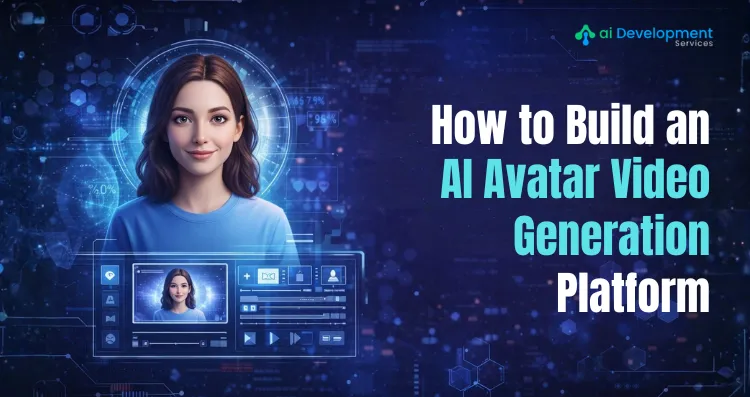
At the most basic level, these platforms take a text script and a digital avatar (either a pre-built stock avatar or a custom avatar created from a person's recorded video) and generate a realistic talking-head video where the avatar lip-syncs to the script, delivered in a specified voice, language, and visual style.
The best platforms go substantially further: real-time avatar customization, multi-language support with accurate lip-sync across dozens of languages, emotion and gesture control, full-body avatars, background replacement, screen-sharing overlays for product demos, and API access for programmatic video generation at scale.
The most advanced systems and the direction the market is moving combine avatar generation with conversational AI, creating interactive avatars that can respond in real time to user input rather than just deliver pre-scripted content. This is the category Soul Machines and UneeQ operate in, and it represents the next significant frontier.
Understanding which of these capabilities you're building towards is the first and most important product decision you'll make.
Turn Scripts Into Stunning Avatar Videos
Step-by-Step: How to Build an AI Avatar Video Generation Platform
Step 1: Define Your Platform Scope and Use Case
Before writing a single line of code, get clear on exactly what your platform will do and who it's for. Are you building a B2B SaaS tool for corporate training videos? A creator-focused platform for social media content? An API-first product for developers? Each direction demands different feature priorities, different avatar quality thresholds, and different infrastructure decisions. Narrowing scope early prevents the most expensive mistake in platform development, building everything for everyone and doing none of it well.
Step 2: Choose Your Avatar Generation Approach
Decide between pre-built stock avatars, user-generated custom avatars, or fully synthetic avatars or a tiered combination of all three. Stock avatars are the fastest to production. Custom avatars are the strongest differentiator. Most successful platforms launch with stock avatars and layers in custom avatar creation as a premium feature once the core rendering pipeline is stable.
Step 3: Integrate Your AI Model Stack
Assemble the core AI components your platform depends on. This includes a face reconstruction model (NeRF or Gaussian Splatting for high fidelity), a lip-sync model (Wav2Lip as a baseline, upgraded over time), a TTS engine (ElevenLabs, PlayHT, or Cartesia via API), and optionally a gesture and expression generation model. At this stage, using existing open-source foundations and commercial APIs rather than training from scratch, the goal is a working pipeline, not a novel model.
Step 4: Build the Video Rendering Pipeline
Connect your AI models into an end-to-end video generation pipeline: script input → TTS audio generation → lip-sync frame generation → compositing with background and overlays → video encoding and export. Start with async rendering (job queue → background processing → notification on completion) before attempting real-time output. Tools like FFmpeg handle video encoding and compositing. GPU instances on AWS (p3 or g4 series), Google Cloud (A100), or Azure handle the compute-intensive inference steps.
Step 5: Develop the Backend Infrastructure
Build the API layer, user authentication, project and asset management, job queue system, and storage architecture that sit behind the rendering pipeline. FastAPI or Node.js work well for the API layer. Redis or AWS SQS handles job queuing. PostgreSQL manages user and project data. S3 or Google Cloud Storage holds generated video assets, delivered via CDN for fast playback worldwide.
Step 6: Build the User-Facing Product
Design and develop the script editor, avatar selection interface, customization controls, background management, preview player, and export options that users interact with daily. This is where product intuition matters as much as engineering; the interface needs to feel simple even though the system behind it is complex. Invest in UX research and iterative prototyping before committing to the final design.
Step 7: Implement Ethical and Compliance Infrastructure
Build consent verification for custom avatar creation, content moderation for generated output, C2PA watermarking, identity verification at onboarding, and the terms of service enforcement mechanisms that protect both users and the platform. This step cannot be deferred; it needs to be in place before any real users are onboarded, not after.
Step 8: Add API Access and Integrations
Expose a well-documented REST API that allows enterprise and developer customers to generate videos programmatically. Add webhook support for async job notifications, SDKs for common languages, and pre-built integrations with tools like HubSpot, Zapier, and Slack that expand the platform's reach into existing workflows.
Step 9: Beta Test with Real Users
Launch a closed beta with a carefully selected group of users who match your target persona. Measure rendering quality, time-to-first-video, job failure rates, and user satisfaction. Use this feedback to fix the sharp edges in both the product experience and the underlying pipeline before opening to a wider audience.
Step 10: Launch, Monitor, and Iterate
Deploy to production with proper monitoring of job success rates, rendering latency, API uptime, GPU utilization, and storage costs all need dashboards from day one. Plan your first post-launch iteration cycle before you launch, not after. The most successful avatar platforms treat launch as the beginning of the product development cycle, not the end.
Ethical Guardrails: Non-Negotiable from Day One
Building an AI avatar video generation platform means building infrastructure that can create convincing, realistic-looking videos of people saying things they never said. The ethical and legal implications of this capability are not edge cases to be handled later. These are core design requirements.
Consent verification for custom avatars, any platform that creates avatars from real people's likenesses must have robust consent verification in place. Users must affirmatively consent to the creation of their avatar, understand how it will be used, and have the ability to delete their avatar and all generated content. Platforms that skip this step face both regulatory exposure and the reputational damage of enabling deepfake misuse.
Content moderation for generated videos, the generated output must be reviewed (either by automated classifiers or human moderators, or both) for content that violates terms of service: impersonation of real public figures, political disinformation, non-consensual intimate content, and other categories. Building a comprehensive content policy and the moderation infrastructure to enforce it is not optional for a platform that operates at scale.
Watermarking and provenance, the Coalition for Content Provenance and Authenticity (C2PA) standard is becoming an industry baseline for labeling AI-generated content. Building C2PA-compliant metadata into every generated video, and optionally adding visible watermarks, is both an ethical responsibility and an increasingly expected feature for enterprise customers who need to document content provenance.
Terms of service and identity verification for platforms enabling custom avatar creation from user video. Identity verification (ensuring the person submitting footage is the person in the footage) is the critical control. Biometric verification services like Persona, Onfido, or Jumio can be integrated into the onboarding flow to verify identity before avatar creation is enabled.
Generative AI Development: The Engine Behind Modern Avatar Platforms
The rapid advancement of generative AI development has been the single biggest driver of quality improvement in this category over the past two years. Diffusion models, which power the most realistic image and video synthesis systems, have moved from research papers to production infrastructure with remarkable speed.
The newest generation of video models, Sora (OpenAI), Veo 2 (Google), and Gen-4 (Runway) can produce photorealistic video from text descriptions. While these general-purpose video models aren't purpose-built for avatar generation, they represent the foundation that next-generation avatar platforms will build on. Teams developing in this space today need to be tracking these models closely and building architectures that can incorporate new model capabilities as they become available.
Monetization Models for AI Avatar Video Generation Platform
Credit-based subscriptions are the dominant model in this category. Users pay monthly for a set of credits; longer videos, higher-quality renders, and real-time interactive features consume more credits. This aligns revenue with value delivered and scales naturally with usage.
Per-seat team plans serve enterprise customers who need collaboration features, shared avatar libraries, centralized billing, and dedicated support. These plans typically carry significantly higher margins than individual subscriptions.
API access tiers enable developers and enterprise customers to generate video programmatically at volume. Pricing by minute of generated video or by API call with volume discounts is the standard model.
White-label licensing offering the underlying platform technology to enterprises or agencies who want to deploy their own branded avatar video solution is a high-value B2B model that works well for platforms with mature, reliable infrastructure.
Building AI Avatar Video Generation Platform: Partner, Buy, or Build
Given the complexity of every layer described above: avatar rendering, TTS, lip-sync, video pipeline, product compliance, the honest framing for most teams is: what do you actually need to build from scratch, and what can you assemble?
The AI models are available as open-source foundations or via commercial API. The GPU infrastructure is available via AWS, Google Cloud, or Azure. The video processing tools are mature and well-documented.
What requires genuine original engineering is system integration, making all these components work together reliably, at scale, with the latency and quality users expect, plus the product layer that turns the infrastructure into something non-technical users can actually use.
This is where working with an experienced partner accelerates significantly. AI Development Service specializes in building production AI video and avatar platforms, with experience integrating the underlying model layer, video pipeline, and product experience into a coherent, scalable system. For teams who want to move faster than a pure build-from-scratch approach allows, this kind of partnership is often the most efficient path to a working product.
Get Your AI Avatar Platform Built by Specialists
Conclusion
The AI avatar video generation market is real, growing at a pace few technology categories match, and still early enough that well-built products can establish lasting positions. Synthesia, HeyGen, and D-ID built their leadership by solving the core technical challenges earlier than most, but they didn't solve everything, and there are genuine gaps in the market for platforms that serve specific verticals better, integrate deeper into specific workflows, or deliver interactive avatar capabilities that the current leaders don't yet offer at scale.
Building in this space is a multi-layer engineering challenge: avatar rendering, voice synthesis, lip-sync, video pipeline, product design, and ethical infrastructure all need to work together. The teams that get this right treat each layer seriously, design for scalability from the start, and build the ethical guardrails into the foundation rather than bolting them on after launch.
The opportunity is significant. The bar to meet it is real. And the tools to build it have never been more accessible.
Frequently Asked Questions - AI Avatar Video Generation Platform
Q1. How technically complex is it to build an AI avatar video generation platform?
Ans. Very complex. The platform requires integrating multiple AI models, face reconstruction, text-to-speech, lip-sync, gesture generation with a video rendering pipeline, cloud infrastructure, and a user-facing product layer. A production-ready platform typically requires 12–18 months of engineering work for a well-resourced team, though a focused MVP with pre-built avatars and API-based TTS can be shipped significantly faster.
Q2. Do I need to train my own AI models or can I use existing ones?
Ans. Most production platforms use a combination of open-source model foundations (Wav2Lip for lip-sync, open TTS models, face reconstruction libraries) fine-tuned on proprietary data, plus commercial APIs for components like voice synthesis (ElevenLabs, PlayHT). Training entirely custom models from scratch is expensive and generally unnecessary given the quality of existing foundations.
Q3. How do I handle the ethical risks of deep fake potential?
Ans. Consent verification for custom avatar creation, robust content moderation for generated output, C2PA-compliant watermarking, identity verification at onboarding, and clear terms of service that prohibit impersonation and non-consensual use. These are not optional features, they are foundational requirements for any legitimate platform in this category.
Q4. What are the biggest infrastructure cost drivers?
Ans. GPU compute for video rendering is the dominant cost, followed by cloud storage for generating video content and CDN delivery costs. Real-time interactive avatar features are significantly more expensive to run than async video generation because they require sustained GPU inference per concurrent user rather than batched processing.
Q5. What monetization model works best for an AI avatar video platform?
Ans. Credit-based subscriptions are the industry standard for individual and SMB users, with per-seat enterprise plans for teams needing collaboration features. API access tiers serve developer and enterprise customers, generating video programmatically. White-label licensing is a high-value B2B model for platforms with mature, reliable infrastructure seeking to expand beyond direct-to-consumer.