Key Takeaways:
- AI companion apps differ fundamentally from chatbots—they're designed for ongoing emotional relationships, not transactional interactions.
- The market is experiencing explosive growth driven by loneliness epidemics, mental wellness awareness, and increasing comfort with AI interactions.
- Replika's success demonstrates that users will pay for meaningful digital companionship when it genuinely meets emotional needs.
- Advanced technologies such as adaptive AI, NLP, and generative models are critical for delivering personalized, context-aware experiences that keep users engaged over time.
- Long-term success in AI companion apps depends on ethical AI practices, data privacy, and responsible emotional design, ensuring user trust while scaling engagement and monetization.
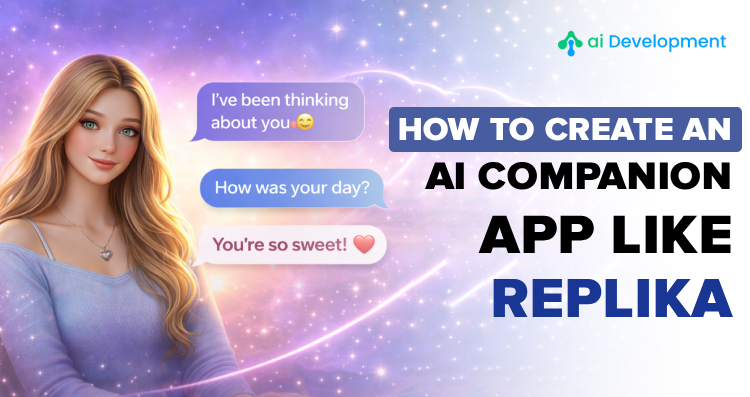
It means a new era in human-computer interaction has arrived, and artificial intelligence is not just a tool; it's becoming a companion. AI buddy apps like Replika have captured the imagination of millions worldwide by offering something quintessentially human in digital packaging: real conversation, emotional support, and understanding without judgment. Why did Replika become such a cultural phenomenon? Replika worked because it spoke to one of our most basic human needs: connection with others in a world of ever-widening solitude.
Everything you need to know, from understanding the technology to navigating the ethics that come with creating digital relationships, will be tackled in this comprehensive guide on how to build your own AI companion app.
AI Companion App Market: Key Statistics & Insights
Market Size & Growth Projections
- The Global AI companion market is valued at USD 28.19 billion in 2024, projected to reach USD 140.75 billion by 2030 at a CAGR of 30.8%. (Grand View Research)
- The AI companion app market is expected to grow from USD 10.8 billion in 2024 to USD 290.8 billion by 2034 with a 39% CAGR. (Market.us)
- Alternative projections show USD 366.7 billion in 2025, rising to USD 972.1 billion by 2035 with a 36.6% CAGR. (Business Research Insights)
Understanding AI Companion Apps
What Is an AI Companion App?
An AI companion is an example of an advanced software application that is driven by artificial intelligence, capable of mimicking human-like conversations and emotional bonding with humans. Unlike traditional AI chatbots, which are only capable of handling customer service or doing practical tasks, an AI companion is an example of an AI that is capable of being with an individual in an ongoing relationship. These AIs remember past interactions, are capable of adapting to an individual’s personality, developing preferences, and replying to statements with empathy, as if they were human friends.
Why AI Companions Are Gaining Popularity
The development and emergence of AI companions do not happen randomly; there are particular needs in society for which they fill a gap. The support for mental wellness could not have turned out to be more important, but therapy remains a costly affair for people. AI companions can be a starting point in a cost-effective manner for people to look towards for support for their emotional needs. The increase in loneliness in society has resulted in the declaration of loneliness as a public health crisis in several countries due to remote work, digital living, and a resultant reduction in physical interactions with people.
How Does the Replika App Work?
Key Features of Replika-Like AI Companion Apps
- Conversational AI with Memory: Recalls previous discussions, personal details, and relationship history to create meaningful continuity in interactions
- Emotional Intelligence & Mood Detection: Recognizes user emotions (happy, sad, anxious, excited) and adjusts responses with appropriate empathy and tone
- Custom Avatars and Personalities: Allows users to customize their companion's appearance and personality traits, creating personal ownership and connection
- Voice Call Capabilities: Enables natural spoken conversations for more intimate, human-like interaction beyond text-based chat
- AR Interactions: Brings AI companions into the physical world through smartphone cameras for immersive mixed-reality experiences
- 24/7 Availability with Personalized Engagement: Provides constant accessibility with responses tailored to individual user preferences, conversation styles, and needs
Business Model Behind Replika
Replika operates under a freemium business model. Additionally, the platform operates on a subscription basis. The free service offers users the ability to chat, while the paid service offers users the ability to have a conversation, interact via voice, have memory, role-play, and build personality. Replika offers additional revenue streams through in-app purchases. Some of the purchases include customizing the avatar and clothes. The free service model will ensure that the start-up continues to invest in the infrastructure of the application while the paid service will ensure the continuous development of the AI technology.
Essential Technologies Needed to Build an AI Companion App
Natural Language Processing (NLP)
Natural Language Processing forms the foundation of any AI companion app. NLP enables the system to understand user intent beyond literal words—recognizing questions, statements, emotions, and nuanced meanings. Context awareness allows the AI to track conversation threads and reference earlier topics naturally. Dialogue management ensures responses flow logically and maintains coherent long-term conversations that feel genuinely interactive rather than scripted.
Machine Learning & Deep Learning Models
It is machine learning that drives the personalization on which the uniqueness of an AI companion hinges. The approach learns continuously from conversations, discovering patterns in communication, topics of interest, and emotional triggers. These tools, using models of personality and behavior, develop uniqueness in companions while being consistent, hence making each digital relationship one-of-a-kind.
Generative AI & Large Language Models (LLMs)
Modern AI companions rely on generative AI and large language models such as GPT to create responses that are like those of humans and seem creative and spontaneous. These models are equipped with the ability to tell stories, and as such, they allow companions to share experiences and build shared stories with their users. Most importantly, they are equipped with the ability to create emotional engagement.
Voice Recognition & Speech Synthesis
Voice-based conversations add an intimate dimension to AI companionship. Speech-to-text (STT) technology converts spoken words into text the AI can process, while text-to-speech (TTS) systems generate natural-sounding voices that make companions feel more alive. Advanced implementations use emotional tone in voice synthesis to match the mood of conversations.
How to Build an AI Companion App Like Replika? Step-by-Step Guide
Step 1: Define Your App's Purpose and Target Audience
Before writing a single line of code, clarify your vision. Will your AI companion focus on mental health support, friendship and social interaction, productivity coaching, or entertainment? Each purpose requires different features and conversational approaches. Develop detailed user personas—understand who will use your app, what they need emotionally, and how they'll engage with it. Define clear engagement goals that balance user wellbeing with business objectives.
Step 2: Choose the Right AI Model & Architecture
Your AI architecture fundamentally shapes the user experience. Rule-based systems offer predictability but limited flexibility, while AI-driven systems provide natural conversations with less control. Most successful apps use large language models with fine-tuning—starting with powerful base models like GPT-4 and customizing them for companion-specific interactions. Critical to success is context retention and memory design that allows your AI to remember user details across sessions without overwhelming computational resources.
Step 3: Design Conversational UX & Personality
Your AI architecture is integral to the user experience. The predictability of rule-based systems comes with little flexibility, while AI-based systems enable natural conversations with limited control. The secret to the success of most successful apps is the use of large language models with fine-tuning, with starting points being very powerful models such as GPT-4, tailored to companion-specific interactions. A crucial element of success is context retention with memory design that enables your AI to retain user information without taxing computational resources.
Step 4: Develop the App (Frontend & Backend)
Technical development requires coordinating multiple systems. Build native mobile apps for iOS and Android that provide smooth, responsive interfaces. Your backend infrastructure must handle real-time processing at scale, with robust APIs connecting frontend experiences to AI processing. Implement real-time chat with minimal latency and voice processing pipelines that feel natural and immediate. Consider cloud infrastructure that scales with user growth while maintaining performance.
Step 5: Train, Test, and Improve the AI
Training your AI companion requires careful data curation and ethical considerations around privacy and bias. Implement robust feedback loops where user interactions inform ongoing improvements without compromising privacy. Establish continuous improvement processes with regular model updates, A/B testing of conversational approaches, and quality monitoring. Remember that AI companions improve over time—launch is just the beginning of development.
Data Privacy, Security & Ethical Considerations
User Data Protection & Compliance
AI companions handle deeply personal information, making security paramount. Implement end-to-end data encryption for all conversations and personal data. Ensure GDPR compliance and adherence to privacy regulations across all markets you serve. Design transparent consent management where users understand what data you collect and how it's used. Consider offering data deletion options and regular transparency reports.
Ethical AI & Mental Health Responsibility
Building AI companions carries significant ethical weight. Design systems that support wellbeing without creating emotional dependency or replacing necessary human connections. Maintain transparency that users understand they're interacting with AI, not humans. Implement human support escalation that recognizes crisis situations and connects users with professional help when needed. Never position your AI as a replacement for therapy or medical treatment.
Future Trends in AI Companion App Development
- Emotion-Aware AI: The ability to perform advanced sentiment analysis and affect computing would result in AI companions that could understand subtle emotional expressions and respond accordingly.
- AR/Virtual Reality Companions: The use of augmented reality/virtual reality technology (AR/VRealities) will create the opportunity for virtual assistants to be present either in the physical world or in virtual space.
- Multimodal AI Interactions: Future AI assistants and companions can combine text, speech, visual, gesture, and possibly even haptic interfaces.
- Healthcare Applications: The use of AI companions will continue to diversify, including their application for mental health, therapies, patient observation, and well-being assistance, thereby serving as digital therapeutic companions.
- Education and Learning Companions: Personalized companions will have tutoring and mentoring roles as they will customize the method and speed of learning.
Why Partner with AI Development Service?
Building a proficient AI companion app requires expertise in AI technologies, adaptive AI models, mobile development, cloud architecture, and intuitive UI/UX design. By partnering with AI Development Service, businesses can leverage the specialized knowledge and hands-on experience of professionals who build intelligent AI companions. This professional development support enables a faster go-to-market, helping you capture opportunities before competition becomes intense. Additionally, custom AI companion app development powered by AI ensures the product evolves with user interactions and is executed exactly as envisioned.
Conclusion
The development of such an AI companion app as Replika is one of the most thrilling challenges in the tech industry, where one can unite the most advanced AI technology with one of the most fundamental needs in mankind—understanding. The key to success in such a project would be to combine a robust approach to AI app development with a deep sense of empathy for the needs of your users, to create something that will complement mankind, not simply leverage its weaknesses. The story of what relationships in the digital age can look like is being written in the present, so in fact, it is your app that could be the next Replika, impacting millions of people’s lives.
Frequently Asked Questions (FAQs)
1. How does an AI companion app like Replika work?
An AI companion app uses natural language processing (NLP), machine learning, and generative AI models to understand user messages, maintain conversation context, and respond in a human-like, emotionally intelligent manner.
2. How much does it cost to develop an AI companion app like Replika?
The development cost typically ranges from $30,000 to $150,000+, depending on features, AI model complexity, voice support, personalization level, and platform (iOS, Android, or both).
3. What is the best AI companion app?
There is no single best AI companion app for everyone. Replika is the most popular for emotional support, while Nomi AI, Character.AI, and Anima are also top choices depending on whether users want realistic conversations, creative roleplay, or social interaction.
4. Is it safe to use AI companion apps for mental wellness?
Yes, when built responsibly. Ethical AI practices, data privacy compliance, transparent disclosures, and human support escalation are essential to ensure user safety and trust.
5. How can AI companion apps be monetized?
AI companion apps are commonly monetized through subscription plans, premium features, voice interactions, avatar customization, and in-app purchases, following a freemium business model.