The AI chatbot market is seeing explosive growth due to rapid development of NLP, ML, and generative models. According to various market research firms, the global chatbot market is expected to grow at a CAGR of more than 20–25% and reach tens of billions in value by the early 2030s. For instance, Knowledge Sourcing Intelligence envisions the size of the AI chatbot market growing from approximately US$19.5 billion in 2025 to US$60.3 billion by 2030. Other estimates put the market value at USD 20.8 billion by 2026, as part of the surging enterprise adoption. Global Growth Insights
It finds its momentum in organizations increasingly leveraging AI-powered conversational agents not only for customer support but also in internal operations such as HR, IT support, sales, and marketing, including transactional workflows. AI chatbots now power 24/7 engagement, smoothen workflows, and reduce costs, while becoming even smarter and contextually aware with the evolution of NLP and machine learning. However, a number of challenges, including data privacy, integration with legacy systems, and the ability to maintain conversational accuracy, continue to raise their heads and thus call for further innovation. It is in this backdrop of relentless evolution that choosing a reliable AI Chatbot Development Company becomes so important. The following are the top 10 companies offering state-of-the-art chatbot development services in 2026.
Start Your AI Chatbot Project Today
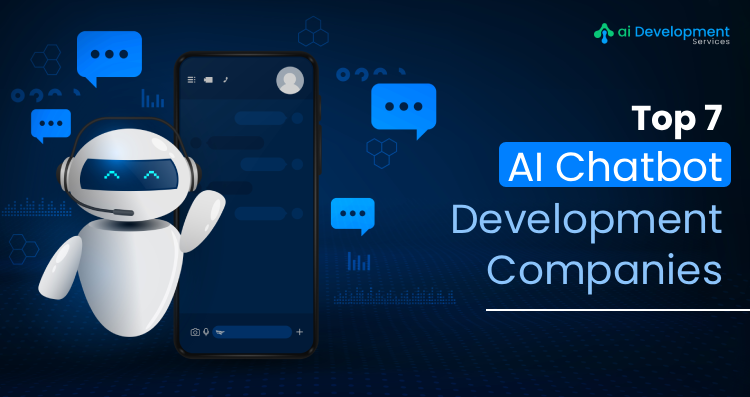
Top 7 AI Chatbot Development Companies for Modern Businesses
1. AI Development Services
Founded / Headquarters: Founded in 2020, AI Development Services has offices in the U.S.
Our Services: Aidevelopmentservices offers custom AI chatbot development, AI consulting, white-label chatbot platforms, and therapy-chatbot solutions.
Why Choose : They blend deep domain expertise (Web3, mobile, enterprise software) with strong data security protocols, building chatbots that integrate smoothly with CRMs, websites, and mobile apps.
Strengths: secure, scalable; experience in mental health
2. Suffescom Solutions
Founded / Headquarters: Founded in 2013, Suffescom Solutions has offices in the U.S.and many more.
Our Services: Suffescom offers custom AI chatbot development, AI consulting, white-label chatbot platforms, and therapy-chatbot solutions.
Why Choose : They blend deep domain expertise (Web3, mobile, enterprise software) with strong data security protocols, building chatbots that integrate smoothly with CRMs, websites, and mobile apps. Their recent launch of “Agentic Commerce” chatbots (2025) shows they’re at the forefront of autonomous conversational systems.
Strengths: Highly customizable, secure, scalable; experience in mental health (HIPAA compliant therapy chatbots)
3. RisingMax Inc.
Founded / Headquarters: Founded in 2015, Based in Delaware, USA.
Our Services: RisingMax offers full-scale AI chatbot development services, including multilingual bots, voice assistants, social media bots, and industry-specific conversation agents.
Why Choose : They follow a rigorous, client-centric development process (requirement gathering, prototyping, testing, deployment) to deliver enterprise-grade AI chatbots. Strengths: Strong in NLP, ML, deep data science (they also provide machine-learning software development). 3
4. Hyperlocal Cloud
Founded / Headquarters: Founded in 2015, headquartered in New York, USA.
Our Services: While known for app and marketplace development, Hyperlocal Cloud also provides AI-driven chatbot development services, particularly for startups that want smart automation embedded into their platforms.
Why Choose : Their youth gives them agility; they combine mobile/web expertise with AI, making them ideal for rapidly scaling businesses.
Strengths: Cost-effective, fast development cycles, strong client satisfaction (Clutch rating, project volume).
5. Web Panel Solutions
Founded / Headquarters: Founded in 2017, Web Panel Solutions operates globally with development teams in India and clients across the U.S. and other regions.
Our Services: Custom AI chatbot development, conversational AI solutions, NLP-based chatbots, and chatbot integration for websites, mobile apps, and CRM systems.
Why Choose Us: Web Panel Solutions builds scalable, secure, and business-focused chatbots that integrate smoothly with existing digital platforms and support automation-driven growth.
Strengths: Customizable solutions, scalable architecture, strong focus on performance and data security.
6. Haptik
Founded / Headquarters: Founded in 2013, headquartered in Mumbai, India.
Our Services: Enterprise-level conversational AI, customer support automation, voice and text bots across web, mobile, and messaging platforms.
Why Choose Them: As one of India’s most mature conversational AI platforms, Haptik brings strong enterprise credibility, especially for businesses in Asia.
Strengths: Highly scalable, deep NLP capabilities, cross-platform expertise, strong in conversational commerce.
7. ValueCoders
Founded / Headquarters: For instance, ValueCoders is in India (founded 2004) and provides wide-ranging software development.
Our Services: They build AI-powered chatbots using NLP and ML, along with mobile/web development.
Why Choose Them: Cost-effective, flexible, ideal for SMEs and startups looking for high-quality chatbot development services without breaking the bank.
Strengths: Custom solutions, good communication, access to top-tier AI talent at competitive rates.
Core Technologies Powering Today’s Conversational Systems
Modern AI chatbots rely on a rich stack of technologies:
- Natural Language Processing (NLP) – Enables understanding of user intent, sentiment, and context.
- Machine Learning (ML) – Used for training bots to improve responses over time, personalization, and prediction.
- Large Language Models (LLMs) – Generative systems (like GPT) help produce more natural, human-like conversational replies.
- APIs & Integrations – Bots connect to CRMs, databases, and third-party services to pull in context and act on data.
- Cloud & Edge Infrastructure – Scalable deployment on cloud platforms ensures bots can handle spikes and grow.
These combined technologies enable modern AI chatbot development companies to create intelligent, scalable systems.
Building Intelligent Chat Flows with NLP and ML
To deliver smart conversation, chatbot development services typically follow these steps:
- Intent Detection & Slot Filling – Design the chat flow around common user intents, and use NLP to extract variables (“slots”) from user input.
- Dialogue Management – Use state machines or more advanced dialogue policies to manage context and decide next actions.
- Machine Learning Optimization – Train models on historical conversation data so the chatbot can predict better responses, suggest prompts, or route to humans.
- Fallback & Escalation – Define fallback strategies when the bot doesn't understand — e.g., clarifying questions, handing over to a human agent.
With ML, chatbots can continuously learn from interactions, improving accuracy, reducing “unknown intent” responses, and increasing user satisfaction over time.
Customization Approaches for Industry-Specific Requirements
Different industries have unique chatbot needs — and top AI Chatbot Development Companies tailor solutions accordingly:
- Healthcare: Therapy chatbots (like Suffescom’s) with emotion detection, HIPAA compliance, and predictive analytics.
- E-commerce / Retail: Conversational commerce bots (e.g., Yalo) that handle orders, recommend products, and process payments.
- Enterprise Support: Bots for internal workflows (HR, IT) that integrate with enterprise systems using secure APIs.
- Finance / Banking: Multilingual chatbots that can handle sensitive user data, authenticate users, and process queries securely.
- Marketplace & Startups: Lightweight, mobile-first bots (Hyperlocal Cloud) that guide users, onboard them, and drive engagement.
Customization involves not just branding, but also conversational style, domain knowledge, integration, and compliance.
Optimizing Chatbot Performance Through Data-Driven Improvements
Once deployed, high-performing chatbots don’t remain static. AI Chatbot Development Companies use data-driven strategies to improve:
- Conversation Analytics: Track metrics like session length, dropout rates, fallback counts, and sentiment.
- A/B Testing: Experiment with different dialogue flows, prompts, or UI to find what works best.
- Retraining: Use recent conversation logs to retrain ML models, improving intent recognition, entity extraction, and response accuracy.
- User Feedback Loops: Gather user ratings, feedback, or optional surveys for continuous refinement.
This iterative, data-driven approach ensures chatbots stay relevant, accurate, and aligned with business goals.
Real-Time Learning and Adaptive Response Mechanisms
Advanced chatbots and AI voice bots leverage real-time learning: as users interact, the system adapts — updating its knowledge base, refining intents, or adjusting its tone. Key mechanisms include:
- On-the-fly Intent Incorporation: New intents or user behaviors can be detected and added without major redevelopment.
- Reinforcement Learning: Bots can be trained to pick better strategies (e.g., ask clarifying questions vs. direct answer) depending on user satisfaction.
- Contextual Memory: Maintaining long-term context (user profile, previous conversations) enables personalized and coherent follow-up.
- Feedback Signal Integration: If users correct or rephrase, the system learns immediate patterns, improving its response quality over time.
These adaptive mechanisms help deliver a more human-like, evolving conversational experience.
Future Innovations Shaping the Next Generation of AI Chatbots
Looking ahead, AI chatbots will continue to evolve along several cutting-edge themes:
- Emotionally Intelligent Bots: Research is increasingly focusing on emotion-sensitive LLM-based agents that adapt their tone and strategy based on user sentiment.
- Multimodal Chatbots: Combining text, voice, image, and even video to create richer conversational experiences.
- Retrieval-Augmented Generation (RAG): Using external knowledge bases so bots can answer domain-specific or regulatory queries in real-time with high accuracy.
- Edge Deployment: Running smaller chatbots on edge devices to reduce latency and maintain privacy.
- Agentic AI: Autonomous agents (like Suffescom’s “Agentic Commerce”) that don’t just respond, but take proactive actions (e.g., closing sales, executing tasks) on behalf of users.
These innovations will push AI chatbot development services into more strategic, autonomous, and deeply integrated roles within business.
Build Your Automation-Ready Chatbot Now
Conclusion
In 2026, one cannot underestimate the significance of selecting a trusted AI Chatbot Development Company. As the market scales, companies have to partner with providers that exhibit technical excellence, domain knowledge, and commitment to security. Thus, the 7 companies above, from Ai development services, Suffescom Solutions, RisingMax, and Hyperlocal Cloud to more niche players like BotsCrew, Haptik, stand for a diverse, reliable set of choices for businesses seeking to leverage chatbot development services.
Be it to develop a therapy bot, a sales assistant, or a virtual enterprise agent, these companies offer custom and future-ready solutions. And with the right partner, your chatbot can deliver more than just automated responses; it can provide meaningful, ever-improving conversational intelligence that drives real business value.
FAQs
Q1: What is an AI Chatbot Development Company?
An AI Chatbot Development Company specializes in designing, building, integrating, and maintaining intelligent conversational agents (chatbots) using technologies like NLP, machine learning, and large language models.
Q2: How much does it cost to build a chatbot in 2026?
Costs vary widely depending on complexity. A simple chatbot might cost a few thousands of dollars, while a generative, transactional, enterprise-grade chatbot could run into tens or hundreds of thousands.
Q3: How long does it take to develop a chatbot?
Typically, an MVP chatbot can be developed in 4–8 weeks, while fully customized, production-grade chatbots may take 3–6 months or more, depending on integrations and features.
Q4: Are AI chatbots secure?
Yes. Reputable chatbot development companies implement strong security protocols (end-to-end encryption, GDPR/HIPAA compliance, secure APIs) to protect user data.
Q5: Can chatbots learn over time?
Absolutely Through machine learning, retraining on conversation logs, and feedback loops, chatbots can improve intent detection, response quality, and personalization over time.