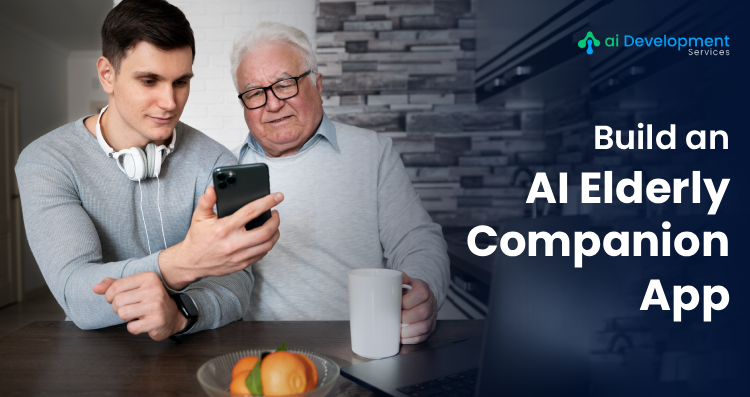
The world population of the elderly is increasing faster than ever before with the UN indicating that by 2050, the population of those aged 60 years and above will hit a total of 2.1 billion. Due to the growing needs in the healthcare systems, companies are devoting a lot of funds to the development of AI elderly companions apps to assist aging individuals with their daily activities, feelings, and protection.
Elderly care solutions based on AI are in the boom market with an estimated value of 5.3 billion in 2024 and expected to exceed 30 billion by 2030 because of the development of the conversational AI technology, predictive health data analytics, and sensor-based monitoring. As AI-based Elderly support companions start to develop, businesses are creating intelligent virtual assistants that are capable of companionship, medication or fall alerts and emergency response.
Current systems make use of generative AI development services, adaptive AI development and multimodal interaction to make sure that the seniors are provided with empathetic, personalized and highly responsive services. This transformation is a new dawn in assisted living- user centred innovation and intelligent automation.
Understanding the Role of AI in Modern Elderly Care
AI plays a transformative role across the assisted-living ecosystem. Beyond basic assistance, modern senior care AI chatbot development solutions offer emotional support, cognitive stimulation, and real-time communication with caregivers or medical providers. With the growing adoption of AI caregiving app development and Elderly care app development, these tools are becoming smarter, more personalized, and more essential for safe, independent senior living.
AI virtual companions for seniors today can:
- Conduct natural conversations and respond empathetically
- Provide medication adherence reminders
- Offer mental wellness coaching
- Assist in emergency alerts
- Suggest nutrition, hydration, and physical activity routines
- Reduce loneliness and enhance social engagement
For elderly individuals living independently, Virtual companion for seniors development ensures safety, comfort, and emotional well-being—all accessible through a friendly AI interface.
Build Your AI Elderly Companion App Today
Key Features Required in an AI Elderly Companion App
To build a competitive and trustworthy companion app, the following features are essential:
1. Conversational AI Support
Natural language processing enables smooth and human-like conversations.
2. Medication and Appointment Management
Timely reminders with voice alerts, notifications, and logs.
3. Emergency Detection & Response
Fall detection, vital-sign alerts, SOS triggers, and auto-notification to caregivers.
4. Emotional & Cognitive Engagement
Daily conversations, memory exercises, storytelling, and wellness check-ins.
5. Activity & Health Tracking
Integration with wearables for monitoring heart rate, steps, sleep, and movement.
6. Multimodal Interaction (Voice, Text, Expression)
Adapts to users who may have visual or mobility limitations.
7. Smart Home Integration
Control lights, locks, alarms, and home devices via voice.
8. Multi-Language Senior-Friendly UI
Simple layout, large buttons, high contrast, and voice navigation.
Core Technologies Powering AI Companion App Development
| Technology Category | Tools / Technologies Used |
| AI & NLP Engines | GPT-based models, BERT, LLaMA, RNN/Transformer models |
| Generative AI Models | Text-generation, voice clones, multimodal emotion AI |
| Speech Recognition & TTS | Google Speech-to-Text, Amazon Polly, Azure Cognitive Voice |
| Health Monitoring Sensors | Wearables, IoT sensors, BLE devices, smart medical kits |
| Real-Time Alert Systems | WebSockets, MQTT, Firebase Cloud Messaging |
| Backend Architecture | Microservices, Node.js, Python, Go |
| Database Systems | MongoDB, PostgreSQL, Redis |
| Security Frameworks | HIPAA/GDPR compliance, encryption, IAM |
| Mobile App Frameworks | Flutter, React Native, Kotlin, Swift |
| Integration APIs | Twilio, HomeKit, Alexa, Google Fit, HealthKit |
Personalization Frameworks for Senior Wellness & Emotional Support
To make elderly care meaningful and supportive, personalization engines are integrated into the app. These systems use AI-driven insights to adapt to the user’s habits, preferences, emotional patterns, and daily routine.
Personalization may include:
- Customized medication and nutrition plans
- Mood-based conversation style adjustments
- Adaptive reminders depending on user activity
- Suggested social activities or health check-ins
- Daily cognitive training programs
Through adaptive AI development, the application gets smarter with time—predicting user needs before they arise and providing proactive care.
Building Real-Time Monitoring and Safety Alert Systems
Safety is the core element of any elderly companion platform. With IoT sensors, wearable integrations, and predictive algorithms, the system ensures immediate detection of unusual patterns. As AI caregiving app development and Elderly monitoring app development advance, these platforms are becoming more proactive, reliable, and responsive to seniors’ real-time needs.
Key components include:
- Fall detection using motion sensors
- Sudden inactivity alerts
- Real-time GPS tracking for seniors with dementia
- Emergency auto-calling to caregivers or medical professionals
- Remote monitoring dashboards for family members
These features make assisted living safer and more reliable, especially for seniors who live alone.
Designing User-Friendly Interfaces for Aging Populations
Senior-focused UI/UX design is crucial. The interface must be simple, intuitive, and tailored to users with visual, cognitive, or mobility challenges.
Best Practices:
- High contrast color schemes
- Large icons and easy-to-read fonts
- Voice-first navigation
- Simplified menus with minimal steps
- Haptic feedback and auditory cues
- Accessibility compliance (ADA, WCAG)
When the design aligns with senior needs, engagement and app adoption improve significantly.
Data Privacy, Security, and Compliance in Senior Care Apps
Since elderly care apps process sensitive medical and personal data, strict security protocols are essential.
Compliance Requirements:
- HIPAA (for medical data handling)
- GDPR (for data privacy)
- CCPA (for U.S. residents)
- End-to-end encryption for all data transfers
- Biometric/2FA authentication
- Secure cloud architecture with role-based access
- Investing in strong cybersecurity ensures trust and long-term reliability.
Development Costs, Timeline, and Deployment Roadmap
The cost of AI elderly companion app development varies based on features, platform, and technical complexity.
Estimated Cost Breakdown:
- Basic companion app: $5,000–$10,000
- Advanced AI-based app: $10,000–$20,000
- Full-scale IoT-enabled solution: $20,000–$30,000+
Typical Development Timeline:
- Planning & Research: 2–3 weeks
- Design & Prototyping: 3–5 weeks
- Development & Integration: 10–14 weeks
- Testing & QA: 3–5 weeks
- Deployment & Optimization: 2–3 weeks
Post-launch, ongoing updates, monitoring, and support are crucial for user retention and system reliability.
Upgrade Senior Care with Smart Digital Assistance
Conclusion
AI-powered elderly care is revolutionizing the ecosystem of assisted living with companionship, safety, emotional well-being, and personalization round the clock. As seniors focus on independence and families seek smarter caregiving solutions, demand remains steadily on the rise for intelligent virtual support systems. Those businesses that invest in Virtual companion for seniors development now will have an early-mover advantage in exponential market growth.
By integrating conversational AI, wearable integrations, real-time monitoring, and empathetic interaction models, organizations can create truly meaningful experiences for aging individuals. Scalable, human-centric, and adaptive AI applications—powered by advances in AI caregiving app development, Elderly care app development, and Elderly monitoring app development—are driving the future of eldercare. Companies that innovate today will shape tomorrow's senior wellness landscape..
FAQs
1. What is an AI elderly companion app?
It is an AI-powered application that supports seniors with daily activities, emotional engagement, health monitoring, reminders, and safety alerts.
2. How much does it cost to build such an app?
Development costs range from $5,000 to $30,000+ depending on complexity, AI models, and IoT integrations.
3. Can the AI work without the internet?
Basic offline functions are possible, but full features like real-time alerts and conversational AI require connectivity.
4. Are these apps safe for seniors?
Yes, modern apps follow HIPAA/GDPR compliance, encryption standards, and secure authentication.
5. What technologies power senior AI companion apps?
NLP engines, generative AI, emotion detection models, wearable sensors, cloud architecture, and IoT systems.