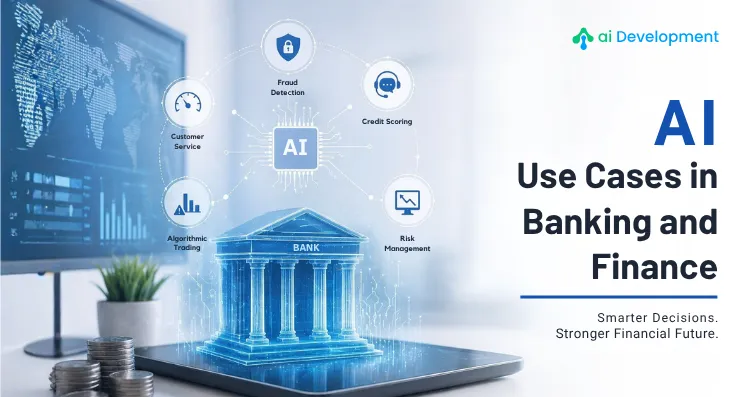
The financial services industry is undergoing its most significant transformation in decades. Banks and fintech companies that once relied on spreadsheets and rule-based systems are now deploying machine learning models that process millions of transactions per second, AI agents that resolve customer complaints autonomously, and predictive engines that assess creditworthiness without a single phone call.
At AI Development Service, we partner with financial institutions to design, build, and deploy intelligent systems that move beyond proof-of-concept into genuine production value. This guide breaks down exactly where AI creates the most impact, which technologies power those outcomes, and how a real implementation looks from discovery to go-live.
Why AI Is Indispensable in Modern Banking
Banking has always been a data-intensive business. Every loan application, every wire transfer, every customer support ticket generates structured and unstructured information that traditional systems struggle to use in real time. AI changes that equation entirely. Modern models can ingest transaction histories, behavioral signals, macroeconomic indicators, and regulatory filings simultaneously, then surface actionable intelligence in milliseconds.
The shift is also cultural. Customers who already interact with AI-driven recommendations on e-commerce and streaming platforms now expect the same intelligence from their bank. They want mortgage advice that accounts for their full financial picture, not a generic rate sheet. They want fraud alerts that are accurate, not ones that block legitimate purchases. Meeting that expectation requires infrastructure that learns and adapts continuously.
According to industry projections, AI is expected to drive cost savings of over $1 trillion for the banking and financial sector by 2030. That number reflects not just automation efficiency but the compounding value of better decisions, faster credit approvals, fewer fraud losses, tighter compliance, and more relevant customer experiences at scale.
One underappreciated dimension of this shift is what practitioners call adaptive AI development, systems designed so that the model deployed on day one is materially better by month six, without requiring a full redevelopment cycle. This is the foundation of every financial AI solution we architect at AI Development Service.
Transform Your Financial Services with AI Today
Core Use Cases: Where AI Creates Real Impact
There is no single "AI for banking" product. Different problems require different architectures, different data pipelines, and different success metrics. The following areas represent the highest-impact use cases where financial institutions are seeing measurable ROI today.
1. Fraud Detection and Prevention
Real-time fraud prevention is one of the earliest and most successful applications of AI in finance. Legacy systems rely on static rules, block transactions above a certain amount from a flagged country, for example. AI models instead build behavioral baselines for individual accounts and flag deviations the moment they occur. A card used in London three hours after a legitimate purchase in Singapore, or a series of micro-transactions matching known card-testing patterns, these anomalies surface instantly.
The models update continuously as new fraud vectors emerge. Financial institutions that have deployed AI-driven fraud engines consistently report significant reductions in false positives, meaning fewer legitimate transactions blocked and fewer frustrated customers calling support.
2. AI-Powered Credit Scoring
Traditional credit scoring ignores enormous amounts of relevant information. AI-based scoring models incorporate alternative data utility payment history, behavioral transaction patterns, employment tenure signals to deliver fairer and more accurate credit decisions, particularly for borrowers who are underserved by conventional scoring methodologies.
3. Anti-Money Laundering (AML) and Compliance
AML compliance is notoriously expensive in both human effort and false positive volume. Graph neural networks model the relationships between accounts, entities, and transactions in ways that surface suspicious networks invisible to traditional rule-based screening. NLP-driven compliance engines simultaneously scan regulatory documents and internal communications, flagging policy breaches in real time and auto-generating audit trails that reduce manual review workloads substantially.
4. Conversational AI and Virtual Assistants
AI chatbots and virtual assistants now handle the full resolution lifecycle for common banking inquiries, account balances, payment scheduling, dispute initiation, and product queries around the clock. The best implementations do not feel like a FAQ database. They understand intent, remember context within a session, and escalate seamlessly to human agents when the situation requires it. The result is measurably higher CSAT scores alongside lower support costs.
5. Algorithmic and Quantitative Trading
Reinforcement learning models execute trading strategies based on live market signals at speeds no human trader can match. These systems continuously optimize portfolios, respond to risk events within defined parameters, and adjust strategies based on real-time performance feedback. For wealth management firms and hedge funds, this represents a durable edge that compounds over time.
6. Document Intelligence and Back-Office Automation
Loan origination, KYC verification, and regulatory reporting all involve enormous volumes of documents, PDFs, scanned identity forms, emails, and data from legacy core banking systems. Generative AI development has unlocked a new class of document intelligence tools capable of extracting, classifying, and validating information from heterogeneous sources at scale. Implement these pipelines end-to-end: document ingestion, OCR, entity extraction, validation against source-of-truth databases, and structured output into the institution's core platform.
7. Hyper-Personalized Financial Advice
By analyzing spending patterns, life events, and financial goals, AI engines generate tailored product recommendations that move the needle on customer lifetime value. A customer who just received a large paycheck might be shown an appropriate savings product. A customer with a recurring monthly payment that resembles rent might be proactively offered a mortgage consultation. These interventions, delivered at the right moment, drive meaningful conversion.
AI Agents in Financial Services: Beyond Standard Automation
Standard automation executes a predefined workflow. An AI agent is fundamentally different, it perceives its environment, reasons for goals, takes actions, and updates its behavior based on outcomes. In financial services, this distinction matters enormously.
Consider a loan processing agent. A simple automation tool follows a checklist: collect documents, run credit checks, send approval emails. An AI agent goes further, identifies missing documents and proactively requests them, cross-references the applicant's transaction history to flag inconsistencies, consults current interest rate data to surface the most appropriate product, and escalates edge cases to a human underwriter with a pre-populated summary. The difference in outcome, both in speed and quality, is significant.
Customer Service Agents handle the full resolution lifecycle for common inquiries, escalate complex cases intelligently, and improve over time from resolution patterns.
- Compliance Monitoring Agents continuously scan transaction streams and internal communications for regulatory violations, generating evidence packages automatically.
- Trading and Investment Agents execute and monitor strategies, manage portfolio exposure, and respond to market risk events within pre-defined guardrails.
- Operational Agents manage reconciliation, exception handling, and reporting workflows across core banking, payments, and accounting systems.
Multi-agent architectures where specialized agents collaborate and hand off tasks to one another are increasingly common in enterprise financial deployments. They mirror how high-performing teams actually work: with clear roles, shared context, and defined escalation paths.
Portfolio Management and Wealth Technology
AI is reshaping how wealth managers serve clients. Predictive analytics identify portfolio drift before it becomes a compliance issue. Automated rebalancing engines respond to market events in real time. Personalization layers surface relevant opportunities based on each client's risk profile, investment horizon, and life stage. The result is scalable, consistent advisory delivery at a fraction of the cost of purely human models and with documentation and audit trails that satisfy regulatory expectations.
Implementation: How We Build AI Solutions for Financial Institutions
Moving from an AI use case to a production system involves considerably more than selecting a model. Regulatory requirements, data governance, model interpretability, and change management each shape what a truly complete solution looks like. Here is how we approaches financial AI implementation:
Step 1 - Discovery and Use Case Prioritization
We begin with a structured assessment of the institution's data maturity, existing technology stack, and strategic objectives. Not every use case is worth pursuing simultaneously. We help clients identify the two or three initiatives where AI will generate the clearest, most measurable value in the shortest timeframe, typically fraud detection, document automation, or customer service AI, depending on the organization's starting point.
Step 2 - Data Audit and Pipeline Architecture
AI systems are only as good as the data that feeds them. We audit available data sources, assess quality and coverage, identify gaps, and design pipelines that aggregate, clean, and transform data into formats the models can learn from. For financial clients, this includes establishing strict access controls and lineage tracking from day one.
Step 3 - Model Development and Validation
Our ML engineers develop, train, and validate models against held-out test sets and, where available, historical ground-truth labels. For high-stakes decisions, credit, fraud, compliance, we also build explainability layers so that the model's reasoning can be interrogated by both internal teams and regulators.
Step 4 - Integration and Deployment
Models are containerized and deployed via APIs that connect to the institution's core systems, whether that is a legacy core banking platform, a modern cloud-native stack, or a hybrid of both. We build monitoring dashboards that track model performance, data drift, and prediction distributions in real time.
Step 5 - Monitoring, Retraining, and Continuous Improvement
A deployed model is not a finished product. Financial data distributions shift, new fraud patterns emerge, economic conditions change, and customer behavior evolves. We establish automated retraining pipelines and human-in-the-loop review processes that keep models accurate and aligned with current conditions over time.
Key Considerations for Financial AI Projects
Before committing to an AI initiative, financial institutions should address a few critical questions:
- Regulatory alignment: Does the model's decision logic meet explainability requirements under applicable regulations? GDPR, fair lending laws, and Basel frameworks all have implications for AI systems that affect customer decisions.
- Data ownership and privacy: Are training datasets properly licensed, consented to, and governed? This is foundational, not optional.
- Change management: Technology is rarely the hardest part. Teams need training, workflows need redesigning, and governance structures need updating to get genuine value from AI deployment.
- Vendor vs. build decision: Generic AI products can solve generic problems. Institutions with proprietary data and differentiated processes typically benefit from custom-built solutions, which is where a specialist partner like AI Development Service adds the most value.
Let's Build Your AI-Powered Banking Solution
FAQ
Q1: What is the most common first AI use case for banks and financial institutions?
Fraud detection is the most common starting point. The data is usually available, the ROI is measurable, and the risk of model error can be managed through human-in-the-loop review. Credit scoring automation and chatbot deployment are close seconds.
Q2: How long does it take to implement an AI solution in banking?
A focused, well-scoped AI project, such as a fraud detection model or a document extraction pipeline, typically takes between eight and sixteen weeks from discovery to production deployment, assuming data is accessible. More complex multi-agent systems or enterprise-wide deployments naturally take longer.
Q3: Can AI in banking comply with financial regulations?
Yes, but it requires intentional design. Explainable AI methods, audit logging, model documentation, and bias testing are all standard components of a compliant financial AI system. Regulatory alignment should be built in from architecture design, not bolted on after deployment.
Q4: How does AI Development Service approach AI development for regulated industries like banking?
AI Development Service treats compliance as a first-class requirement, not an afterthought. Every engagement includes a regulatory review phase, explainability layers for decision-making models, full data lineage documentation, and post-deployment monitoring designed to catch model drift before it becomes a compliance issue.
Q5: What makes AI Development Service different from other AI development partners?
We specialize in production-grade AI systems, not demos, not prototypes that sit in a sandbox. Our teams have delivered end-to-end AI solutions across fraud, compliance, document automation, and customer intelligence for financial clients. If you're ready to move from evaluation to deployment, AI Development Service is the right partner to get there.