The global artificial intelligence market is projected to reach USD 827 billion by 2030, growing at a CAGR of 27.67% from 2025. That is not just growth, it is a transformation. From hospital corridors to factory floors, from courtrooms to classrooms, AI is no longer a futuristic concept reserved for tech giants. It is here, it is operational, and it is reshaping how every industry creates value. In fact, recent studies show that 89% of workers already use AI in their roles.
This blog offers a comprehensive, industry-by-industry breakdown of how AI is being applied today. Whether you are a business leader exploring where to start, a developer building the next intelligent product, or simply someone curious about the future, this guide covers the most impactful AI use cases across major sectors. One thing is clear: AI is no longer a luxury. It is a competitive necessity.
AI Use Cases in Major Industries
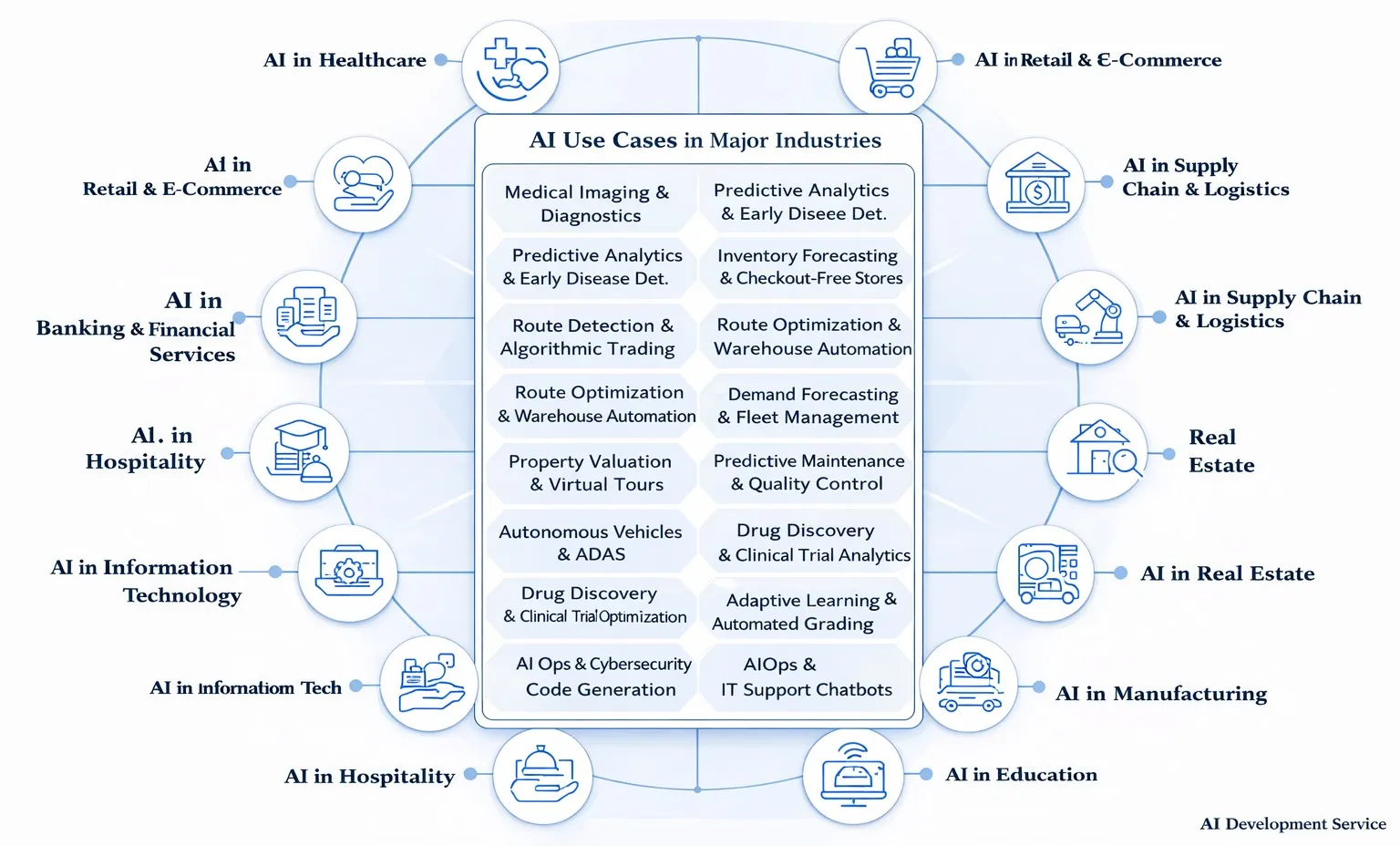
1. AI in Healthcare
Healthcare is one of the most high-stakes environments on the planet, and AI is rising to meet that challenge with remarkable precision.
Medical Imaging and Diagnostics: AI models trained on millions of X-rays, CT scans, and MRI images can now detect abnormalities with accuracy that rivals experienced radiologists. Systems deployed in clinical settings are already catching early-stage lung cancer, diabetic retinopathy, and cardiovascular anomalies that might otherwise go undetected until it is too late.
Predictive Analytics and Early Disease Detection: By analyzing patient data including vitals, lab results, and medical history, AI can flag patients at high risk of conditions like sepsis, heart failure, or hospital readmission before symptoms escalate. This enables proactive intervention rather than reactive treatment.
Personalized Treatment Plans and Drug Discovery: AI accelerates drug discovery by simulating how molecules interact with biological targets, cutting years off the traditional R&D timeline. On the clinical side, it tailors treatment regimens based on a patient's genetic profile, lifestyle, and medical history, making medicine more precise and effective.
Administrative Automation: Billing, appointment scheduling, prior authorizations, and claims processing are time-consuming and error-prone. AI-powered automation is dramatically reducing the paperwork burden, freeing clinical staff to focus on what matters most: patient care.
2. AI in Retail and E-Commerce
Retail is a fiercely competitive space where understanding the customer is everything. AI has become the backbone of modern retail strategy.
Personalized Product Recommendations: Every time a customer sees "You may also like" or "Frequently bought together," that is AI at work. Recommendation engines analyze browsing history, purchase patterns, and demographic data to surface products most likely to convert, increasing average order values significantly.
Inventory and Demand Forecasting: AI models predict future demand by analyzing sales trends, seasonality, local events, and even weather data. This allows retailers to stock the right products in the right quantities, reducing both stockouts and costly overstock situations.
Visual Search and AR-Powered Shopping: Shoppers can now upload a photo of a product they like and find similar items instantly using visual search. Augmented reality tools let customers virtually try on clothing, glasses, or furniture before purchasing, reducing return rates and boosting confidence at checkout.
Checkout-Free Stores: Computer vision technology powers fully automated stores where cameras and sensors track what customers pick up and charge them automatically as they walk out. This frictionless experience is no longer experimental. It is being rolled out at scale.
3. AI in Banking and Financial Services
The financial sector handles enormous volumes of sensitive transactions daily, making it one of the most fertile grounds for AI adoption.
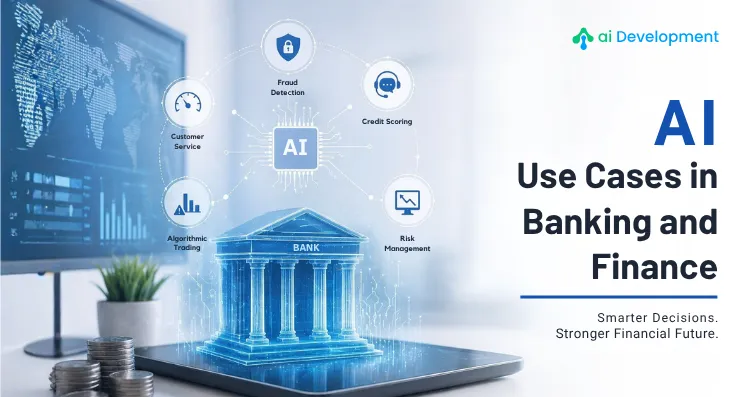
Fraud Detection and Real-Time Transaction Monitoring: AI systems analyze thousands of data points per transaction in milliseconds to identify suspicious patterns. Unlike rule-based systems, machine learning models adapt continuously, catching new fraud tactics as they emerge while minimizing false positives that frustrate legitimate customers.
Algorithmic Trading and Market Forecasting: Hedge funds and investment banks use AI to execute trades at speeds and scales no human trader can match. Predictive models analyze news sentiment, macroeconomic indicators, and historical price data to identify profitable opportunities across global markets.
Credit Risk Assessment and Loan Processing: Traditional credit scoring relies on a narrow set of variables. AI expands this to hundreds of data points, enabling more accurate risk profiling and faster loan approvals, including for individuals with thin credit histories who might otherwise be excluded from financial services.
AI Chatbots for Customer Support: Banks and fintech companies are deploying intelligent virtual assistants to handle everything from balance inquiries and transaction disputes to financial planning advice. These tools reduce call center load while delivering 24/7 support. For businesses looking to build such systems, partnering with experienced AI chatbot development companies can accelerate time to deployment significantly.
4. AI in Supply Chain and Logistics
Supply chains are complex, global, and vulnerable to disruption. AI is bringing much-needed intelligence and resilience to this critical sector.
Route Optimization and Delivery Efficiency: AI calculates optimal delivery routes in real time by factoring in traffic, weather, vehicle capacity, and delivery windows. This reduces fuel consumption, shortens delivery times, and improves customer satisfaction simultaneously.
Warehouse Automation and Robotics: AI-powered robots pick, sort, and pack goods with speed and accuracy that humans cannot match consistently. Combined with computer vision systems that verify product quality and placement, warehouses are becoming increasingly autonomous operations.
Demand Forecasting and Inventory Management: By integrating data from sales channels, supplier lead times, and market signals, AI helps businesses maintain leaner, more responsive inventory. This reduces carrying costs while ensuring availability when demand spikes.
Fleet Management and Predictive Maintenance: Sensors embedded in vehicles feed data to AI systems that predict when components are likely to fail. Maintenance can then be scheduled proactively, reducing unexpected breakdowns and costly roadside emergencies.
Build Custom AI Solutions for Your Business
5. AI in Real Estate
Real estate transactions involve enormous financial stakes and complex decision-making. AI is making the process smarter for buyers, sellers, and investors alike.
Property Valuation and Price Prediction: Machine-learning models analyze comparable sales, neighborhood trends, school ratings, crime statistics, and economic indicators to generate accurate property valuations. These models can also forecast how prices are likely to move in a given area over the coming months.
AI-Powered Property Search and Recommendations: Rather than manually scrolling through listings, buyers can describe what they want in natural language and receive curated recommendations that match their preferences, budget, and lifestyle needs with high precision.
Virtual Tours and Smart Contracts: AI-enhanced virtual tours allow buyers to explore properties from anywhere in the world. On the transactional side, blockchain-backed smart contracts automate the execution of purchase agreements when predefined conditions are met, reducing closing times and legal overhead.
Market Trend Analysis: Investors and developers use AI to analyze zoning changes, infrastructure plans, demographic shifts, and economic data to identify emerging markets before the broader industry catches on.
6. AI in Manufacturing
Manufacturing has always been driven by efficiency, and AI is taking operational performance to an entirely new level.
Predictive Maintenance with IoT and AI: Sensors on machines continuously stream data to AI systems that monitor for anomalies indicating wear or impending failure. Maintenance teams receive alerts before breakdowns occur, reducing unplanned downtime and extending equipment lifespan.
Quality Control via Computer Vision: AI-powered cameras inspect products on the production line at speeds and resolutions that far exceed human capability. Defects that would have slipped through traditional quality checks are caught automatically, reducing waste and warranty claims.
Generative AI in Product Design and Simulation: Generative AI enables engineers to input design constraints and receive hundreds of optimized design options in return. Simulations can then test these designs under various conditions without building a single physical prototype, compressing development cycles dramatically.
Energy Optimization: AI systems monitor energy consumption across production lines and automatically adjust equipment operations to minimize waste, a capability that is increasingly important as manufacturers face both rising energy costs and sustainability mandates.
7. AI in Automotive
The automotive industry is undergoing its most significant transformation since the invention of the internal combustion engine.
Autonomous Vehicles and ADAS: Self-driving technology relies on a combination of computer vision, LiDAR, sensor fusion, and deep learning models that make real-time decisions about navigation, obstacle avoidance, and traffic interaction. Advanced Driver Assistance Systems (ADAS) bring many of these capabilities to consumer vehicles available today.
Predictive Maintenance for Fleets: Fleet operators use AI to monitor the health of thousands of vehicles simultaneously, predicting mechanical issues before they cause failures, reducing maintenance costs and keeping vehicles on the road longer.
AI-Powered Design and Crash Simulation: Automakers use generative AI to explore design variations and run virtual crash simulations, accelerating the path from concept to road-ready vehicle while improving safety outcomes.
Connected Car Data Analytics: Modern vehicles generate vast amounts of data about driver behavior, route patterns, and vehicle performance. AI analyzes this data to improve navigation systems, personalize the in-car experience, and feed insights back into future vehicle design.
8. AI in Pharmaceuticals
The pharmaceutical industry faces a brutal reality: developing a new drug takes over a decade and costs billions of dollars. AI is changing that math.
AI-Accelerated Drug Discovery: Machine learning models analyze vast biological databases to identify promising drug candidates in a fraction of the time traditional methods require. What once took years of laboratory screening can now be narrowed down computationally in weeks.
Clinical Trial Optimization: AI helps pharmaceutical companies identify the right patient populations for clinical trials, predict dropout rates, and monitor trial data in real time for safety signals. This reduces costs and increases the probability of successful outcomes.
Molecule Simulation and Compound Analysis: Deep-learning models can simulate how a drug molecule will fold, bind to its target, and interact with the body at a molecular level, providing researchers with critical insights before expensive wet-lab experiments begin.
Regulatory Compliance Automation: Preparing regulatory submissions is an enormously document-intensive process. AI tools extract, organize, and validate data from clinical records and research reports, accelerating the path to regulatory approval.
9. AI in Education
Education is fundamentally about meeting learners where they are. AI is making truly personalized learning a practical reality at scale.
Personalized and Adaptive Learning Paths: Adaptive AI in education means that learning platforms can continuously assess a student's strengths, weaknesses, and learning pace, then dynamically adjust the content and difficulty of lessons to maximize progress for each individual learner.
AI Tutoring Systems and Real-Time Feedback: Intelligent tutoring systems can engage students in dialogue, answer questions, explain concepts from multiple angles, and provide instant feedback on assignments, filling the gap that exists between teacher availability and student need.
Automated Grading and Content Creation: AI handles routine grading tasks, freeing educators to focus on mentorship and deeper instruction. It also assists in generating practice questions, study materials, and lesson plans. If you are building educational technology, exploring AI-powered study tools can provide valuable inspiration for product development.
Campus and Administration Management: Beyond the classroom, AI optimizes class scheduling, predicts enrollment trends, identifies students at risk of dropping out, and streamlines administrative workflows across entire institutions.
10. AI in Fashion
Fashion moves fast, and getting the product mix right means the difference between a hit season and a warehouse full of unsold inventory.
Trend Forecasting Using Social and Sales Data: AI analyzes social media posts, runway coverage, search trends, and point-of-sale data to identify emerging trends weeks or months before they peak. Brands can respond faster to what consumers actually want.
AI-Assisted Design and Pattern Optimization: Designers use AI tools to generate and iterate on design concepts, explore colorway combinations, and optimize cut patterns to minimize fabric waste, all while staying within production cost targets.
Personalized Styling Recommendations: Online fashion platforms use AI to build detailed style profiles for each customer, delivering recommendations that feel curated and personal. This deepens engagement and drives repeat purchases.
Sustainable Supply Chain Management: AI helps fashion brands trace materials through complex global supply chains, identify sustainability risks, and optimize production and shipping to reduce the environmental footprint of each garment.
11. AI in Legal Businesses
Legal work is document-intensive, research-heavy, and demands extreme precision. AI is becoming an indispensable tool for law firms and legal departments.
Contract Review and Due Diligence Automation: AI can review thousands of pages of contracts in minutes, flagging unusual clauses, missing provisions, and potential risks that human reviewers might miss when working under time pressure. This is especially valuable in M&A transactions and large commercial deals.
Legal Research and Case Outcome Prediction: Rather than manually searching through case law databases, lawyers can describe a legal question in natural language and receive highly relevant precedents, statutes, and analysis. Predictive models can also estimate the likely outcome of cases based on historical judicial decisions.
Document Drafting and Compliance Monitoring: AI assists in generating the first drafts of standard legal documents and continuously monitors regulatory changes to flag compliance risks before they become legal liabilities.
E-Discovery and Evidence Analysis: In litigation, AI dramatically accelerates the review of electronic communications, financial records, and other documents relevant to a case, reducing the time and cost of discovery by orders of magnitude.
12. AI in Information Technology
Ironically, the industry that builds AI is also one of its most enthusiastic adopters.
Automated Incident Detection and Resolution: IT operations teams use AI to monitor complex infrastructure, automatically detect anomalies, correlate alerts across systems, and in many cases resolve issues before end users are even affected.
Code Generation and Software Testing: AI coding assistants help developers write, review, and debug code faster than ever. Automated testing tools use AI to generate test cases, identify edge cases, and detect security vulnerabilities that manual testing might overlook.
Cybersecurity Threat Detection: AI models analyze network traffic, user behavior, and system logs to detect threats in real time. Unlike signature-based antivirus tools, AI can identify previously unknown attack patterns and respond dynamically.
Intelligent IT Support Chatbots: First-level IT support, password resets, software provisioning, and troubleshooting are increasingly handled by AI-powered virtual assistants, freeing IT staff to focus on higher-complexity infrastructure and security work.
13. AI in Hospitality
Hospitality is a people's business, and AI is helping hotels, airlines, and travel companies deliver more personalized experiences at scale.
AI-Powered Booking and Dynamic Pricing: Revenue management systems use AI to adjust room rates, seat prices, and package offerings in real time based on demand signals, competitor pricing, local events, and historical booking patterns, maximizing revenue per available unit.
Personalized Guest Experience: AI analyzes guest preferences from past stays, loyalty program data, and real-time feedback to personalize everything from room temperature settings and pillow preferences to dining recommendations and local activity suggestions.
Chatbot Concierge and Virtual Assistants: Hotels are deploying AI concierge systems that handle reservation inquiries, room service orders, local recommendations, and checkout processes via messaging apps or in-room devices, raising service levels without proportional increases in staffing costs.
Revenue Management and Occupancy Forecasting: AI models integrate dozens of variables to predict occupancy weeks in advance, allowing hospitality operators to optimize staffing, procurement, and marketing spend accordingly.
Why Are Businesses Partnering With AI Experts ?
Understanding where AI can add value is one thing. Building reliable, production-grade AI systems is another challenge entirely. Many organizations find that the gap between proof-of-concept and deployed solutions is where most AI initiatives stall.
That is why businesses across all these sectors are turning to specialized AI development partners. AI Development Service works with companies to bridge exactly that gap. Their capabilities span machine learning model development, natural language processing, computer vision, predictive analytics, and end-to-end AI product delivery. Rather than building fragile, one-off experiments, they focus on scalable solutions that integrate cleanly with existing business systems and deliver measurable ROI.
Whether you are a startup building your first AI-powered product or an enterprise looking to modernize critical workflows, working with the top AI development companies can significantly accelerate your time to value while reducing technical risk.
Ready to Implement AI in Your Industry?
The Future of AI Across Industries
We are still in the early chapters of the AI story. The next wave will be defined by agentic AI systems that do not just answer questions but take autonomous actions across complex, multi-step workflows. Multimodal AI that simultaneously understands text, images, audio, and video will unlock capabilities that current narrow models cannot touch.
At the same time, the conversation around AI governance, ethics, and transparency is maturing. Businesses that build responsible AI practices now will be better positioned as regulatory frameworks tighten globally.
Across every industry covered in this blog, one pattern is consistent: AI is not replacing human judgment. It is amplifying it. The Organizations that treat AI as a core business strategy, rather than a side initiative, will set the pace for everyone else.
Frequently Asked Questions
1. What are the most impactful AI use cases across industries?
The most impactful applications include medical imaging in healthcare, fraud detection in financial services, predictive maintenance in manufacturing, personalized recommendations in retail and e-commerce, and adaptive learning in education. Each of these delivers measurable, high-value outcomes that directly affect revenue, safety, or efficiency.
2. How is AI transforming healthcare and pharmaceuticals?
In healthcare, AI is improving diagnostic accuracy, enabling earlier disease detection, and reducing administrative overhead. In pharmaceuticals, it is dramatically shortening drug discovery timelines by identifying viable molecular candidates computationally, optimizing clinical trial design, and automating regulatory documentation.
3. Can small and mid-sized businesses implement AI solutions?
Absolutely. Many AI tools are now available as cloud-based services with accessible pricing models. Small businesses can start with pre-built AI capabilities, such as chatbots, demand forecasting tools, or recommendation engines, before investing in custom model development as their needs and budgets grow.
4. What is the role of generative AI in industries like manufacturing and fashion?
In manufacturing, generative AI accelerates product design by producing and evaluating thousands of design variations against engineering constraints. In fashion, it supports trend forecasting, personalized styling, and pattern optimization. Across both sectors, it is compressing creative and development cycles significantly.
5. How does AI improve customer experience in hospitality and retail?
In hospitality, AI delivers hyper-personalized experiences based on guest history and preferences, while dynamic pricing ensures competitive rates. In retail, personalized recommendations, visual search, and AR-powered try-on tools make shopping more intuitive and satisfying, driving both conversion and loyalty.
6. How can AI Development Service help build industry-specific AI solutions?
AI Development Service specializes in translating industry-specific challenges into production-ready AI solutions. Their team works across the full development lifecycle, from problem definition and data strategy through model development, integration, and ongoing optimization. They have experience delivering solutions across healthcare, fintech, logistics, retail, and more.
7. Why choose AI Development Service for your AI project?
AI Development Service combines deep technical expertise with a strong focus on business outcomes. They prioritize solutions that are scalable, explainable, and aligned with your specific operational context. Their track record across multiple industries means they bring pattern recognition from real-world deployments, not just theoretical frameworks, to every engagement.