Key Takeaways:
- AI Outperforms Traditional Methods Machine learning models detect 95%+ of phishing attempts compared to 80-85% for rule-based systems by identifying subtle patterns and zero-day threats.
- Multiple AI Techniques Required Effective phishing detection combines natural language processing for content analysis, computer vision for visual similarity, and anomaly detection for behavioral patterns.
- Training Data Quality is Critical Models require diverse, labeled datasets of 100K+ examples including legitimate emails, known phishing samples, and edge cases to achieve production-ready accuracy.
- Real-Time Processing is Essential Detection must happen in milliseconds as emails arrive—batch processing creates dangerous windows where phishing emails reach inboxes before analysis completes.
- Cost Ranges from $50K to $500K+ Simple implementations start around $50K-$100K while enterprise-grade systems with custom models, integrations, and ongoing training exceed $500K for comprehensive deployment.
- Continuous Learning Prevents Obsolescence Static models become ineffective within months as phishing techniques evolve—successful systems implement adaptive AI with continuous retraining pipelines fed by new threat intelligence.
But the statistics paint a grim picture: 3.4 billion phishing messages per day, 36 percent of data breaches are phishing-related, with the average data breach costing $4.91 million, according to the most recent IBM data available. But these are only numbers, and the actual toll is much higher: the finance staffer who sends half a million dollars in funds to scammers masquerading as the CEO, the healthcare professional who exposes tens of thousands of records for compromised PHI due to a single phishing event, or the startup that gives away its edge due to IP theft via a spear-phishing attack.
Artificial Intelligence upsets this balance. Rather than comparing attacker activity to detected threats, AI models learn what phishing is—language patterns, image similarity, angelfire URLs, strange behavior by senders, and other anomalies that indicate nefarious activity. It is necessary to understand both the risk and the technology that mitigates this risk to successfully design an artificial intelligence-based phishing solution. This paper outlines this roadmap in order to safeguard ourselves in this hazardous digital world.
What is an AI Phishing Detection Tool?
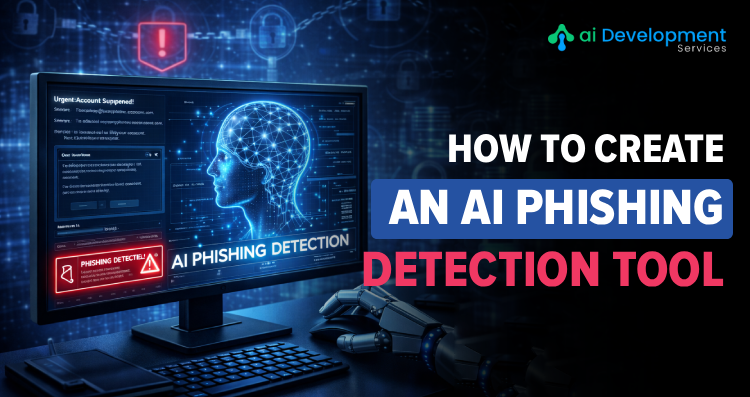
An AI phishing detection tool is a sophisticated security system that uses machine learning algorithms, natural language processing, and behavioral analysis to identify and block phishing attempts in real-time. Unlike traditional rule-based filters that match against predefined patterns or blacklists, AI systems learn from examples to recognize the characteristics of phishing across multiple dimensions—content, structure, sender behavior, and contextual anomalies.
Core Capabilities:
- Content Analysis: Advanced NLP development techniques enable the system to examine email text, subject lines, and attachments for linguistic patterns associated with phishing—urgency language, requests for credentials, impersonation attempts, and social engineering tactics.
- Visual Similarity Detection: Computer vision compares email layouts, logos, and branding against legitimate sources to identify spoofing attempts that look nearly identical to real communications.
- URL Analysis: Machine learning evaluates links for suspicious characteristics—newly registered domains, typosquatting, redirects, and URL shorteners commonly used in attacks.
- Sender Reputation: Behavioral models assess sender authenticity through historical patterns, authentication protocols (SPF, DKIM, DMARC), and anomaly detection.
- Contextual Awareness: AI considers recipient-specific context—is this sender expected, does the request align with normal business processes
Key Differentiators from Traditional Systems
Traditional phishing filters rely on static rules-if an email contains specific keywords, if it was sent from a rejected domain, or if it failed authentication checks, block them. This is a reactive approach, meaning threats must be seen before defenses activate. An AI system is more proactive, identifying threats through learned patterns rather than explicit rules. It detects zero-day phishing campaigns and adapts with attacker evolution to reduce false positives.
Deployment Models
AI phishing detection can operate as email gateway filters scanning all inbound messages, browser extensions warning users about suspicious websites, endpoint agents analyzing downloaded files, or integrated modules within existing security platforms. The most effective implementations combine multiple detection points, creating defense-in-depth where threats blocked at one layer inform protection in others.
How an AI Phishing Detection Tool Works
Understanding the workflow helps demystify the technology and inform design decisions when building your own system.
Step 1: Data Ingestion and Preprocessing: As emails arrive, the system extracts multiple data streams: raw text content, HTML structure, embedded images, URLs, attachment metadata, sender information, and email headers. Preprocessing normalizes this data—converting HTML to text, extracting features from images, parsing URLs into components, and standardizing formats for analysis. This stage also handles internationalization, character encoding issues, and obfuscation techniques attackers use to hide malicious content.
Step 2: Feature Extraction: Machine learning models don't understand emails directly—they need numerical features representing email characteristics. Feature extraction transforms raw email data into vectors the model can process:
- Linguistic Features: Word frequencies, sentence structure complexity, sentiment scores, urgency indicators, grammar patterns
- Structural Features: HTML complexity, image-to-text ratios, presence of forms, embedded scripts, attachment types
- URL Features: Domain age, SSL certificate status, URL length, presence of IP addresses, redirect chains, typosquatting distance from legitimate domains
- Sender Features: Authentication results, historical sending patterns, domain reputation, geographic origin anomalies
- Contextual Features: Time of day, recipient role, business relationship indicators, deviation from normal communication patterns
Step 3: Multi-Model Analysis: Rather than relying on a single algorithm, effective systems employ ensemble approaches combining multiple specialized models:
- NLP Models: Transformer-based models (BERT, GPT variants) analyze text for semantic meaning, detecting social engineering language and impersonation attempts.
- Computer Vision: Convolutional neural networks compare email visuals against legitimate brand templates, identifying pixel-level differences in logos and layouts.
- URL Classifiers: Gradient-boosting machines or random forests evaluate URLs based on domain characteristics, lexical features, and network properties.
- Anomaly Detection: Isolation forests or autoencoders identify sender behavior deviations from established baselines.
- Meta-Learners: Final ensemble models combine predictions from specialized models, weighing their confidence and optimizing overall accuracy.
Step 4: Risk Scoring and Decision: Each model provides probability scores for multiple threat indicators. These are combined into a single composite risk score that represents the overall likelihood of phishing. Thresholds on this score drive decisions: high-confidence threats are quarantined, medium-risk emails are flagged with warnings, and low-risk messages pass through normally. Advanced systems provide explainability-showing users which feature triggered alerts-so users make more informed decisions.
Step 5: Continuous Learning: User feedback-either confirming or disputing the classifications-and security team input feeds back into training pipelines. The system uses adaptive AI development techniques to periodically retrain models with new data, automatically adjusting to evolving phishing techniques. Trained from new data at periodic intervals, the system adapts to evolving phishing techniques. Labeled examples of emerging attacks are fed into the system via threat intelligence feeds. Model improvements are tested with A/B testing before deployment into production. This continuous learning loop ensures the system remains effective as threats change and evolve over time.
Phishing Detection: Key Statistics & Insights
Threat Landscape Scale
- Phishing jumped to the number one attack vector in 2025, accounting for 16% of breaches (IBM Cost of a Data Breach Report)
- 3.4 billion phishing emails are sent globally every day
- 94% of malware is delivered via email, with phishing as the primary vector
- Phishing attacks increased 61% year-over-year in 2024
- Average user receives 14 phishing emails monthly
- 36% of all data breaches involve phishing or social engineering
Attack Sophistication
- 65% of phishing campaigns now use HTTPS (secure connections) to appear legitimate
- Spear-phishing campaigns targeting specific individuals have 70% open rates
- AI-generated phishing content has 25% higher success rates than template-based attacks
- Brand impersonation increased 150% in 2024, with Microsoft, Google, and Amazon most targeted
Financial Impact
- Average cost per successful phishing attack: $4.91 million
- Business Email Compromise caused $2.77 billion in U.S. losses in 2024 Sensor Tower (DeepStrike)
- 43% of cyber attacks target small businesses, often through phishing
- Ransomware delivered via phishing costs businesses $20 billion annually
Response Times
- Traditional blacklists update in 12-48 hours after threat identification
- AI systems detect zero-day phishing in real-time without prior knowledge
- Average time from phishing email delivery to user click: 82 seconds
- Detection must happen within milliseconds to prevent inbox delivery
These statistics underscore both the severity of the phishing threat and the effectiveness of AI-powered approaches in addressing it.
How to Build an AI Phishing Detection Tool
Building production-ready phishing detection requires methodical execution across multiple phases.
Phase 1: Define Scope and Requirements
Start by clarifying what you protect and against what threats. Are you building email-focused detection, browser-based URL filtering, or comprehensive multi-channel protection? Define your user base: enterprise employees, consumer applications, or managed security service offerings. Establish performance requirements: what accuracy in detection is acceptable, what false positive rate can your users tolerate, what latency is allowed. Document compliance requirements if handling regulated data. Define success metrics: detection rate, false positive rate, user satisfaction, incident reduction.
Phase 2: Collect and Prepare Training Data
Model quality depends entirely on training data quality. You need:
- Legitimate Emails: 50,000-100,000 normal business communications representing your organization's typical patterns
- Known Phishing Examples: 50,000+ confirmed phishing emails from threat intelligence feeds, security communities, and historical incidents
- Edge Cases: Legitimate emails that look suspicious (urgent internal communications, vendor requests) and sophisticated phishing that appears legitimate
- Diverse Attack Types: Credential harvesting, malware delivery, business email compromise, vendor impersonation, CEO fraud
Label data accurately—binary (phishing/legitimate) or multi-class (credential theft, malware, BEC, spam). Clean data by removing duplicates, handling encoding issues, and normalizing formats. Split into training (70%), validation (15%), and test (15%) sets, ensuring test data contains recent examples the model hasn't seen.
Phase 3: Feature Engineering
Extract meaningful signals from raw email data:
- Text Features: Use TF-IDF or word embeddings to represent content, extract urgency keywords, identify requests for action or information
- Structural Features: Count links, attachments, images; measure HTML complexity; identify forms and scripts
- URL Features: Parse domains, check registration dates, calculate edit distance from legitimate brands, analyze redirect chains
- Sender Features: Extract authentication results, analyze sending patterns, assess domain reputation
- Network Features: GeoIP lookups, ASN information, hosting provider reputation
Advanced systems use deep learning for automatic feature extraction, but starting with engineered features provides interpretability and requires less training data.
Phase 4: Model Selection and Training
Experiment with multiple approaches:
- Traditional ML: Random forests or gradient boosting (XGBoost, LightGBM) work well for structured features and require less data
- Deep Learning: BERT or similar transformers excel at text analysis but require substantial computational resources
- Ensemble Methods: Combine multiple models—use random forests for structured features, transformers for text, and CNNs for images
Train models using standard supervised learning, monitoring validation accuracy, precision, and recall. Optimize your business context—enterprise deployments may prioritize precision (few false positives) while consumer tools might emphasize recall (catching more threats despite some false positives).
Phase 5: Build Detection Pipeline
Create production infrastructure:
- Ingestion: API or email gateway integration, receiving messages in real-time
- Preprocessing: Fast text extraction, URL parsing, feature generation
- Inference: Model serving infrastructure (TensorFlow Serving, AWS SageMaker, custom APIs) providing low-latency predictions
- Post-processing: Risk scoring, threshold application, user notification
- Feedback Loop: Capture user responses and security team classifications
Optimization for latency—detection should be completed in under 100ms to avoid user-noticeable delays. Use caching for reputation lookups and URL checks. Implement graceful degradation if ML models fail.
Phase 6: Integration and Deployment
Connect your detection system to existing infrastructure:
- Email Gateways: API integration with Microsoft 365, Google Workspace, or on-premise mail servers
- SIEM Integration: Send alerts to security information and event management platforms
- User Interface: Browser extensions, Outlook/Gmail plugins, or dedicated security dashboards
- Threat Intelligence: Ingest external feeds and contribute findings to security communities
Deploy gradually—start with monitoring mode where the system generates alerts without blocking. Validate accuracy, tune thresholds, then enable automated blocking for high-confidence detections.
Phase 7: Continuous Improvement
Establish ongoing operations:
- Retraining Pipeline: Weekly or monthly model updates incorporating new phishing examples and user feedback
- Performance Monitoring: Track detection rates, false positives, user reports, and model confidence over time
- Threat Intelligence: Subscribe to phishing feeds, analyze missed attacks, incorporate emerging threat patterns
- A/B Testing: Validate model improvements on subsets of traffic before full deployment
Document everything—model versions, training data sources, performance metrics, and incident responses. This documentation proves invaluable when debugging issues or explaining decisions to stakeholders.
Cost to Build an AI Phishing Detection Tool
Understanding cost structure helps budget appropriately and identify potential savings.
Development Costs: $50,000 - $500,000+
Simple Implementation ($50,000 - $100,000):
- Using pre-trained models or open-source frameworks
- Basic email text analysis with standard ML algorithms
- Limited integration (single email platform)
- Small team (2-3 developers, 3-6 months)
- Suitable for small businesses or MVP validation
Mid-Tier Solution ($100,000 - $250,000):
Mid-Tier Solution ($100,000 - $250,000):
- Custom feature engineering and model training
- Multi-model ensemble approach
- URL analysis and sender reputation integration
- Multiple platform integrations (Office 365, Google Workspace)
- Medium team (4-6 developers, 6-9 months)
- Appropriate for mid-market companies or specialized use cases
Enterprise-Grade System ($250,000 - $500,000+):
- Fully custom deep learning models
- Computer vision for brand impersonation detection
- Real-time threat intelligence integration
- Comprehensive multi-channel protection (email, web, endpoints)
- Large team (8-12 developers, 12-18 months)
- Advanced features: explainability, automated response, threat hunting
- Necessary for large enterprises or MSP/MSSP offerings
Cost Optimization Strategies:
- Use transfer learning from pre-trained models to reduce training data and computational needs
- Start with simpler algorithms, adding complexity only where accuracy demands it
- Leverage open-source tools (TensorFlow, PyTorch, scikit-learn, SpaCy) rather than proprietary platforms
- Use serverless or autoscaling infrastructure to match costs with actual usage
- Consider phishing-as-a-service APIs (like Google Safe Browsing, VirusTotal) for supplementary checks rather than building everything custom
Total cost of ownership over three years typically ranges from $150,000 for simple systems to $1.5 million+ for enterprise deployments with dedicated security teams.
Tech Stack for an AI Phishing Detection Tool
Choosing the right technologies balances capability, cost, development speed, and team expertise.
Programming Languages:
- Python: Primary choice for AI/ML development with extensive libraries (TensorFlow, PyTorch, scikit-learn, NLTK, SpaCy)
- Go or Rust: High-performance components like URL parsing and network analysis
- JavaScript/TypeScript: Browser extensions and frontend dashboards
Machine Learning Frameworks:
- TensorFlow or PyTorch: Deep learning model development and training
- scikit-learn: Traditional ML algorithms (random forests, gradient boosting)
- Hugging Face Transformers: Pre-trained NLP models (BERT, RoBERTa) for text analysis
- XGBoost or LightGBM: High-performance gradient boosting
Natural Language Processing:
- SpaCy or NLTK: Text preprocessing, tokenization, named entity recognition
- BERT or GPT models: Semantic text understanding and classification
- Sentence Transformers: Generating embeddings for similarity detection
Computer Vision:
- OpenCV: Image preprocessing and feature extraction
- TensorFlow/Keras or PyTorch: CNN models for logo and layout comparison
- PIL (Pillow): Image manipulation and analysis
Data Storage:
- PostgreSQL or MySQL: Structured data (email metadata, classifications, user feedback)
- MongoDB or Elasticsearch: Unstructured data (email content, analysis results)
- Redis: Caching for reputation lookups and feature storage
- S3 or similar: Email and attachment storage for analysis and retraining
Security and Compliance:
- OAuth or SAML: Authentication for email API access
- Encryption libraries (cryptography): Data protection at rest and in transit
- Compliance tools: GDPR, CCPA data handling frameworks
This stack provides production-ready capabilities while remaining flexible enough to adapt as requirements evolve and new technologies emerge.
Why Partner with AI Development Service ?
Building sophisticated phishing detection requires deep AI development expertise that few organizations have in-house. Here are some key strategic advantages of a partnership that accelerates deployment and reduces risk and cost.
AI phishing detection tool development requires specialized expertise that many organizations lack internally. Building effective phishing detection combines machine learning, natural language processing, cybersecurity knowledge, and production engineering—a rare skill combination. Partnering with aidevelopmentservice.com provides several strategic advantages that accelerate AI phishing detection tool development while reducing risk and cost.
FAQs
How accurate are AI phishing detection tools compared to traditional methods?
AI-based phishing detection systems are able to attain overall model accuracy of 95-98%, compared with 80-85% for rule-based systems. They lower false positives because of understanding the context, rather than using predefined keywords. AI also detects new phishing tactics more effectively, though accuracy depends on quality training data and continuous model updates. Combining AI with human oversight delivers the best results.
What type of phishing attacks can AI detection tools identify?
AI tools detect a wide range of attacks, including credential theft, malware delivery, business email compromise (BEC), vendor impersonation, spear-phishing, whaling, smishing, vishing, and brand impersonation. Advanced systems also identify AI-generated phishing and complex social engineering through multi-layered analysis like text, URL, and behavior monitoring.
How long does it take to build and deploy an AI phishing detection system?
A basic AI phishing solution can be deployed in 2–3 months, while mid-level custom systems take 6–9 months. Enterprise-grade platforms typically require 12–18 months, followed by ongoing monitoring and model retraining. Organizations without ML expertise often benefit more from managed solutions than building from scratch.
Can AI phishing detection tools be integrated with existing email systems?
Yes. AI phishing tools integrate with platforms like Microsoft 365 and Google Workspace via APIs, and with on-premise servers through SMTP gateways. They can also work via browser extensions and endpoint agents. Many organizations use multi-layer setups and connect detection tools with SIEM systems for centralized security monitoring.
Related Posts:
1. How to Build an AI Insider Threat Detection Platform
2. Cost to Develop an AI Investment App