The mobile app industry stands at a critical crossroads in 2026. Business leaders face a defining choice that will determine their competitive position for years to come: embrace artificial intelligence or stick with conventional development methods. This isn't simply a technology decision—it's a strategic inflection point that separates market leaders from those struggling to keep pace.
This complete analysis explores whether it is more effective to create an app using Artificial Intelligence or traditional app development from all aspects, such as technology architecture, costs, capabilities, scalability, and future business value. Whether it’s your first app experience or changing an already existing digital product, this allows app makers to compete, grow, and gain success in this evolving marketplace.
Understanding AI App Development: Intelligence That Evolves
AI app development represents a paradigm shift from static software to intelligent systems that learn, adapt, and improve autonomously. Unlike conventional applications that execute predetermined instructions, AI-powered apps observe patterns in data, make informed decisions, and refine their behavior based on real-world interactions.
The fundamental distinction lies in capability. Traditional apps perform tasks; AI apps develop understanding. This difference transforms user experiences, operational efficiency, and business outcomes in ways that static software simply cannot match.
Core Components That Power AI Applications
Modern AI applications are built on sophisticated technological foundations that enable intelligent behavior:
Machine Learning Infrastructure: At the heart of every AI app lies machine learning—the engine that enables systems to learn from data without explicit programming. These algorithms study patterns in user behavior, transaction histories, content interactions, and environmental variables to make increasingly accurate predictions and decisions over time.
Data Pipelines: AI applications operate at the termination of large pipes feeding data from hundreds and thousands of sources. Strong data pipelines collect, clean, transform, and prepare information for machine learning models to glean insights from. The quality of these pipes determines the intelligence of this application directly.
Neural Networks and Deep Learning Models: Advanced AI applications also make use of neural networks, drawing inspiration from the structure of the human brain. These models are great at complicated tasks such as image recognition, natural language comprehension, speech processing, and predictive analytics. When correctly implemented, they yield capabilities well beyond the realm of conventional, rule-based programs.
Continuous Learning Mechanisms: Perhaps the most revolutionary aspect of AI app development is the ability to improve continuously after deployment. Each user interaction generates new data that refines the model's understanding, creating a virtuous cycle where the application becomes more valuable the longer it operates.
These components work together to create applications that don't just respond to user input—they anticipate needs, personalize experiences, and solve problems that developers never explicitly programmed them to handle.
Choose the Right App Development Approach for Your Goals
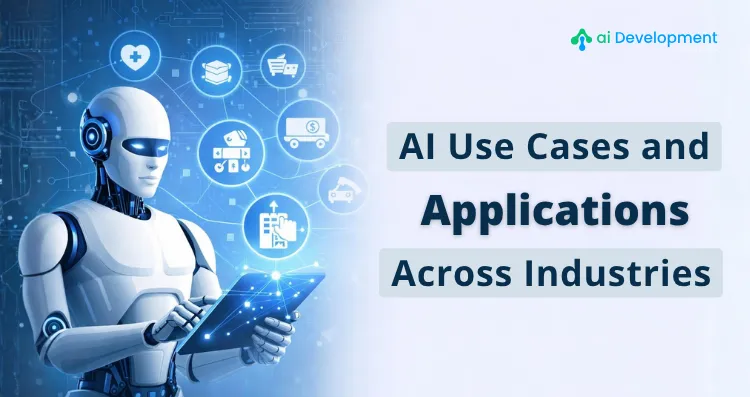
Real-World Applications for Transforming Industries
The theoretical promise of AI becomes tangible when examining how leading organizations deploy these capabilities:
Personalization at Scale: Streaming platforms like Netflix and Spotify analyze billions of user interactions to deliver hyper-personalized content recommendations. Their AI models understand individual preferences so precisely that they can predict what content users want before users themselves know.
Intelligent Customer Service: Modern AI chatbot development has evolved far beyond simple scripted responses. Advanced natural language processing enables conversational AI that understands context, emotion, and intent—resolving customer issues with human-like comprehension while operating 24/7 at unlimited scale.
Predictive Healthcare: Medical applications now use AI to analyze patient data, identify early warning signs of diseases, suggest treatment protocols, and predict health outcomes with accuracy that rivals or exceeds human physicians in specific diagnostic tasks.
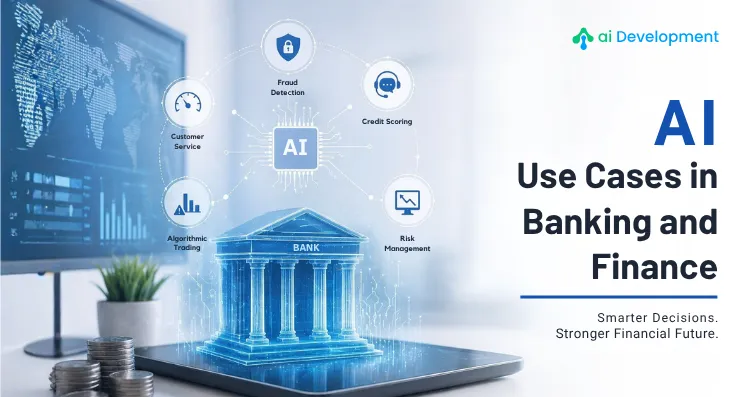
Financial Risk Detection: Banking and fintech apps employ sophisticated machine learning models to detect fraudulent transactions in real-time by identifying anomalous patterns invisible to traditional rule-based systems. These systems prevent billions in losses annually while minimizing false positives that frustrate legitimate customers.
Autonomous Supply Chain Optimization: Logistics and retail applications use AI to forecast demand, optimize inventory levels, route deliveries efficiently, and adjust pricing dynamically based on market conditions—all without human intervention.
Traditional App Development: The Established Approach
Traditional app development follows methodologies refined over decades. Developers write explicit code that defines every feature, workflow, and response the application will exhibit. The software performs precisely what programmers instruct it to do—nothing more, nothing less.
This deterministic approach offers clarity and predictability. Developers know exactly how the application will behave because they've explicitly defined every scenario. For many business requirements, this predictability remains valuable and appropriate.
Technical Foundations of Conventional Development
Traditional applications are constructed using well-established technology stacks:
Frontend Frameworks: User interfaces are built with proven frameworks like React, Angular, Vue.js, or native mobile SDKs. These tools enable developers to create responsive, visually appealing interfaces that work consistently across devices and platforms.
Backend Languages and Frameworks: Business logic runs on servers using mature languages like Java, Python, PHP, Ruby, or .NET. These backend systems handle data processing, user authentication, business rules, and integration with other services.
Relational and NoSQL Databases: Applications store data in structured databases like PostgreSQL, MySQL, MongoDB, or Firebase. Database design follows normalized schemas that ensure data integrity and enables efficient queries.
APIs and Integration Layers: RESTful APIs or GraphQL endpoints connect frontend applications with backend services and third-party integrations. These interfaces define exactly how different system components communicate.
This technology stack has powered millions of successful applications and remains the foundation for much of the digital economy.
Where Traditional Development Still Makes Sense
Despite AI's growing dominance, traditional app development remains the optimal choice for specific use cases:
Content Management Systems: Corporate websites, blogs, and digital publications that serve relatively static content don't require AI capabilities. Traditional CMS platforms deliver exactly what these applications need at lower complexity and cost.
Internal Business Tools: Employee-facing applications for tasks like timesheet tracking, expense reporting, project management, or inventory control often function perfectly well with conventional logic and don't justify AI investment.
Simple E-commerce Platforms: Basic online stores with standard product catalogs, shopping carts, and checkout flows can operate efficiently using traditional development, especially for smaller businesses with limited technical budgets.
Compliance-Focused Applications: Industries with strict regulatory requirements sometimes prefer traditional development's predictability and transparency over AI's "black box" decision-making processes.
Understanding when traditional approaches suffice versus when AI capabilities become essential represents a critical strategic judgment that determines app development roadmap success.
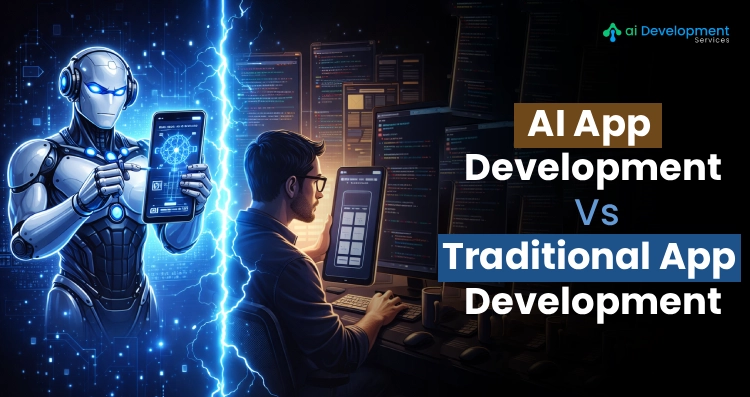
AI App Development vs Traditional App Development: A Complete Comparison
Choosing between AI-driven and traditional app development requires a clear understanding of how each approach impacts scalability, cost, user experience, and long-term business value. This comparison highlights the fundamental differences and explains why many organizations are increasingly shifting toward AI-powered applications to stay competitive.
Architecture and Design Philosophy
AI app development is built around data-centric architectures. These systems rely on continuous data ingestion, model training pipelines, and learning mechanisms that evolve over time. Application behavior is not entirely predefined; instead, it emerges from patterns learned from real-world data, enabling adaptive and self-improving systems.
Traditional app development follows a rule-based architecture. Every workflow, logic path, and response is explicitly coded by developers. The application behaves exactly as programmed, offering predictability but limited adaptability beyond predefined scenarios.
Scalability and Growth Potential
AI applications scale intelligently. As user activity and data volume increase, the system improves its accuracy and performance through learning. Scaling primarily involves expanding computational resources, while the intelligence of the application enhances organically over time.
Traditional applications scale through manual effort. New features, user segments, or workflows require code changes, testing, and redeployment. Growth is closely tied to engineering capacity, making scalability a continuous development challenge.
Development Complexity and Required Expertise
AI app development demands a multidisciplinary skill set. Beyond conventional software engineering, teams must manage data pipelines, model training, validation, and deployment. This makes early-stage development more complex and resource-intensive.
Traditional development is comparatively straightforward. It relies on well-established frameworks and practices, with fewer specialized skills required. This predictability simplifies hiring, onboarding, and project planning.
Cost Structure Over Time
AI applications typically require higher upfront investment due to specialized talent, data infrastructure, and model development. However, as automation increases and systems self-optimize, ongoing maintenance costs tend to decline, resulting in a more favorable long-term return on investment.
Traditional applications have lower initial costs, but expenses increase steadily over time. Feature expansion, technical debt, and manual maintenance drive up total cost of ownership throughout the application’s lifecycle.
Time-to-Market Considerations
AI-based solutions often take longer to launch initially because of data preparation and model training requirements. Post-launch, however, iteration becomes faster as systems improve automatically through real-world usage data.
Traditional applications can reach the market more quickly at the outset. However, every enhancement requires a full development cycle, which slows innovation and limits rapid evolution.
User Experience and Personalization
AI apps deliver highly personalized experiences by adapting to individual user behavior, preferences, and context. Each interaction contributes to a more tailored and predictive user journey.
Traditional apps offer standardized experiences designed for broad user groups. Personalization is limited to predefined settings or basic segmentation, resulting in largely uniform interactions.
Decision-Making Capabilities
AI systems excel at real-time decision-making in complex, data-rich environments. They can evaluate multiple variables simultaneously, handle uncertainty, and make predictive decisions that are difficult to predefine in code.
Traditional systems rely on static decision trees and business rules. While transparent and easy to audit, they struggle with ambiguity, edge cases, and unanticipated scenarios.
Automation and Data Utilization
AI app development enables deep automation across analysis, optimization, and decision-making. Data is treated as a strategic asset that continuously enhances system intelligence and business outcomes.
Traditional development uses data mainly for storage, reporting, and manual analysis. While valuable for insights, data does not directly improve application behavior or capabilities.
Final Perspective
This comparison highlights a clear distinction: traditional app development remains suitable for simple, predictable use cases, while AI app development delivers greater long-term value for organizations focused on innovation, personalization, and operational efficiency. For businesses competing in dynamic markets, AI-powered applications provide a decisive strategic advantage.
The Compelling Advantages of AI App Development
Organizations investing in adaptive AI development gain competitive advantages that compound over time. These benefits extend far beyond technological sophistication to directly impact revenue, customer loyalty, operational costs, and market position.
Personalization That Drives Engagement and Revenue
Modern consumers expect experiences tailored to their preferences, contexts, and behaviors. AI enables personalization at a scale and sophistication impossible with traditional methods.
Machine learning algorithms analyze thousands of data points per user—browsing patterns, purchase history, content consumption, device usage, time preferences, and behavioral signals. This analysis creates a detailed understanding that powers hyper-relevant recommendations, dynamic content, and contextual features.
The business impact is substantial. Research shows personalized experiences increase customer engagement by up to 300%, improve conversion rates by 25%, and boost customer lifetime value by 40% or more. These aren't marginal improvements—they represent fundamental competitive advantages.
Automation That Transforms Economics
AI doesn't just automate repetitive tasks; it automates judgment, analysis, and decision-making across operations. This deep automation transforms cost structures and enables business models impossible with manual processes.
Customer service operations using AI chatbot systems reduce support costs by 60-70% while improving response times from hours to seconds. Inventory management systems using AI forecasting reduce carrying costs by 30% while simultaneously decreasing stockouts by 50%. Marketing platforms using AI optimization improve campaign ROI by 35% while reducing the analyst time required per campaign.
These automation capabilities free human talent to focus on strategy, creativity, and complex problem-solving rather than routine operational tasks.
Predictive Capabilities That Enable Proactive Strategy
Perhaps AI's most valuable capability is prediction—forecasting future events, behaviors, and outcomes based on historical patterns and current signals.
Retail applications predict product demand weeks in advance, optimizing inventory and reducing waste. Financial systems detect fraudulent transactions before they complete, preventing losses. Healthcare platforms identify patients at risk of complications before symptoms appear, enabling preventive intervention. Marketing systems predict customer churn probability, triggering retention efforts before customers leave.
This shift from reactive response to proactive strategy represents a fundamental business advantage. Organizations can allocate resources optimally, mitigate risks before they materialize, and capitalize on opportunities competitors haven't yet recognized.
Continuous Improvement Without Manual Development
The most revolutionary aspect of AI app development is autonomous improvement. Traditional applications remain static between releases—they don't get better without developer intervention. AI applications improve continuously as they process more data and encounter more scenarios.
A recommendation engine becomes more accurate with every user interaction. A fraud detection system recognizes new attack patterns automatically. A customer support AI handles increasingly complex queries as it learns from successful resolutions.
This continuous improvement means the application becomes more valuable over time without proportional increases in development costs. The ROI curve bends upward rather than flattening or declining as it does with traditional software.
Cost Analysis: Investment vs. Value Creation
Understanding the true cost of AI app development vs traditional app development requires looking beyond initial development budgets to total cost of ownership and value creation over multi-year horizons.
Initial Development Investment
AI App Development: Typical projects range from $80,000 to $250,000+ depending on model complexity, data requirements, and feature sophistication. This higher initial cost reflects:
- Specialized AI/ML engineering expertise
- Data infrastructure development
- Model training and validation
- Integration of AI frameworks and services
- More extensive testing requirements
Traditional App Development: Projects typically cost $30,000 to $120,000 for a comparable scope, excluding AI features. Lower costs result from:
- More abundant development talent
- Established frameworks and patterns
- Simpler testing requirements
- Fewer specialized tools and services
Operating Costs Over Time
AI App Development: Infrastructure costs start moderate to high for computational resources and data processing but often decrease over time as systems optimize. Model retraining and monitoring require ongoing investment, but automation reduces manual operational costs significantly.
Traditional App Development: Infrastructure starts lower but scales linearly with usage. Manual maintenance and optimization costs increase steadily as the application matures and complexity grows.
Return on Investment Timeline
AI App Development: ROI typically turns positive within 12-24 months as automation benefits, improved conversion rates, and operational efficiencies compound. The ROI curve accelerates over time as the system improves and benefits multiply.
Traditional App Development: ROI is steadier but grows more slowly. Returns plateau as the application matures and competitive advantages erode. Without continuous manual development investment, value creation stagnates.
Choosing Your Development Path: Strategic Considerations
The decision between AI app development and traditional app development shouldn't be made purely on technical grounds. Strategic business factors should guide the choice.
When AI App Development Makes Sense
Choose AI-powered development when:
Your Business Competes on Experience: If customer experience differentiation drives your competitive advantage, AI personalization capabilities become essential rather than optional.
You Have or Can Acquire Relevant Data: AI requires data to learn from. If you currently collect user interaction data or can implement data collection, AI becomes viable. Start with available data and expand as capabilities mature.
Continuous Improvement Drives Value: If your application's value increases with accuracy, relevance, or intelligence over time, AI's continuous learning delivers compounding benefits.
Automation Can Transform Economics: When operational costs are high and automation could dramatically improve margins, AI's deep automation capabilities justify the investment.
You're Building for Scale: Organizations planning to serve millions of users with personalized experiences find AI development essential—manual approaches simply don't scale to that level of sophistication.
Selecting the Right Development Partner
Choosing a development partner represents one of the most consequential decisions in your digital transformation journey. The right partnership accelerates success; the wrong one leads to wasted investment and missed opportunities.
Essential Capabilities to Evaluate
Proven AI Expertise: Look for demonstrated experience delivering production AI applications, not just theoretical knowledge. Request case studies, client references, and examples of systems they've built and deployed.
Full-Stack Development Proficiency: The best AI applications require excellence in both AI/ML engineering and traditional software development. Ensure your partner can handle the complete technology stack.
Data Engineering Excellence: AI applications live or die on data quality. Your partner must excel at designing data pipelines, ensuring data quality, and implementing robust data governance.
Business-Focused Approach: Technology should serve business objectives, not the reverse. Choose partners who understand your industry, market dynamics, and business model—who can shape technology decisions around business outcomes.
Transparent Communication: AI development involves uncertainty and iteration. Partners who communicate clearly about challenges, trade-offs, and realistic timelines enable better decision-making than those who overpromise.
Ready to Build an Intelligent App for Your Business?
The Future Belongs to Intelligent Applications
The evolution from traditional to AI-powered app development isn't a temporary trend—it represents a permanent shift in how successful digital products are built. Applications that learn, adapt, and improve autonomously will increasingly dominate markets across every industry.
Organizations that embrace adaptive AI development now will establish competitive advantages that compound over time. Those that delay risk falling permanently behind competitors who leverage AI to deliver superior experiences, operate more efficiently, and innovate faster.
Contact us to discuss how generative AI development and advanced AI capabilities can accelerate your digital transformation and create sustainable competitive advantage.
Frequently Asked Questions
Q1. How long does it take to develop an AI-powered application?
Ans. AI app development typically takes 4-9 months for initial deployment, depending on data availability, model complexity, and feature scope. Unlike traditional apps that require similar timelines, AI applications continue improving post-launch as they learn from real-world data. Plan for iterative enhancement rather than a single "complete" release.
Q2. Do I need massive amounts of data to start AI app development?
Ans. Not necessarily. While more data improves accuracy, many AI projects start with smaller datasets and expand over time. Techniques like transfer learning allow you to leverage pre-trained models that require less data for customization. The key is having relevant, quality data—not just volume. Start with available data and build data collection into your application.
Q3. Can existing traditional applications be upgraded with AI features?
Ans. Absolutely. Many organizations enhance existing applications by adding AI capabilities incrementally—starting with high-value features like personalized recommendations, intelligent search, or automated customer support. This hybrid approach allows you to modernize gradually while preserving working functionality. The key is ensuring your data infrastructure can support AI requirements.
Q4. Is AI app development suitable for startups and small businesses?
Ans. Yes. Cloud AI services, pre-trained models, and AI-as-a-service platforms have dramatically reduced barriers to entry. Startups can now access AI capabilities that were previously available only to large enterprises. Focus on specific high-value use cases rather than trying to build comprehensive AI systems. Many successful startups use AI strategically for competitive differentiation from day one.
Q5. What industries benefit most from AI app development?
Ans. While nearly every industry can leverage AI, sectors seeing dramatic transformation include healthcare (diagnostic support, personalized treatment), financial services (fraud detection, risk assessment), retail and e-commerce (personalization, demand forecasting), logistics (route optimization, predictive maintenance), and SaaS platforms (intelligent automation, user analytics). Industries with abundant data and high-value decision-making see the fastest returns.