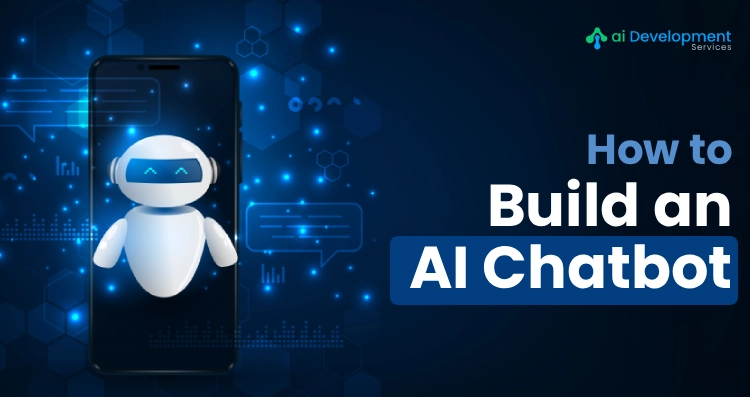
Chatbots have evolved from basic scripted tools into intelligent AI assistants that understand context, learn from interactions, and deliver meaningful user experiences. Today, they are a common part of customer support, bookings, and online interactions—often working seamlessly in the background.
Today, in 2026, the creation of an AI-powered chatbot is easier than ever and requires sufficient power to address business problems. Whether to support automation by start-ups or businesses looking to expand their operations, this guide helps to create effective chatbots that result in added benefits. Because of its increasing popularity, organizations are utilizing chatbots for their cost, satisfaction, and availability benefits, making it an important skill to have and acquire.
What Is an AI Chatbot?
An AI chatbot is a software application that uses artificial intelligence to simulate human-like conversations with users through text or voice. Unlike traditional chatbots that follow rigid, pre-programmed scripts, AI chatbots understand natural language, learn from interactions, and provide contextually relevant responses.
Think of the difference this way: a basic chatbot is like a choose-your-own-adventure book where you click on predefined options. An AI chatbot is more like having a conversation with a knowledgeable person who understands your questions even when you phrase them differently, remembers what you said earlier, and adapts their responses based on context.
Contemporary AI chatbots use a combination of various technologies. Natural language processing enables them to interpret what users intend to say and not only what is expressed. Machine learning helps them improve with each interaction. AI chatbots can also use generative AI so that they can compose new answers rather than relying on a template. Knowledge bases enable them to have essential information that can be utilized when answering questions.
Need Help Building a Scalable AI Chatbot?
Types of AI Chatbots You Can Build in 2026
Not all chatbots serve the same purpose. Understanding the different types helps you choose the right approach for your specific needs.
Rule-Based Chatbots
These are the simplest forms that follow decision trees. The user is given options or buttons that are pre-defined, and the chatbot reacts to them. Although less flexible, rule-based chatbots are the best examples of those functions that are straightforwardly defined, such as answering FAQs, filling out forms, or following a series of instructions.
AI-Powered Conversational Chatbots
These are capable of using natural language processing to identify the users’ intent no matter the manner in which the questions are posed. These are capable of handling language variation, typos, slang terms, among other things. These chatbots are capable of handling open conversations using artificial intelligence. They are capable of personalizing their conversations to suit the manner in which the conversation is conducted.
Hybrid Chatbots
By incorporating rule-based structuring and AI capabilities, hybrid chatbots are able to combine the benefits of the two approaches. Hybrid chatbots apply rule-based routines for predictable situations and then turn to AI for handling unpredictable situations. They are quite effective as they incorporate the benefits of rule-based and AI-powered chatbots.
Voice-Enabled Chatbots
These handle spoken conversations, using speech recognition to convert voice to text, natural language processing to understand intent, and text-to-speech to respond verbally. Voice chatbots are becoming increasingly common in customer service phone systems, smart home devices, and accessibility applications.
Transactional Chatbots
Designed to perform tasks like appointment setting, order placing, checking account balances, or updates, transactional chatbots integrate backend systems and databases. They incorporate a conversational interface with real business logic and data manipulation.
Social Media Chatbots
Such bots work within messaging services such as Facebook Messenger, WhatsApp, and Instagram or Telegram. The chatbots make use of platform-specific functionality as well as functionality for automated responses and interaction. Social media chatbots assist in ensuring that a business maintains its presence on platforms where its customers are most active.
Why Businesses and Startups are Investing in AI Chatbot Development
The surge in chatbot investment isn't hype—it's driven by measurable business outcomes and changing customer expectations.
Dramatic Cost Reduction
The customer support service is a substantial overhead for most companies. Chatbots can handle tens of thousands of conversations at once and do so at cheaper rates compared to humans. Though not replacements for human customer service, chatbots address common issues effectively and allow human customer service personnel to address issues and concerns that actually call for their intervention. Organizations have seen up to 20-30% savings in customer service costs following effective chatbot implementation.
24/7 Availability Without Proportional Costs
Customer service has to be available outside normal business hours, but doing so would have a significant cost. The advantage of the chat bot is that it will give answers at 3 AM or 3 PM without any cost implications for overtime or differential pay or the need for extra employees.
Instant Response Times
No individual prefers being placed on hold or awaiting responses via emails. Chatbots will immediately respond without any wait time whatsoever being necessary for routine inquiries. Even in situations that require human interaction, they get as much information as possible while waiting in the queue for the human interface.
Consistent Quality
Human agents have good days and bad days. They get tired, frustrated, or distracted. Chatbots provide consistent experiences every single time, following best practices and company policies without deviation. This consistency improves brand perception and reduces compliance risks.
Data Collection and Insights
Every chatbot conversation generates data about customer needs, common pain points, product confusion, and feature requests. This intelligence guides product development, marketing strategy, and process improvements in ways that traditional support channels might miss.
Lead Generation and Qualification
For sales-focused applications, chatbots engage website visitors, qualify leads through conversational questioning, schedule sales calls, and pass qualified prospects to human sales teams with complete context. This automation lets sales teams focus on closing rather than qualifying.
Competitive Differentiation
As chatbots become expected rather than novel, businesses without them risk seeming outdated. Early adopters of sophisticated AI chatbots gain reputation advantages as innovative and customer-focused organizations.
Step-by-Step Process to Build an AI Chatbot in 2026
Building an effective AI chatbot involves strategic planning, technical implementation, and ongoing refinement. Here's the comprehensive process.
Step 1: Define Purpose and Goals
Start with crystal-clear objectives. What specific problem should your chatbot solve? Common goals include reducing support ticket volume by a specific percentage, qualifying sales leads before human contact, providing product information and recommendations, processing routine transactions like bookings or orders, or engaging users to reduce bounce rates.
Step 2: Understand Your Users and Use Cases
Research how your target users currently solve the problems your chatbot will address. What questions do they ask? What language do they use? What frustrates them about current solutions? Collect actual customer service transcripts, support tickets, and frequently asked questions.
Map out conversation flows for your primary use cases. Create detailed scenarios showing how conversations should progress from initial greeting through successful resolution. Including branches for different intents and potential conversation paths.
Step 3: Choose Your Development Approach
You have several paths to building a chatbot:
Platforms such as Chatfuel, ManyChat, or Landbot allow less-technical people the option of creating simple chatbots using graphic interfaces. Such solutions may not offer advanced functions but can easily support basic functions.
There are low-code offerings such as Dialogflow, Microsoft Bot Framework, or Amazon Lex that are more flexible and provide pre-built pieces all the same.
Custom Development allows for unlimited control; however, it requires programming knowledge. This is because everything is coded entirely using Python or JavaScript and natural language processing tools available in programming tools.
Chatbot development services combine expertise with customization, allowing businesses to achieve sophisticated solutions without building internal AI teams.
Step 4: Design the Conversation Experience
Good chatbots respond intuitively to a user. The flow of a dialogue should be designed to cover introductions stating what assistance the chat robot can give, understanding the statements, taking into consideration the context, error handling when the chat robot doesn’t understand a statement, and escalation to a human.
Consider writing real dialogues for your personality in your chatbot. Should it be formal or informal? Helpful or playful? Short or long? This consistency in personality is very important in your user interface.
Step 5: Build and Train the Chatbot
Implementation would differ depending on the platform you are using, but some general steps would be as follows: implement natural language processing capabilities for intent identification and extraction of entities from the message, design logic for responses based on intent for corresponding actions, integrate with backend solutions for data access/transaction purposes, implement conversation management for maintaining context, and train the natural language model using sample messages for each intent.
The model needs a lot of example data for learning. For each of the intents your chatbot will understand, you need dozens of different examples of how users can phrase that need.
Step 6: Test Thoroughly
Before launching, test extensively with scenarios including typical conversations, edge cases and unusual requests, attempts to confuse or trick the chatbot, very long or very short messages, rapid successive messages, and conversations that should escalate to humans.
Recruit beta testers representing actual users. Their feedback reveals issues you won't discover internally, particularly around unclear responses, missing intents, or frustrating conversation paths.
Step 7: Deploy and Monitor
First, release it to a small audience and monitor the conversations, while eliciting feedback from users. Observe the patterns of conversation failure, commonly misunderstood intent, and user frustration signals.
Track these predefined success metrics daily at the beginning, then weekly as the pattern starts to stabilize. Be prepared to make iterations quickly based on real-world usage that always differs from testing scenarios.
Step 8: Continuously Improve
Development work for a chatbot is required to continue even after its completion and release. It encompasses a series of activities such as analysis of conversation logs for identifying new intents, feedback-based improvement of responses, improvement of accuracy using expanded training sets, development of new functionalities based on changing demands, and upgradation of knowledge repositories with updated knowledge.
The most effective chatbots continue learning; hence, they become more accurate and informative with time because of the continuous learning process.
How NLP, ML, and Generative AI Power Chatbots
Understanding the technologies underlying modern chatbots helps you build better solutions and set realistic expectations.
Natural Language Processing (NLP)
This allows chatbots to handle the untidiness of human language. Core functions of NLP include intent identification, entity extraction, sentiment analysis, language identification, and spelling error correction. Intent identification involves understanding what the user wants to achieve. This can range from simple tasks such as getting the current day and time or locating nearby restaurants, to complex tasks such as answering medical or financial queries.
Contemporary NLP relies on trained neural networks and huge corpora of text in order to capture meaning and even slang. This enables a level of conversation rather than forcing a user to ask their question in a preordained way.
Machine Learning (ML)
Machine learning allows chatbots to improve through experience. Instead of programming every possible conversation manually, you provide examples and let the ML model learn patterns. As the chatbot has more conversations, it can identify new patterns, improve accuracy on existing intents, and adapt to changing user behavior.
ML powers features like conversation flow prediction (anticipating what users might need next), personalization (adapting responses based on user history), anomaly detection (identifying unusual requests that might need human review), and continuous optimization (automatically refining models as new data arrives).
Generative AI
The newest advancement in chatbot technology, generative AI, creates original responses rather than selecting from templates. Models like GPT-4 can understand questions, reason about appropriate responses, and generate natural-sounding replies on the fly.
It makes the chatbots capable of answering open-ended questions that they are not trained to answer, describe a concept in a different manner in case the visitor doesn't understand the first explanation, carry out creative problem-solving techniques, conduct more natural conversations that are less repetitious.
However, there are many considerations needed when putting in practice generative models. These models may have incorrect answers ("hallucinations"), have to be guided on how to respond properly to questions, and be monitored to ensure the quality of responses. The most intelligent chatbots comprise both rule-based decision logic and generative models.
AI Chatbot Development Cost in 2026
Understanding cost structures helps you budget appropriately and choose the right development approach.
No-Code Platform Chatbots
For small applications, no-code tools are the cheapest solution. They charge $50 to $500 per month based on functionality and conversation levels. Since development time is low, taking just hours or days, you can develop the application quickly with low development cost too. However, customization is not possible with them, and scaling up may also incur high costs as you grow.
Low-Code Platform Chatbots
Some of these are technical, so more versatile platforms like Dialogflow or Microsoft Bot Framework also exist. The typical cost includes platform costs of $100 to over $1,000 a month, depending on usage; development costs, ranging between $5,000 and $25,000 for an initial build, depending on the level of sophistication; and sometimes integration costs with your existing systems. This balances being affordable with capability for most business needs.
Custom-Built Chatbots
Building from scratch allows the most control. The development cost may range from $30,000 in the case of the simplest customer chatbots to as high as $150,000+ in the case of complex enterprise-level chatbots. The subsequent costs will be that of server costs, training the models, maintaining models, etc.
Factors Affecting Cost
Several variables significantly impact final costs, including conversation complexity (simple FAQ vs. complex transactions), number of integrations with existing systems, languages supported (multilingual adds complexity), voice capabilities if needed, training data requirements, expected conversation volume, and level of customization required.
Ongoing Operational Costs
Beyond development, budget for API costs if using third-party NLP services (typically $0.002-$0.10 per request), hosting and infrastructure ($100-$2,000+ monthly), maintenance and updates (10-20% of development cost annually), and continuous training and improvement (ongoing time investment).
Working with an experienced AI chatbot development company often provides better value than attempting custom development without specialized expertise, as they avoid common pitfalls and implement proven architectures that scale effectively.
How AI Development Service Helps Build Scalable AI Chatbots
When you're ready to build a serious chatbot solution, partnering with experienced developers accelerates success and reduces risk.
Comprehensive Strategy Development
AI Development Service begins with strategic consultation to understand your business objectives, user needs, and technical requirements. They help define realistic goals, identify high-value use cases, and design conversation experiences that actually solve user problems rather than just deploying technology for its own sake.
Technical Expertise Across Platforms
Their team has deep experience with various chatbot platforms, frameworks, and custom development approaches. This breadth means they recommend solutions based on your needs rather than limiting options to a single platform. Whether you need a simple customer service bot or a complex transactional system, they've built similar solutions and understand what works.
Advanced NLP and AI Implementation
Building chatbots that truly understand natural language requires expertise in machine learning, training, data preparation, model optimization, and continuous refinement. AI Development Service implements sophisticated NLP capabilities that handle real-world conversation complexity, not just demo scenarios.
Seamless Integration
Chatbots rarely operate in isolation. They need connections to CRM systems, knowledge bases, transaction databases, analytics platforms, and other business tools. AI Development Service handles these integrations comprehensively, ensuring your chatbot has access to necessary information and can take actual actions on behalf of users.
Scalability Planning
A chatbot that works perfectly with 100 conversations daily might collapse under 10,000. AI Development Service architects solutions for scale from the beginning, implementing infrastructure that handles growth, optimizing for performance and cost efficiency, and monitoring systems that alert to issues before they impact users.
Quality Assurance and Testing
Thorough testing catches issues before they reach customers. Their QA process includes conversation testing across diverse scenarios, integration testing to verify system connections, load testing to ensure scalability, security testing to protect user data, and accessibility testing to ensure usability for all users.
Ongoing Support and Optimization
Post-launch support distinguishes good chatbot implementations from failed ones. AI Development Service provides continuous monitoring of performance metrics, regular analysis of conversation logs to identify improvements, model retraining as new data accumulates, feature additions as needs evolve, and technical support to resolve any issues quickly.
Their experience across industries and use cases means they bring proven best practices to your project, avoiding common mistakes and implementing solutions that deliver measurable business value from day one.
Ready to Build Your AI Chatbot?
Conclusion
Creating an AI chatbot in 2026 is an intelligent move to optimize and amplify customer satisfaction and scalable growth. Though creating a chatbot has never been simpler, it is often dependent on achieving well-defined goals and a profound understanding of users. It is essential to acknowledge that it is only the most optimal and superior-quality chatbots that are recognized as facilitators of customer experience and growth and do not function solely as agents of cost-cutting. It is crucial to remember that, regardless of whether it is a no-code application, a customized application, or a consultative approach, it is vital to keep a chatbot relevant to business.
Frequently Asked Questions
How long does it take to build an AI chatbot?
Simple rule-based chatbots can be built in 1-2 weeks using no-code platforms. AI-powered chatbots typically require 6-12 weeks for development, training, and testing. Complex enterprise chatbots with multiple integrations may take 3-6 months from concept to production deployment.
Can chatbots handle multiple languages?
Yes, modern AI chatbots can support multilingual conversations. Most NLP platforms include language detection and translation capabilities. However, each language requires training data and testing, so multilingual support increases development complexity and cost.
What's the difference between a chatbot and a virtual assistant?
The terms overlap significantly, but generally chatbots handle specific tasks or domains (customer support, booking, FAQ), while virtual assistants like Siri or Alexa handle broader capabilities across multiple domains. The distinction is becoming less meaningful as technologies converge.
How do I measure chatbot success?
Key metrics include resolution rate (percentage of conversations successfully completed without human escalation), customer satisfaction scores, average handling time, containment rate, and cost per conversation. Also track conversation volume, common intents, and failure patterns for optimization insights.
Do I need technical expertise to build a chatbot?
For basic chatbots using no-code platforms, technical skills aren't necessary. However, AI-powered chatbots with NLP capabilities, custom integrations, and sophisticated features require programming knowledge or partnership with development teams experienced in chatbot implementation.