Raising children has always been one of the most rewarding and demanding undertakings in life. From sleep schedules and developmental markers to questions and outdoor play time versus screen time, parents have their hands full. That's when and where technology comes in—not to replace the level of human experience needed when raising a child, but to offer assistance.
Parenting apps using AI technology are reshaping the way in which families keep up with the initial stages of child development. Smart parenting apps enable parents to receive tailored advice and make well-informed decisions utilizing analytical data provided by the app. If you are planning to develop an AI parenting app in 2026, you are certainly venturing into a meaningful and lucrative area.
What is an AI Parenting App?
An AI parenting app is a mobile application that leverages artificial intelligence to provide personalized support and guidance to parents. Unlike traditional parenting apps that offer static content and generic advice, AI-powered solutions adapt to each family's unique circumstances, learning patterns, and preferences.
These apps can do everything from tracking a baby's feeding and sleeping patterns to predicting developmental milestones, answering parenting questions through conversational interfaces, and even detecting early signs of developmental concerns. The intelligence behind these apps comes from machine learning algorithms that continuously improve their recommendations based on user interactions and outcomes.
Think of it as having a knowledgeable parenting coach available 24/7, one that remembers your child's history, understands your parenting style, and grows smarter with every interaction. The technology analyzes vast amounts of data to provide insights that would be impossible for any individual to process manually.
The Importance of AI in Modern Parenting in 2026
Today's parents have it tough. They're surrounded by conflicting information from numerous sources: pediatricians, relatives, bloggers, and influencers. Sorting out the difference between good information and opinion can, quite literally, drive you nuts, especially when you're operating on fumes due to sleep deprivation.
AI offers several important benefits when it comes to parenting. Firstly, it gives everyone the benefit of personalization. AI systems can analyze individual patterns and provide tailored recommendations that respect these differences.
Secondly, AI makes services consistent and accessible. It is a reality that many parents have questions at unusual hours when doctors' offices are closed. With an intelligent chatbot development solution, parents receive immediate answers to their questions based on medical guidelines. Thus, parents gain confidence in their decision-making.
Third, AI can identify patterns that humans might miss. By tracking multiple data points over time, these systems can spot potential developmental delays, health concerns, or behavioral patterns early, when interventions are most effective. This preventive approach can make a significant difference in a child's long-term wellbeing.
Steps to Build an AI Parenting App in 2026
Building a successful AI parenting app requires careful planning and execution. Here's a roadmap to guide your development journey.
Research and Market Analysis
Before putting a single line of code down on paper, it is important that you understand your target market intimately. Carry out surveys of parents to include a range of demographics. What are parents most frustrated about? Which tools would they personally use on a day-to-day basis? Which tools are they currently not satisfied with?
Analyze your competitors. Try to download popular apps related to parenting. Analyze their effectiveness. See their pros and cons. Try to explore gaps in their offerings where your app can fill in.
Define Your Core Value Proposition
Your app needs a clear reason to exist. Are you focusing on infant sleep training? Developmental milestone tracking? Behavioral guidance for toddlers? Educational activity suggestions? Trying to do everything will result in an app that does nothing particularly well. Choose your niche and excel at it.
Assemble Your Team
An AI app development project requires diverse expertise. You'll need experienced mobile developers for iOS and Android platforms, AI and machine learning engineers who can build and train your models, UX/UI designers who understand how stressed, tired parents interact with technology, and pediatric consultants or child development experts to ensure your content is medically accurate and developmentally appropriate.
Design the User Experience
Parents don't have time for complicated interfaces. Your app should be intuitive enough that someone can use it while holding a crying baby. Focus on quick data entry, clear visualizations, and easy navigation. Every screen should serve a purpose, and every feature should solve a real problem.
Developing the AI Backend
This is where the concept of adaptive AI development comes into the picture. Your machine learning system will require some training. Collaborate with pediatricians or research centers or parenting groups for anonymized developmental data. You will then require machine learning.models that enable the chat system to understand natural language chats, detect patterns from sleep and behavior information, and predict when milestones will occur based on the progress that is being made.
Implement Privacy and Security
You're dealing with highly sensitive information about children. Privacy isn't optional—it's essential. Implement end-to-end encryption, comply with regulations like GDPR give parents complete control over their data, and be transparent about how AI algorithms make decisions.
Test Extensively
Beta test with real families from diverse backgrounds. Gather feedback on accuracy, usefulness, and usability. Be prepared to iterate multiple times based on what you learn.
Launch and Iterate
Your first version won't be perfect, and that's okay. Launch with your core features working well, then continuously improve based on user feedback and new AI capabilities that emerge.
Let's Bring Your Parenting App Idea to Life
Core Features of a Successful AI Parenting App
The features you include can make or break your app's success. Here are the essentials that parents actually want and use.
Personalized Milestone Tracking
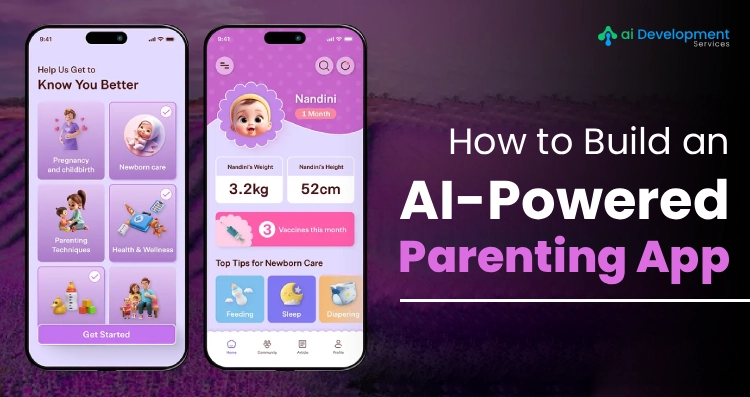
Your app should track developmental milestones across physical, cognitive, social, and emotional domains. The AI should learn what's normal for each individual child and flag potential concerns while avoiding unnecessary alarm. Visual timelines help parents see progress at a glance and feel proud of their child's growth.
Intelligent Sleep Analysis
Sleep deprivation is the number one complaint among new parents. An effective AI system can analyze sleep patterns, identify factors affecting sleep quality, suggest personalized sleep training approaches, and predict optimal nap times and bedtime windows based on accumulated data.
AI-Powered Q&A Assistant
Parents have countless questions throughout the day. A sophisticated chatbot can answer common parenting questions using natural language, provide evidence-based advice from pediatric sources, escalate serious concerns to healthcare professionals, and remember previous conversations for context.
Activity and Learning Suggestions
AI can recommend age-appropriate activities based on the child's current developmental stage, suggest educational games that target specific skills, and adapt to difficulty levels as the child grows and masters new abilities.
Health and Symptom Tracking
While never replacing medical advice, your app can help parents track symptoms and vaccination schedules, identify patterns in recurring issues, and prepare comprehensive health summaries for pediatrician visits.
Community and Support
Connect parents with others at similar stages through AI-matched community groups, moderated forums with expert participation, and local parent meet-ups suggestions.
Growth Charts and Analytics
Visual representations of growth data, comparisons with WHO standards (presented carefully to avoid anxiety), and long-term trend analysis help parents understand their child's unique growth pattern.
Emerging Trends in AI Parenting Apps (2026)
The landscape of parenting technology is evolving rapidly. Here are the trends shaping AI parenting apps in 2026.
Voice-First Interfaces
Hands-free interaction is crucial for parents. Voice commands allow data entry while changing diapers, asking questions while cooking, and setting reminders while playing with children. Natural language processing has advanced to the point where conversational AI feels genuinely helpful rather than frustratingly robotic.
Emotion Recognition Technology
Some cutting-edge apps now analyze baby cries to determine whether they're hungry, tired, in pain, or just fussy. While not perfect, these features provide helpful starting points for new parents still learning their baby's cues.
Predictive Health Insights
AI models trained on vast datasets can now identify subtle patterns that might indicate emerging health issues, developmental delays, or behavioral concerns. These systems work alongside healthcare professionals, not in place of them, providing early alerts that prompt timely consultations.
Integration with Smart Home Devices
Modern parenting apps connect with baby monitors, smart thermometers, wearable health trackers, and environmental sensors. This ecosystem approach provides comprehensive insights without requiring manual data entry.
Augmented Reality Features
AR is being used for educational purposes—teaching parents infant CPR, demonstrating proper car seat installation, and showing age-appropriate play activities through guided visual overlays.
Personalized Content Curation
Rather than overwhelming parents with generic articles, AI now curates reading materials, videos, and podcasts specifically relevant to their current stage and interests, delivered at times when they're most likely to engage.
Challenges in Developing AI Parenting Apps
Building an AI parenting app isn't without its difficulties. Understanding these challenges upfront helps you plan effectively.
Balancing Automation with Human Touch
Parents want support, not replacement. Your AI needs to enhance human judgment and instinct, not override it. Striking this balance requires careful messaging and thoughtful feature design. Technology should empower parents to trust themselves while having reliable information at their fingertips.
Ensuring Medical Accuracy
Any health-related guidance must be evidence-based and current. This requires ongoing relationships with pediatric experts, regular content reviews as medical guidelines evolve, and clear disclaimers about when to seek professional medical care. The liability concerns here are significant.
Managing Parental Anxiety
Data can be empowering or anxiety-inducing, depending on how it's presented. Your app must avoid creating unnecessary worry through comparisons, alarmist language, or overwhelming parents with too much information. Design with compassion and understanding of the emotional state of your users.
Data Privacy Concerns
Parents are rightfully protective of their children's data. You need robust security measures, transparent privacy policies written in plain language, minimal data collection practices, and compliance with evolving regulations across different regions and countries.
Cultural Sensitivity
Parenting practices vary enormously across cultures. Your AI models and content must respect this diversity, avoiding assumptions about family structures, feeding choices, sleeping arrangements, or discipline approaches. Building truly inclusive technology requires diverse teams and extensive cultural consultation.
Keeping Up with AI Advancements
The field of artificial intelligence is evolving rapidly. Your development team needs to stay current with new techniques, regularly update your models with better algorithms, and continuously improve accuracy and capabilities without disrupting the user experience.
Cost of Developing an AI Parenting App
Understanding the financial investment required helps you plan realistically and secure appropriate funding.
The cost of developing an AI-powered parenting app varies widely based on complexity, features, and team location. Here's a breakdown of typical expenses.
Development Costs
For a minimum viable product with basic AI features, expect to invest $80,000 to $150,000. This includes simple milestone tracking, basic chatbot functionality, and standard mobile app features across iOS and Android platforms.
A mid-tier app with advanced machine learning models, comprehensive features, personalized recommendations, and polished UX typically ranges from $150,000 to $300,000. This version would include sophisticated pattern recognition, integrated health tracking, and community features.
Enterprise-grade applications with cutting-edge AI capabilities, predictive analytics, AR features, extensive integrations, and medical-grade accuracy can exceed $300,000 to $500,000 or more.
Ongoing Costs
Development is just the beginning. Plan for monthly expenses including cloud infrastructure and AI processing (typically $2,000 to $10,000+ depending on user base), content updates and medical review, customer support operations, continuous AI model training and improvement, and marketing and user acquisition.
Hidden Costs to Consider
Don't forget about legal and compliance expenses for privacy regulations, insurance for liability protection, partnerships with medical institutions or experts, and regular security audits and penetration testing.
The investment is substantial, but the parenting app market is growing rapidly, with parents increasingly willing to pay for tools that genuinely help them raise healthy, happy children.
Why Choose us for AI App Development?
When you're ready to bring your AI parenting app vision to life, choosing the right development partner makes all the difference. AI Development Service brings unique advantages to parenting technology projects.
Our team has specific experience in healthcare and family-focused applications, understanding the unique regulatory, ethical, and emotional considerations these projects require. We don't just write code—we build solutions that respect the profound responsibility of supporting families.
We maintain partnerships with pediatric experts and child development specialists who review our work, ensuring that the technology we build provides genuinely helpful, evidence-based guidance. Our AI engineers stay at the forefront of machine learning research, implementing the latest advances in natural language processing, predictive analytics, and personalization.
AI Development Service follows a collaborative development process where you're involved at every stage. We believe the best products emerge from ongoing dialogue between technical experts and those who understand the market deeply. Your insights shape the solution from initial concept through final deployment.
We prioritize privacy and security from day one, implementing industry-leading practices for data protection. We understand that earning parents' trust requires demonstrating that trust through our technical architecture and transparent practices.
Post-launch support is where many development shops fall short, but we view it as essential. We provide ongoing maintenance, feature enhancements, performance optimization, and strategic guidance as your user base grows and market needs evolve.
Build the Next Generation of Parenting Technology
Conclusion
Building an AI-powered parenting app in 2026 represents an exciting opportunity to make a meaningful difference in families' lives while creating a viable business. The technology has matured to the point where genuinely helpful, personalized support is possible at scale.
Success requires more than just technical capability. You need deep empathy for your users, commitment to accuracy and safety, respect for privacy and cultural diversity, and willingness to iterate based on real-world feedback.
The parents using your app are navigating one of life's most important journeys, often feeling uncertain, overwhelmed, or alone. Technology that reduces that stress, provides reliable information, and helps them feel more confident deserves to exist. If you approach this project with the seriousness and care it requires, you can build something that genuinely matters.
The market is ready, the technology is available, and families need support now more than ever. The question is whether you're ready to commit to building something exceptional.
FAQs
How long does it take to develop an AI parenting app?
A basic MVP typically takes 4-6 months, while a full-featured app with advanced AI capabilities usually requires 8-12 months from concept to launch. Ongoing improvements continue indefinitely.
Do I need a medical license to launch a parenting app?
No, but you need clear disclaimers that your app doesn't replace medical advice, partnerships with healthcare professionals for content review, and compliance with relevant health data regulations.
What's the best monetization strategy for parenting apps?
Freemium models work well—offer basic features free with premium subscriptions for advanced AI insights, personalized plans, and unlimited access to expert content. Avoid intrusive ads given the sensitive context.
How do I ensure my AI recommendations are safe and accurate?
Work with pediatric consultants during development, train models on validated datasets from reputable sources, implement human review for health-related content, and continuously monitor user feedback for issues.
Can AI really understand the nuances of parenting?
AI excels at pattern recognition and information retrieval but can't replace human judgment and parental instinct. The best apps augment human decision-making rather than trying to automate it completely.