The infrastructure landscape is undergoing a seismic shift. While traditional physical infrastructure has long been controlled by centralized entities, a new paradigm is emerging that promises to democratize access, reduce costs, and enhance transparency. Decentralized Physical Infrastructure Networks (DePIN) represent this transformation, combining blockchain technology with real-world physical resources to create community-owned, distributed systems.
With the DePIN market projected to reach $3.5 trillion by 2028, businesses and entrepreneurs are racing to understand how to build these revolutionary platforms. However, developing a successful DePIN platform requires more than just blockchain knowledge—it demands expertise in IoT integration, tokenomics design, physical infrastructure management, and user experience optimization.
This comprehensive guide walks you through every critical step of DePIN platform development, from conceptualization to deployment, ensuring you have the knowledge needed to build a robust, scalable, and secure decentralized infrastructure network.
Understanding DePIN: Fundamentals
Before diving into development, it's essential to grasp what makes DePIN platforms unique and transformative.
What is a DePIN Platform?
A DePIN platform enables the decentralized provisioning, management, and utilization of physical infrastructure through blockchain technology. Unlike traditional infrastructure controlled by centralized corporations or governments, DePIN platforms distribute ownership and governance among participants who contribute resources to the network.
These platforms connect physical hardware—whether sensors, storage devices, wireless hotspots, or energy sources—to blockchain networks, allowing users to contribute resources and earn rewards while others access these resources on-demand. This creates self-sustaining ecosystems where supply and demand balance organically through market mechanisms.
Key Components of DePIN Platforms
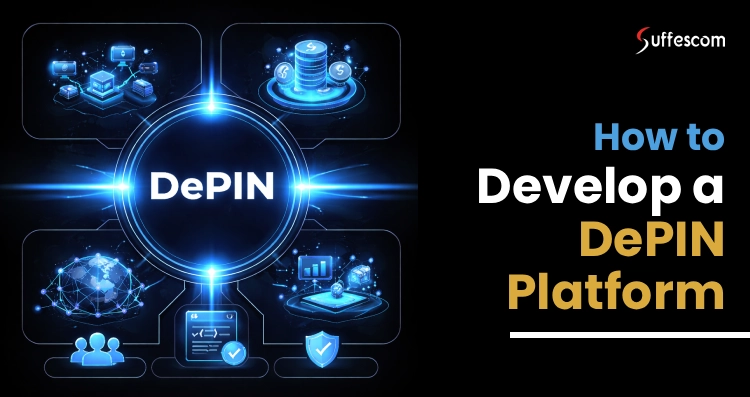
Successful DePIN platforms integrate several critical components that work together seamlessly:
Decentralized Node Network: Individual participants operate nodes that contribute physical resources to the network. These nodes maintain network integrity while providing services to users.
Blockchain Infrastructure: The underlying blockchain layer records all transactions, manages token distribution, enforces smart contract logic, and ensures transparency across the network.
Physical Resource Layer: The actual hardware and infrastructure being decentralized—storage devices, connectivity equipment, sensors, computing resources, or energy generation systems.
Token Economic Model: Carefully designed incentive mechanisms that reward resource providers, penalize bad actors, and create sustainable value for all participants.
User Interface: Intuitive applications that allow both resource providers and consumers to interact with the network effortlessly.
Turn Your DePIN Idea into a Scalable Platform
Essential Prerequisites for DePIN Platform Development
Building a DePIN platform requires thorough preparation across multiple dimensions.
Identifying the Problem to Solve
The foundation of any successful DePIN platform begins with identifying a genuine market need. Conduct comprehensive research to understand existing infrastructure inefficiencies, high costs, or access barriers that your platform can address. Define your target audience precisely—whether individual consumers, enterprises, or specific industries—and analyze how competitors are approaching similar challenges.
Technical Requirements
Assembling the right technical capabilities is crucial. Your team needs expertise in blockchain development, particularly smart contract programming and distributed systems architecture. IoT integration knowledge is equally vital, as you'll be connecting physical devices to blockchain networks. Understanding machine learning app development concepts can enhance your platform's ability to optimize resource allocation and predict demand patterns, creating more efficient operations.
Resource Planning
Establish clear resource requirements from the outset. Define your team composition, ensuring coverage of blockchain development, IoT engineering, frontend/backend development, and security expertise. Allocate budget realistically across development, security audits, hardware procurement, and marketing. Set achievable timeline milestones and select your technology stack based on project requirements and team expertise.
Step-by-Step DePIN Platform Development Process
Step 1: Platform Architecture Design
Architecture design lays the groundwork for your entire platform. Begin by mapping out the high-level system architecture, clearly defining how blockchain components, physical infrastructure, and user interfaces will interact. Design your data structures to efficiently handle information flow between on-chain and off-chain components.
Plan for scalability from day one. Your architecture should accommodate network growth without performance degradation. Consider layer-2 solutions or side-chains if your chosen blockchain has throughput limitations. Security must be architected at every level—from device authentication to smart contract execution to user data protection.
Step 2: Blockchain Platform Selection
Choosing the right blockchain platform significantly impacts your project's success. Ethereum offers the largest ecosystem and developer community but comes with higher transaction costs. Solana provides exceptional speed and low fees, making it ideal for high-frequency transactions. Polkadot excels at interoperability, allowing your DePIN to interact with multiple blockchain networks.
Evaluate platforms based on transaction throughput, finality time, cost per transaction, developer tools availability, and community support. For specialized requirements, consider building a custom blockchain using frameworks like Substrate or Cosmos SDK, though this requires significantly more resources.
Step 3: Smart Contract Development
Smart contracts form the brain of your DePIN platform, automating resource allocation, payments, and governance. Begin with comprehensive tokenomics design that defines your token's utility, distribution model, and incentive mechanisms. Your token should reward resource providers fairly while remaining economically sustainable.
Develop core smart contracts covering essential functions: token contracts managing supply and transfers, governance contracts enabling decentralized decision-making, resource allocation contracts matching supply with demand, and payment mechanisms facilitating seamless transactions. Integrate generative AI development capabilities into your smart contracts to enable dynamic pricing models that adapt based on real-time supply and demand conditions.
Testing is absolutely critical. Use frameworks like Hardhat, Truffle, or Brownie to write comprehensive unit tests covering all functions and edge cases. Engage professional auditing firms to review your contracts before mainnet deployment—vulnerabilities in smart contracts can be catastrophic.
Step 4: Physical Infrastructure Integration
Connecting physical devices to your blockchain network requires careful planning and execution. Select hardware that balances cost, reliability, and performance. Implement secure authentication mechanisms ensuring only authorized devices can participate in the network.
Establish data collection protocols that efficiently capture relevant information from physical devices. Design transmission protocols optimizing for bandwidth constraints and energy efficiency, particularly important for battery-powered IoT devices. Implement real-time monitoring capabilities allowing network administrators to track device health, performance metrics, and potential issues.
Data validation becomes crucial when dealing with physical devices. Implement mechanisms verifying that reported data is accurate and hasn't been tampered with. Adaptive AI development techniques can help your platform learn normal device behavior patterns and flag anomalies automatically, improving network integrity.
Step 5: Backend Infrastructure Development
Your backend serves as the bridge between blockchain and traditional application components. Set up robust Node.js servers (or your preferred backend framework) to handle API requests, process data, and interact with the blockchain.
Develop comprehensive APIs that enable frontend applications to query blockchain data, submit transactions, retrieve historical information, and manage user accounts. Implement efficient caching strategies to minimize blockchain queries and improve response times.
Set up databases for storing off-chain data such as user profiles, device metadata, and historical analytics. While blockchain provides immutability for critical transactions, not all data needs to live on-chain. Implement proper data validation at the backend level, ensuring data integrity before blockchain submission.
Step 6: Frontend Application Development
User experience can make or break your DePIN platform. Design intuitive interfaces using modern frameworks like React, Vue.js, or Angular. Integrate cryptocurrency wallet connections seamlessly, supporting popular options like MetaMask, WalletConnect, and Coinbase Wallet.
Create comprehensive dashboards for different user types. Resource providers need visibility into earnings, device performance, and network contributions. Consumers require easy resource discovery, transparent pricing, and usage analytics. Administrators need monitoring tools, network health metrics, and governance capabilities.
Implement real-time data visualization allowing users to track resource availability, network status, and transaction history. Consider mobile app development for on-the-go access, particularly important for DePIN platforms involving location-based services.
Step 7: Security Implementation
Security must be paramount throughout your DePIN platform. Implement multi-signature wallets for treasury management, requiring multiple approvals for critical transactions. Use industry-standard encryption protocols for all data transmission, both between devices and across network communications.
Establish robust access control mechanisms ensuring users can only access authorized resources and perform permitted actions. Schedule regular security audits with reputable firms specializing in blockchain and IoT security. Develop comprehensive incident response plans detailing steps to take if vulnerabilities are discovered or attacks occur.
Testing and Quality Assurance
Thorough testing prevents costly errors and ensures smooth platform operation.
Unit Testing for Smart Contracts
Write comprehensive unit tests covering every smart contract function. Test normal operations, edge cases, failure scenarios, and potential attack vectors. Use code coverage tools ensuring at least 90% of your contract code is tested. Implement automated testing in your development pipeline, running tests with every code change.
Integration Testing
Test how all platform components work together. Verify that physical devices successfully communicate with blockchain nodes. Ensure frontend applications correctly interact with backend APIs and smart contracts. Test the complete user journey from device registration to resource provision to payment receipt.
Conduct performance testing under various load conditions. Simulate thousands of simultaneous users and devices to identify bottlenecks. Test network behavior during peak usage periods and verify graceful degradation when limits are approached.
User Acceptance Testing
Before public launch, conduct beta testing with real users in controlled environments. Gather feedback on user experience, identify confusing workflows, and validate that the platform solves the intended problem. Iterate based on user feedback, making improvements before wider deployment.
Deployment and Launch Strategy
Testnet Deployment
Deploy your platform on a blockchain testnet first, allowing for risk-free testing with fake tokens. Run pilot programs with selected users, gathering performance data and identifying issues. Use this phase to fine-tune economic parameters, optimize resource allocation algorithms, and validate security measures.
Mainnet Deployment
When ready for production, implement a phased rollout strategy. Start with limited geographic regions or user groups, gradually expanding as confidence grows. Deploy node infrastructure in strategic locations ensuring network coverage and redundancy.
Create comprehensive onboarding materials helping users understand how to participate as resource providers or consumers. Provide clear documentation, video tutorials, and responsive support channels.
Post-Launch Activities
After launch, focus intensively on community building. Your DePIN platform succeeds or fails based on network effects—more participants make the network more valuable for everyone. Engage actively on social media, forums, and community channels. Develop partnership programs bringing enterprises or organizations onto the platform.
Implement continuous monitoring tracking key metrics: network growth, resource utilization, transaction volume, user satisfaction, and token economics health. Be prepared to adjust parameters based on real-world performance.
Why Choose AI Development Service?
Building a successful DePIN platform requires not just blockchain expertise, but also advanced capabilities in artificial intelligence, machine learning, and system optimization. AI Development Service brings deep experience in integrating AI-powered solutions into decentralized systems.
Our team specializes in AI development, enabling your DePIN platform to continuously learn and optimize resource allocation based on real-world usage patterns. We understand how to implement intelligent pricing algorithms, predictive maintenance systems, and anomaly detection mechanisms that keep your network running efficiently.
With proven expertise in blockchain development, IoT integration, and AI/ML implementation, AI Development Service provides end-to-end support from architecture design through deployment and beyond. We help you build DePIN platforms that don't just work—they evolve and improve over time, delivering superior ROI for stakeholders.
Ready to Build Your DePIN Platform?
Critical Considerations for Success
Regulatory Compliance
DePIN platforms operate at the intersection of multiple regulatory domains. Understand cryptocurrency and token regulations in your target markets. If handling user data, comply with GDPR, CCPA, and other privacy regulations. For platforms involving licensed services (like telecommunications), ensure appropriate approvals are obtained.
Engage legal counsel experienced in blockchain and decentralized systems. Implement compliance mechanisms at the technical level, such as KYC/AML procedures where required and geographic restrictions for unavailable jurisdictions.
Governance Model Implementation
Establish clear governance structures allowing stakeholders to participate in platform evolution. Implement DAO mechanisms enabling token holders to propose and vote on changes. Define governance parameters: voting thresholds, proposal requirements, and implementation timeframes.
Balance decentralization with practicality. Early-stage platforms often benefit from more centralized decision-making to enable rapid iteration, gradually transitioning to full decentralization as the network matures.
Sustainability and Long-term Viability
Design economic models ensuring long-term sustainability. Your token economics must reward participants fairly while generating sufficient revenue for platform maintenance and development. Model various scenarios ensuring the network remains viable even during periods of low activity or market downturns.
Plan for technical evolution. Technology advances rapidly—your platform should be upgradeable without disrupting existing users. Implement governance-controlled upgrade mechanisms allowing the community to improve the platform over time.
Common Challenges and Solutions
Technical Challenges
Scalability Issues: As your network grows, transaction throughput can become a bottleneck. Solution: Implement layer-2 scaling solutions, optimize smart contract efficiency, or consider migrating to higher-throughput blockchains.
Latency Problems: Physical infrastructure requires real-time responses that blockchain confirmation times may not support. Solution: Use hybrid architectures with off-chain processing for time-sensitive operations, settling final state on-chain.
Integration Complexities: Connecting diverse hardware to blockchain networks presents numerous challenges. Solution: Develop standardized integration protocols and provide comprehensive SDKs simplifying device onboarding.
Business Challenges
User Adoption: Convincing users to trust and participate in a new decentralized network is difficult. Solution: Start with strong use cases demonstrating clear value, offer attractive early adopter incentives, and build trust through transparency.
Network Effects: DePIN platforms require critical mass to become valuable. Solution: Focus initially on specific geographic regions or use cases where you can quickly reach critical density rather than spreading too thin.
Competition: Traditional centralized players have established market positions. Solution: Emphasize unique DePIN advantages—lower costs, true ownership, censorship resistance, and community governance—that centralized alternatives cannot match.
Real-World DePIN Platform Examples
Several DePIN platforms have successfully launched, demonstrating the model's viability. Helium created a decentralized wireless network where individuals deploy hotspots earning tokens for providing coverage. Filecoin built decentralized storage infrastructure where users contribute hard drive space to the network. Render Network decentralized GPU rendering, allowing anyone with powerful graphics cards to earn by providing computing power.
These platforms share common success factors: solving genuine problems, designing sustainable tokenomics, building strong communities, and delivering reliable service quality. Study their approaches to understand what works in practice.
Conclusion
Developing a DePIN platform represents a significant undertaking, but the potential rewards—both financial and societal—are substantial. By following this comprehensive guide, you'll be equipped to navigate the complexities of blockchain integration, IoT connectivity, tokenomics design, and community building that successful DePIN platforms require.
Ready to build the future of decentralized infrastructure? Partner with experts who understand both the technical complexities and business realities of DePIN development. The journey from concept to successful platform is challenging, but with the right guidance and execution, you can create infrastructure that empowers communities and generates lasting value.
FAQs
Q1. What is a DePIN platform and how does it work?
Ans. A DePIN (Decentralized Physical Infrastructure Network) platform connects real-world physical infrastructure to blockchain technology, allowing individuals to contribute resources like storage, connectivity, or computing power and earn rewards. Users can access these distributed resources on-demand while the blockchain handles payments, governance, and transparency.
Q2. How long does it take to develop a DePIN platform?
Ans. DePIN platform development typically takes 6-12 months depending on complexity. Simple platforms with basic features may launch in 4-6 months, while enterprise-grade platforms with custom blockchain integration, extensive IoT connectivity, and advanced features can take 12-18 months from concept to mainnet deployment.
Q3. What blockchain is best for building a DePIN platform?
Ans. The best blockchain depends on your requirements. Ethereum offers the largest ecosystem and developer support, Solana provides high speed and low costs, and excels at interoperability. For specialized needs, custom blockchains built with Substrate or Cosmos SDK offer maximum flexibility but require more development resources.
Q4. What are the main costs involved in DePIN platform development?
Ans. Major costs include blockchain development and smart contract audits ($50,000-$200,000), backend and frontend development ($40,000-$150,000), physical hardware and IoT integration ($30,000-$100,000), security audits ($20,000-$50,000), and ongoing infrastructure and maintenance. Total costs typically range from $150,000 to $500,000+ for production-ready platforms.
Q5. How do DePIN platforms generate revenue?
Ans. DePIN platforms generate revenue through transaction fees (small percentage on each resource exchange), token appreciation (platform tokens increase in value as network grows), premium features for enterprise users, and service subscriptions. The tokenomics model should balance rewarding resource providers while ensuring platform sustainability and growth.