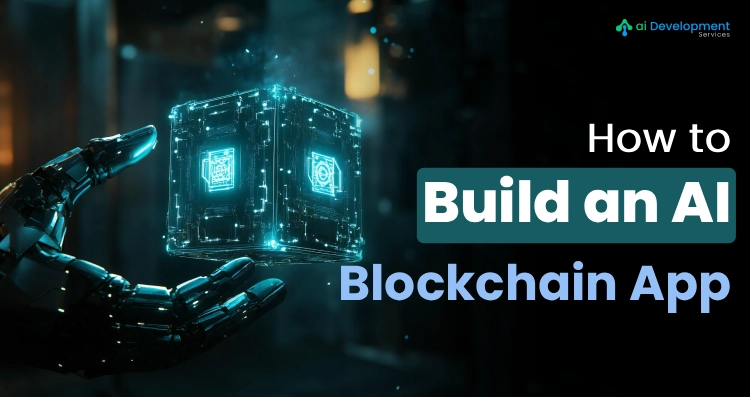
Something remarkable is happening at the intersection of artificial intelligence and blockchain technology. These two powerful innovations are coming together to create applications that are smarter, more transparent, and fundamentally different from anything we've seen before.
This guide will walk you through everything you need to know about building your first AI blockchain app. Whether you're a developer looking to expand your skillset or an entrepreneur exploring new possibilities, you'll find practical advice and actionable steps to bring your ideas to life.
Key Takeaways:
Before we dive deeply into the technical details, here are the essential points you need to understand:
- Blockchain app development services help businesses eliminate manual workflows and reduce operational overhead through self-executing contracts.
- Running AI models on blockchain infrastructure provides better data protection and gives users more control over their information.
- The blockchain-AI market is valued at about USD 735.25 million in 2025 and is projected to grow to over USD 4 billion by 2033.
- Working with an experienced blockchain app development company from the start helps avoid common pitfalls and keeps projects on track.
- Developers who understand both AI and blockchain technologies are becoming essential as more companies explore these integrated solutions.
Understanding AI and Blockchain Integration
What Makes This Combination So Powerful?
Let's begin with the fundamentals. Blockchain is basically a digital book that stores information in a manner that is virtually impossible to alter or hack. Each transaction is bundled into "blocks" that are connected in a "chain" - hence the name.
AI, on the other hand, refers to computer systems that can perform tasks normally requiring human intelligence. This includes things like recognizing patterns, making predictions, and learning from experience.
Here's a real-world example: imagine a supply chain where blockchain tracks every product's journey from factory to customer. Now add AI into the mix. The AI can analyze all that blockchain data to predict when delays might happen, suggest better routes, and even automatically adjust orders based on demand patterns - all while keeping every decision transparent and auditable.
Where AI in Blockchain Makes a Real Impact
The applications are already changing how industries operate:
- Financial Services: Banks and fintech companies are using AI blockchain solutions to detect fraud in real-time while maintaining transparent audit trails. The AI spots unusual patterns, and the blockchain ensures nobody can hide or alter the evidence.
- Healthcare: Medical facilities are storing patient records on blockchain while using AI to analyze symptoms and suggest treatments. Patients control their own data, doctors get intelligent assistance, and everything remains private and secure.
- Supply Chain: Companies are tracking products from manufacture to delivery using blockchain, with AI predicting potential disruptions and optimizing logistics. When issues occur, the immutable record shows exactly what happened and when.
- Content Verification: Media companies are using AI to detect manipulated images or deepfakes, then store verification hashes on blockchain. This creates a permanent, tamper-proof record of authentic content.
The key insight here is that blockchain app development services aren't just about adding new features - they're about fundamentally rethinking how applications can be built to be more trustworthy and intelligent.
Planning Your AI Blockchain Application
Start With the Right Questions
Before you write any code, you need to get crystal clear on what you're actually building. I've seen too many projects fail because developers get excited about the technology without thinking through the fundamentals.
Ask yourself these questions:
Does your application really need both AI and blockchain?
Be honest here. Sometimes a regular database with machine learning is enough. You should only use blockchain when you need decentralization, transparency, or immutability. Add AI when you need automation, prediction, or pattern recognition that goes beyond simple rules.
Who will use your application and what problems are you solving for them?
Writing down specific user stories. "As a supplier, I want to automatically verify product authenticity" is much better than "I want to build something with AI and blockchain."
What data will your AI assistant app need?
Consider where this data is coming from, how much of it you will have, and if it makes sense to store it on the blockchain. Keep in mind that storage on the blockchain is costly – you will likely want to store large datasets outside the blockchain and store only the hashes for verification on the blockchain.
Create Your AI Blockchain Platform
Choosing Your Technology Stack
This decision will affect everything from development speed to long-term maintenance costs. Let me break down your options:
For Blockchain:
- Ethereum - The most mature ecosystem with extensive documentation and developer tools. Gas fees can be high, but Layer 2 solutions like Polygon help with this.
- Solana - Offers much faster transaction speeds and lower costs. Great for applications needing high throughput.
- Hyperledger Fabric - Best for private blockchain networks where you need controlled access and enterprise features.
For AI Development:
- Python remains the king of AI development, with libraries like TensorFlow, PyTorch, and scikit-learn providing everything you need for adaptive AI development.
- JavaScript/TypeScript works well for lightweight models that run in the browser, using libraries like TensorFlow.js.
The right blockchain app development company will help you navigate these choices based on your specific requirements.
How AI and Blockchain work together?
AI and blockchain work together by combining AI's analytical power with blockchain's secure, transparent data infrastructure.
Key synergies:
- Data integrity: Blockchain provides tamper-proof data that AI can trust for training and decision-making
- Decentralized AI: Blockchain enables distributed AI models and marketplaces where people can share algorithms and computing power
- Smart contracts: AI can trigger automated blockchain transactions based on real-world data analysis
- Transparency: Blockchain creates auditable records of AI decisions, helpful for accountability in finance or healthcare
- Federated learning: Multiple parties can train AI models on shared blockchain networks without exposing private data
How to Build a Blockchain App in 2026?
Let me walk you through the fundamental process of building a blockchain application, which forms the foundation for adding AI capabilities later.
Step 1: Define Your Blockchain Architecture
Start by mapping out what will live on-chain versus off-chain. This is crucial because putting everything on blockchain is neither practical nor cost-effective.
On-chain elements typically include:
- Critical transactions and state changes
- Smart contracts containing your business logic
- Ownership records and access controls
- Verification hashes for off-chain data
Off-chain elements usually include:
- Large datasets and files
- Heavy computational work
- AI model training and execution
- User interface and frontend code
Think of the blockchain as your source of truth for an important state, while everything else happens off-chain and reports back when needed.
Step 2: Set Up Your Development Environment
You'll need several tools to build blockchain applications effectively:
Start by installing Node.js and npm. Then add a development framework - I recommend Hardhat for its excellent testing features and developer experience. Install MetaMask or another Web3 wallet for testing transactions.
Step 3: Write Your Smart Contracts
Smart contracts are self-executing programs that run on the blockchain. They contain the rules and logic of your application.
Let's say you're building a simple data registry. Your contract needs to:
- Store data records with timestamps
- Control who can add or modify records
- Emit events that AI components can monitor
- Handle payments or token transfers if needed
Focus on security from day one. Use established patterns, validate all inputs, and never trust data from external sources without verification.
Step 4: Test Everything Thoroughly
Testing blockchain applications is non-negotiable. Once you deploy a contract, you can't easily change it. Write tests that cover:
- Normal operation scenarios
- Edge cases and error conditions
- Security vulnerabilities
- Gas consumption and optimization
Use test networks (testnets) extensively before deploying to the mainnet. Get free test tokens from faucets and run through every possible user interaction.
Step 5: Deploy and Monitor
When you're ready to deploy, use deployment scripts that handle verification and configuration. Deploy to a testnet first, then monitor it for a few days before considering mainnet deployment.
Working with blockchain app development services can help you avoid costly mistakes during this critical phase.
Building Your Smart Contracts
Designing for AI Integration
Smart contracts in AI blockchain applications need to be designed differently than traditional contracts. You're not just storing data - you're creating an interface between on-chain logic and off-chain intelligence.
Start by thinking about what events your AI components will need to monitor. Maybe it's new user registrations, transaction patterns, or data submissions. Design your contracts to emit detailed events with all the information your AI needs.
Create Modular Contract Architecture
Break your application into separate contracts:
- Data Contract - Stores and manages data records
- Access Control Contract - Handles permissions and roles
- AI Oracle Contract - Receives predictions from off-chain AI
- Token Contract - If your app uses tokens for incentives
This separation makes testing easier and allows you to upgrade components without disrupting everything.
Why Choose AI Development Service for Blockchain App Development?
When you're building something as complex as an AI blockchain application, having the right partner can make the difference between success and frustration. Let me tell you why AI Development Service stands out.
Deep Expertise in Both Domains
Most companies specialize in either AI or blockchain, but rarely both. AI Development Service brings genuine expertise in both technologies, which matters enormously when you're trying to integrate them.
Their team has also been involved in many AI blockchain projects. They know the dynamics involved in the interaction of these technologies and the pitfalls that most people encounter. This is important because they can help you avoid pitfalls even before they occur.
Comprehensive Blockchain App Development Services
AI Development Service offers end-to-end support:
Strategy and Planning
- Help you determine if blockchain is right for your project
- Design the optimal architecture for your specific needs
- Choose the right blockchain platform and AI frameworks
- Plan for scalability from day one
Development and Implementation
- Write secure, gas-optimized smart contracts
- Build robust oracle infrastructure
- Develop and train AI models
- Create intuitive user interfaces
- Integrate all components seamlessly
Testing and Security
- Comprehensive testing at every layer
- Security audits by experienced professionals
- Performance optimization
- Testnet deployment and validation
Deployment and Support
- Smooth mainnet deployment
- Infrastructure setup and monitoring
- Ongoing maintenance and updates
- 24/7 technical support
Proven Track Record
AI Development Service has delivered successful projects in:
- Decentralized finance with AI-powered risk assessment
- Supply chain with intelligent tracking and prediction
- Healthcare with privacy-preserving AI diagnostics
- Content verification with automated authenticity checks
Adaptive AI Development Approach
What makes AI Development Service particularly effective is their adaptive approach. They don't apply cookie-cutter solutions. Instead, they:
Understand Your Unique Needs
They start by deeply understanding your business, users, and goals. What problems are you trying to solve? Who benefits? What does success look like?
Iterate Based on Real Feedback
Rather than building everything upfront, they create working prototypes quickly and refine them based on actual usage. This adaptive AI development approach means your solution evolves with your needs.
Focus on Practical Results
Technology for its own sake doesn't interest them. They focus on delivering measurable business value - whether that's cost savings, new revenue streams, or improved user experiences.
Cost-Effective Solutions
Building AI blockchain applications can get expensive quickly if you're not careful. AI Development Service helps you:
- Avoid costly mistakes through experienced guidance
- Optimize gas usage to reduce ongoing costs
- Build scalable systems that don't require constant rewrites
- Get to market faster with proven development practices
Partnership Beyond Development
The relationship doesn't end at deployment. AI Development Service provides:
- Ongoing Support: Technical assistance when you need it
- Performance Monitoring: Proactive identification of issues
- Regular Updates: Keeping your application current and secure
- Growth Planning: Helping you scale as your user base grows
Making the Right Choice
Choosing a blockchain app development company is a significant decision. You need a partner who understands both the technical complexities and the business realities.
AI Development Service has the expertise, experience, and commitment to help you succeed. They've been where you are and guided dozens of projects from concept to successful deployment.
Visit us to learn more about their services and discuss your project. Whether you're just starting to explore possibilities or ready to build, they're here to help.
Ready to Build Your AI Blockchain App?
Frequently Asked Questions
Q: How long does it take to build an AI blockchain application?
The time frame can be quite different depending on the complexity. A basic AI blockchain proof of concept may only take 2-3 months, but a full-fledged production-level application would require 4-8 months. This could depend on the number of smart contracts that are required, the complexity of the AI models, and the extent of testing that is required. The involvement of professional blockchain app development services can help speed up the process.
Q: What are the typical costs involved in developing an AI blockchain app?
Costs break down into several categories: smart contract development ($20,000-$100,000), AI development and training ($15,000-$75,000), frontend development ($10,000-$50,000), and infrastructure ($500-$5,000/month). Mainnet deployment involves gas fees varying from hundreds to thousands of dollars depending on the blockchain.
Q: Can I use existing AI models with blockchain, or do I need to train from scratch?
Of course, you can make use of pre-trained models and fine-tune them for your particular task. Transfer learning is a very powerful technique in many blockchain-related tasks. For instance, you can use a pre-trained natural language processing model and fine-tune it on blockchain transaction data. This is much faster and requires less training data than training models from scratch, which makes it suitable for most AI in blockchain applications.
Q: How do I ensure my AI blockchain app remains secure?
Security needs to be layered: write secure smart contracts, test thoroughly including edge cases, have professional security audits before mainnet launch, set up access controls and rate limiting, monitor for unusual traffic patterns, and update AI models against adversarial attacks. Work with a professional blockchain app development company that has security as a priority in the development process.
Q: What's the difference between building an AI assistant app and a full AI blockchain platform?
Building an AI assistant app typically focuses on helping users with specific tasks using AI, running mostly off-chain with limited blockchain interaction. A full AI blockchain platform deeply integrates both technologies, with significant on-chain logic, decentralized AI execution, and blockchain-native features like tokenomics and governance.
Conclusion
Building an AI blockchain application is challenging, but the potential rewards make it worthwhile. You're not just creating software - you're contributing to a fundamental shift in how applications can be built to be both intelligent and trustworthy.
The key is to start with a clear understanding of the problem you're solving and why AI and blockchain are the right tools for the job. Choose your technology stack carefully, invest heavily in testing and security, and don't try to do everything at once. Build incrementally, learn from real usage, and iterate based on feedback.
The combination of AI and blockchain isn't just a technical achievement - it's an opportunity to build a future where applications are smarter, fairer, and more transparent. That's a future worth building.