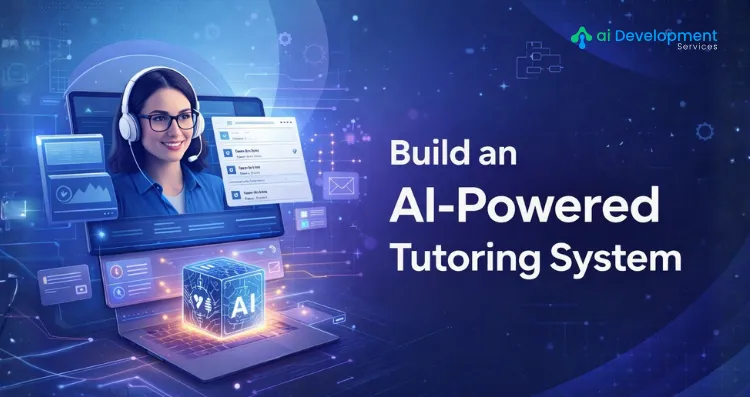
Education is no longer confined to classrooms, textbooks, or fixed schedules. Learners today expect experiences that adapt to them, ones that recognize where they struggle, adjust the pace in real time, and keep them engaged without a human tutor sitting beside them around the clock. That shift has created a genuine demand for AI-powered tutoring systems, and businesses, edtech startups, and institutions are racing to build them.
At AI Development Service, we've worked on intelligent tutoring platforms across K-12, higher education, professional upskilling, and language learning. In this guide, we walk you through exactly how we approach building one, from the features that matter to the tech stack, development process, and realistic cost expectations.
What Is an AI-Powered Tutoring System?
An AI tutoring system is a software platform that uses artificial intelligence to deliver personalized, interactive learning experiences. Unlike static eLearning apps or pre-recorded video courses, an AI tutor dynamically responds to each learner's inputs, performance history, and knowledge gaps.
The most sophisticated versions are known as AI-powered intelligent tutoring systems (ITS), a term borrowed from cognitive science and education research. These systems don't just present content; they model the learner's knowledge state, diagnose misconceptions, select the most appropriate next lesson or question, and provide immediate, context-aware feedback.
Think of it as the closest digital equivalent to a patient, knowledgeable human tutor available 24/7.
Why Build an AI Tutoring System Now?
The global AI in the education market is on a steep upward curve. Several converging factors make this the right moment to invest:
Personalization at scale has become the single biggest gap in traditional education. A classroom teacher managing 30 students cannot tailor instruction to each learner simultaneously. An AI system can.
Large language models (LLMs) like GPT-4 and Claude have dramatically lowered the barrier to building conversational, subject-aware tutoring interfaces. What once required years of NLP engineering can now be implemented through well-structured API integration.
Learner retention data consistently shows that adaptive, interactive experiences outperform passive consumption. Platforms that adjust to the user keep them coming back.
Remote and hybrid learning created a permanent behavioral shift. Learners are now comfortable and often prefer digital-first instruction.
For any edtech entrepreneur or organization evaluating this space, the window to build a differentiated product is open right now.
Have a Tutoring Platform Idea? Let's Make It Intelligent.
Core Features of an AI Intelligent Tutoring System
When we scope an AI intelligent tutoring system project at AI Development Service, we start by mapping out the feature set across three tiers: essential, enhanced, and advanced.
Essential features every platform needs:
- Adaptive learning engine: Adjusts content difficulty, sequencing, and pacing based on real-time performance data. This is the heart of the system.
- Natural language Q&A interface: Allows students to ask questions in plain language and receive accurate, contextual answers rather than keyword matches.
- Progress tracking and analytics dashboard: Gives learners visibility into their own progress and gives educators or administrators aggregate data.
- Content library management: Structured storage for lessons, exercises, quizzes, and multimedia content, organized by subject, topic, and difficulty level.
- Instant feedback engine: Evaluates student responses and returns specific, actionable feedback rather than just "correct" or "incorrect."
Enhanced features that improve engagement and outcomes:
- Gamification layer: Points, badges, streaks, and leaderboards that tap into intrinsic motivation without trivializing the learning objective.
- Spaced repetition system: Resurfaces topics at scientifically optimized intervals to reinforce long-term retention.
- Multi-modal content delivery: Supports text, video, diagrams, audio, and interactive simulations depending on how a particular concept is best learned.
- Voice interaction: Particularly valuable for language learning and accessibility use cases.
Advanced features for enterprise-grade platforms:
- Knowledge graph modeling: Maps the conceptual relationships between topics so the system understands prerequisites and can identify root causes of a learner's confusion.
- Emotion and engagement detection: Uses behavioral signals (response time, skip patterns, revisit frequency) to infer cognitive load or disengagement.
- Teacher/admin portal: Lets educators review AI-generated insights, override recommendations, and add custom content.
- Multilingual support: Expands reach and is especially critical for global deployments.
How We Build an AI Tutoring System: Our Step-by-Step Process
Here is the exact development methodology we follow at AI Development Service when a client engages us to build an AI tutor app:
Step 1: Discovery and Requirement Mapping
Before a single line of code is written, we spend time understanding the product's purpose. Who is the learner? What subjects or skills does the platform teach? What does success look like: test scores, skill certification, engagement hours? Is the audience school-age children, adult professionals, or enterprise employees?
This phase also includes a competitive audit, a feature prioritization exercise, and agreement on the MVP scope. Getting this right saves significant rework later.
Step 2: Learning Architecture Design
This is where the AI logic begins to take shape. We design the learner model, how the system will represent and update a student's knowledge state over time. We also define the pedagogical model: the rules and logic that govern when to introduce new material, when to revisit old content, when to offer hints, and when to escalate difficulty.
For platforms requiring deep subject expertise, we work with subject-matter experts at this stage to ensure the content structure and assessment logic reflect real-world teaching best practices.
Step 3: Tech Stack Selection
Our standard stack for an AI-powered tutoring system looks like this:
- Frontend: React.js (web) or React Native (mobile cross-platform)
- Backend: Node.js or Python (FastAPI/Django)
- AI/ML layer: OpenAI GPT-4 or Claude API for conversational tutoring; custom ML models (scikit-learn, TensorFlow) for adaptive difficulty and learner modeling
- Database: PostgreSQL for structured learner data; MongoDB for content; Redis for session management
- Infrastructure: AWS or GCP with auto-scaling to handle variable load
- Analytics: Mixpanel or a custom data warehouse for learning analytics
The choice between using a third-party LLM API versus fine-tuning an open-source model is one of the most consequential technical decisions. For most platforms, LLM API integration is faster, more cost-effective, and more capable. Fine-tuning makes sense when you have a proprietary content corpus or highly specialized domain requirements. We cover this decision in more depth in our guide on AI app development cost.
Step 4: Core AI Module Development
This is the most technically intensive phase. We build and integrate:
The adaptive engine: Logic that tracks performance per topic, updates difficulty parameters, and selects the next learning object from the content library. This often uses a combination of item response theory (IRT) models and machine learning classifiers trained on historical learner data.
The NLP tutoring layer: The conversational interface through which students interact. We engineer the prompts carefully so the LLM stays on-topic, explains at the right level, avoids giving answers directly when scaffolded hints are more pedagogically appropriate, and handles incorrect answers with empathy rather than binary correction.
The feedback engine: For open-ended responses, this goes beyond pattern matching. We use LLM-based evaluation to assess whether a student's answer demonstrates understanding, even when it doesn't match the expected exact phrasing.
Step 5: Content Integration and Knowledge Base Setup
The AI is only as good as the content it works with. We build a content management system (CMS) that allows the platform team to upload, tag, and structure lessons, questions, and multimedia assets. For platforms with existing content, we handle migration and reformatting. For new platforms, we work with the client's subject experts or open educational resources.
Step 6: Testing - Pedagogical and Technical
Testing an AI tutor is different from testing a standard software product. Beyond QA for bugs and edge cases, we conduct pedagogical testing: does the system actually teach effectively? Does the adaptive engine make sensible decisions? Is the feedback accurate? Does the conversation flow feel natural and supportive?
We run structured user testing sessions with representative learners and iterate on the AI behavior, prompt design, and UX based on findings.
Step 7: Launch, Monitoring, and Iteration
Post-launch, we instrument the platform to track not just technical metrics (uptime, latency, error rates) but learning metrics: completion rates, assessment scores over time, engagement depth, and topic-level performance distributions. These signals drive continuous improvement of both the product and the AI models underneath it.
Tech Stack for AI-Powered Tutoring System at a Glance
| Layer | Technology |
| Frontend (Web) | React.js |
| Frontend (Mobile) | React Native |
| Backend | Node.js / Python FastAPI |
| Conversational AI | OpenAI GPT-4 / Anthropic Claude |
| Adaptive ML Models | scikit-learn, TensorFlow |
| Primary Database | PostgreSQL |
| Content Store | MongoDB |
| Cache / Sessions | Redis |
| Cloud Infrastructure | AWS / GCP |
| Analytics | Custom + Mixpanel |
Trends in AI Tutor Development Worth Watching
Space is evolving fast. The trends in AI tutor development that we see shaping platform decisions right now:
Multimodal tutoring: Next-generation systems will accept image inputs (a student photographs their handwritten work) and video, not just text. This opens up subjects like mathematics, physics, and chemistry in a more natural way.
Emotionally intelligent tutors: Research into effective computing is making its way into production products. Systems that can infer frustration or boredom from behavioral patterns and respond with encouragement or a change of approach will see meaningfully higher retention.
AI-generated practice content: Generative AI development capabilities now make it feasible to generate unlimited, novel practice questions tailored to a learner's exact gap, removing the bottleneck of manually authored question banks.
Peer learning integration: AI orchestrating group study sessions, matching learners with complementary strengths, or facilitating collaborative problem-solving is an emerging frontier.
Offline-capable AI: Particularly important for markets with unreliable connectivity. Smaller, on-device models are making this increasingly viable.
How Much Does It Cost to Build an AI Tutoring App?
Cost is naturally one of the first questions clients bring to us. The honest answer is: it depends significantly on scope, but here is the framework we use.
| Platform Tier | What's Included | Estimated Cost Range |
| MVP / Prototype | Core adaptive quiz engine, basic NLP Q&A, progress dashboard, single subject | $10,000 – $20,000 |
| Standard Product | Full adaptive engine, conversational tutor, gamification, multi-subject, mobile + web | $20,000 – $30,000 |
| Enterprise Platform | Knowledge graph, emotion detection, teacher portal, multilingual, custom ML models | $30,000 – $40,000+ |
The biggest cost drivers are the sophistication of the adaptive engine, the degree of custom ML model development versus API integration, the number of platforms (web vs. mobile vs. both), and the volume and complexity of content to be integrated.
Challenges to Anticipate
Building an AI tutoring system is genuinely complex. These are the challenges we help clients navigate:
Data cold start: Adaptive systems need learner data to personalize effectively. New platforms start with no data. We address this with rule-based defaults that transition to data-driven personalization as usage grows.
Content quality dependency: A poorly structured content library will produce poor learning outcomes regardless of AI sophistication. Content strategy is not an afterthought; it is a core product decision.
Prompt reliability: LLMs can hallucinate, go off-topic, or produce explanations that are technically correct but pedagogically inappropriate. Robust prompt engineering, output validation, and fallback logic are essential.
Student data privacy: Platforms handling minor learner data are subject to regulations like COPPA (US), FERPA (US), GDPR (EU), and their equivalents. Compliance must be designed from the start, not bolted on later.
Measuring learning outcomes: Engagement metrics are easy. Actual learning improvement is harder to measure and requires thoughtful assessment design.
Why Work with a Specialized Tutor App Development Company
Choosing the right tutor app development company is one of the most consequential decisions in a project like this. General software agencies can build apps; building an effective AI tutoring system requires the intersection of AI engineering, educational design expertise, and product development experience.
At AI Development Service, we bring all three to every engagement. We've built adaptive AI systems across verticals from health and fitness to finance and we apply that cross-domain experience to education. Our team handles everything from initial discovery through post-launch optimization, so you have a single accountable partner throughout.
We also believe in transparency on timelines and costs. A well-scoped MVP can be delivered in 10–16 weeks. A full-featured platform typically takes 6–9 months. We're happy to walk through a detailed estimate based on your specific requirements.
Ready to Build Your AI-Powered Tutoring System?
FAQ
Q1. What is the difference between an AI tutoring system and a standard eLearning app?
A standard eLearning app delivers fixed content in a predetermined sequence to all users. An AI tutoring system continuously adapts, adjusting difficulty, pacing, and content selection based on each individual learner's performance and knowledge state. The AI tutor also provides dynamic, conversational feedback rather than static responses.
Q2. How long does it take to build an AI-powered tutoring system?
An MVP focused on a single subject with core adaptive features typically takes 10–16 weeks. A full-featured, multi-subject platform with a conversational tutor, gamification, and an educator portal generally takes 5–9 months, depending on the complexity of the AI models and the volume of content to integrate.
Q3. Can AI Development Service build a tutoring platform for a niche or specialized subject?
Yes. At AI Development Service, we've built AI-powered platforms across a range of specialized domains. We work with your subject-matter experts during the learning architecture phase to ensure the system's content structure, assessment logic, and feedback approach accurately reflect real-world teaching standards for your specific field.
Q4. Do I need to own my own AI model, or can the platform use existing APIs?
For most projects, integrating a third-party API (such as OpenAI or Anthropic) is the right choice; it's faster to build, lower cost to maintain, and the models are highly capable. Custom model fine-tuning is worth the investment when you have a large proprietary content corpus, strict data residency requirements, or a highly specialized domain where general models underperform.
Q5. What sets AI Development Service apart as a tutor app development company?
AI Development Service combines deep AI engineering capabilities with hands-on experience building adaptive, personalized applications. We don't just integrate APIs; we design the learning architecture, build the adaptive engine, handle content structuring, and stay with the product through post-launch iteration. If you're serious about building an AI-intelligent tutoring system that actually improves learning outcomes, we'd love to talk.