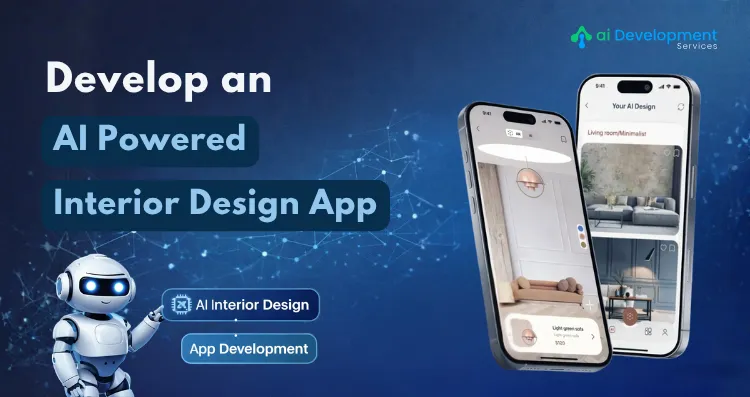
Interior design has always been a deeply personal, creative, and often expensive process. But today, artificial intelligence is rewriting those rules entirely. From uploading a photo of your living room and seeing it transformed in seconds, to receiving smart furniture recommendations based on your lifestyle, the AI-powered interior design app is one of the most exciting product categories in tech right now.
At AI Development Service, we have helped multiple clients bring their vision of an AI Interior Design App to life, from early-stage ideation all the way to a market-ready product. This guide walks you through exactly how we do it, covering the market opportunity, must-have features, the full development process, the tech stack, cost considerations, and timelines.
If you are a startup founder, a real estate company, a furniture brand, or an entrepreneur looking to build in this space, this guide is for you.
Why is the AI Interior Design Market Booming?
The global interior design market is valued at over $150 billion, and the AI-driven segment of it is growing faster than any other. Apps like Roomstyler have already proven a strong consumer appetite. But the next generation of AI-Powered Interior Design apps will go far beyond simple room visualization.
Users today want a tool that understands them, learns from their preferences, responds to their space's dimensions and lighting, and delivers professional-quality design suggestions instantly, without hiring a designer. The demand is real, and the window to build a category-defining product is wide open.
The market signal is also backed by data. AI-driven home improvement and design tools saw a 3x spike in downloads between 2022 and 2026, and that curve has only steepened. Whether you are building a standalone AI Interior Design Platform or embedding these capabilities into an existing real estate or e-commerce app, the opportunity is significant.
Core Features Your AI Interior Design App Must Have
Before a single line of code is written, we work with our clients to define what features will actually deliver user value versus what would simply be technical complexity for its own sake. Here is what we consistently identify as the essential feature set.
Room Scanning and 3D Visualization
Users need to be able to photograph or scan their existing space and have the app generate an accurate 3D model. This uses computer vision and depth-mapping technology to understand the room's dimensions, wall angles, window placements, and existing furniture. The output is a real-time, manipulable 3D view that the user can rearrange freely.
AI Style Profiling
Before serving design recommendations, the app should learn the user's aesthetic preferences. This is done through a short onboarding quiz, swipe-based preference selection (think Tinder for design styles), or analysis of images the user uploads or bookmarks. The AI builds a personalized style profile and uses it to filter every subsequent recommendation.
Generative Design Suggestions
This is where generative AI development shines in the interior design context. The app uses image-generation models to show the user what their room would look like with different color palettes, furniture arrangements, lighting setups, or decor styles, all rendered photorealistically. Users can explore dozens of variations in minutes.
Furniture and Product Integration
Great design suggestions are only useful if the user can actually buy what they see. Integrating with furniture brand APIs, e-commerce catalogs, and affiliate product databases allows the app to surface shoppable items that match the AI's design output. This also creates a strong monetization layer.
AR (Augmented Reality) Placement
Using the device camera, users should be able to place virtual furniture in their real room in real time. AR-powered placement builds confidence in purchase decisions and dramatically reduces returns for furniture retailers who embed this feature.
Mood Board Creation and Sharing
Users love to collect, curate, and share design ideas. A built-in mood board tool where they can save AI-generated looks, pin products, and export or share their boards increases engagement, session length, and virality.
AI Design Assistant (Chat Interface)
A conversational AI assistant lets users describe what they want in plain language. "Make this room feel warmer and more Scandinavian" or "I have two kids and two dogs, suggest a durable sofa" are the kinds of inputs the assistant can interpret and act on, adjusting recommendations accordingly.
The Development Process of AI Interior Design App
Building an AI Interior Design App is a multi-disciplinary project. At AI Development Service, we follow a structured, phase-by-phase approach that keeps development lean, the product testable at every stage, and the final output scalable.
Phase 1: Discovery and Product Definition
Every project we take on begins with a deep discovery session. We work with the client to understand their target user, their key differentiator in the market, their monetization strategy, and any domain-specific constraints (for example, if the app is for a specific furniture retailer or a real estate platform).
We map out user journeys, define the MVP feature set, and produce a detailed product requirements document. This phase typically takes two to three weeks and saves enormous time later by preventing scope creep and misaligned expectations.
Phase 2: UX and UI Design
Interior design is a visually-driven domain. The app's own design language has to communicate taste, trust, and quality. Our design team creates wireframes, interactive prototypes, and high-fidelity UI screens that reflect the sophistication users expect from a design-focused product.
We pay particular attention to the onboarding flow, since this is where user data for personalization is captured, and to the room visualization interface, since this is the app's core wow moment.
Phase 3: AI Model Selection and Integration
This is where the technical substance lives. The AI capabilities of an AI-Powered Interior Design app are not built from scratch in most cases. We integrate and fine-tune existing models:
For image generation and style transfer, we work with models like Stable Diffusion, DALL-E, or Midjourney's API, fine-tuned on interior design datasets to produce contextually accurate outputs.
For room understanding and object detection, we use computer vision models built on frameworks like TensorFlow or PyTorch, trained to identify furniture, dimensions, and spatial relationships from images.
For the conversational assistant, we integrate large language models with domain-specific prompting and retrieval-augmented generation so the assistant understands interior design terminology and can give contextually relevant responses.
For personalization and recommendation, we build collaborative filtering and content-based recommendation engines that learn from user behavior over time.
Phase 4: Backend and API Development
The backend is the engine that ties everything together. We build robust APIs that handle image uploads and processing, AI model inference calls, user profile management, product catalog queries, AR data serving, and third-party integrations with e-commerce platforms, payment gateways, and furniture brand APIs.
Our backend is built to scale from day one, using cloud-native architectures on AWS or Google Cloud with auto-scaling enabled, so the app can handle both early-stage traffic and growth-stage spikes without re-architecture.
Phase 5: Mobile App Development
We develop natively for iOS and Android, or use React Native or Flutter for cross-platform builds when the project timeline and budget call for it. The choice depends on the complexity of AR features (which tend to benefit from native development) and the client's go-to-market strategy.
The mobile app integrates all AI features through clean API calls, ensuring the on-device experience is fast, smooth, and battery-efficient. We also build for offline-first interactions where possible, so basic features remain accessible without a strong internet connection.
Phase 6: AR Feature Development
For augmented reality furniture placement, we use ARKit on iOS and ARCore on Android. These frameworks handle plane detection, light estimation, and object anchoring. Our team builds a seamless flow where a user can go from a product listing to a live AR preview of that product in their room within two or three taps.
Phase 7: Testing and Quality Assurance
An AI Interior Design App has many moving parts, and the quality bar for a design product is high. Our QA process covers functional testing of all features, AI output quality review (ensuring generated images are photorealistic and relevant), performance testing under load, UX testing with real users, and device compatibility testing across screen sizes and OS versions.
Phase 8: Launch and Post-Launch Optimization
We support clients through app store submission, launch, and the critical first 90 days of user data collection. Post-launch, the AI models are retrained and refined based on real user interactions, making the product demonstrably better over time. This is the compounding advantage of AI-powered products: they get smarter as they grow.
If you are curious about how we handle AI-powered mobile app development more broadly, our blog on artificial intelligence in mobile apps is a good resource for understanding the patterns we apply across projects.
Technology Stack Used by AI Development Service
The technology choices we make are driven by the specific requirements of each project, but for an AI Interior Design App, the stack typically looks like this:
Frontend (Mobile): React Native or Flutter for cross-platform, Swift for iOS-native, Kotlin for Android-native.
Backend: Node.js or Python (FastAPI or Django), hosted on AWS or Google Cloud.
AI and ML: PyTorch or TensorFlow for model training, Stable Diffusion or DALL-E for image generation, OpenAI or open-source LLMs for the chat assistant, Pinecone or Weaviate for vector search in the recommendation engine.
AR: ARKit (iOS), ARCore (Android).
Database: PostgreSQL for relational data, MongoDB for unstructured content, Redis for caching.
Storage: AWS S3 or Google Cloud Storage for user images and generated assets.
Monetization Models for AI Interior Design Platform
A strong AI Interior Design Platform can generate revenue through multiple channels simultaneously. We help clients think through monetization from the beginning so it is baked into the product architecture and UX flows, not bolted on later.
Freemium with Premium Subscriptions: Free users get limited AI generations per month. Premium subscribers get unlimited access, higher-resolution outputs, and exclusive style collections.
Affiliate Commerce: Every AI-generated design suggestion includes shoppable product links. The platform earns a commission on purchases made through these links.
Brand Partnerships: Furniture and decor brands pay for featured placement or sponsored style collections within the app.
White-Label Licensing: Real estate agencies, property developers, and furniture retailers license the AI interior design software to embed in their own platforms under their brand.
B2B API Access: Interior design studios and architecture firms pay for API access to power their own tools with your platform's AI capabilities.
Timeline And Cost of Building AI-Powered Interior Design App
Timeline and cost of building an AI interior design app vary depending on the feature scope, platform targets, and the depth of custom AI model training required. Based on our experience at AI Development Service, here is a realistic framework:
- A focused MVP with core room visualization, style profiling, AI design suggestions, and basic product catalog integration typically takes four to six months to build and launch.
- A full-featured platform, including AR placement, a conversational AI assistant, complete e-commerce integration, and a mood board feature typically takes eight to twelve months.
- In terms of investment, AI interior design apps are moderately complex products. The AI model integration, AR development, and backend infrastructure all add cost relative to a standard mobile app.
For clients who want to understand how AI development company selection works, our overview of top AI development companies covers the key criteria to evaluate any prospective development partner, from technical capability to post-launch support practices.
Challenges in Developing AI Interior Design App
Developing an AI-Powered Interior Design app comes with real technical and product challenges. Here are the ones we encounter most often and how we navigate them.
Image Quality and Consistency: AI-generated room renders need to look photorealistic and consistent across different input photos. We solve this through careful model fine-tuning of domain-specific datasets and by building pre-processing pipelines that normalize user-uploaded images before they are passed to the generation model.
AR Accuracy: Placing virtual furniture in a real room requires accurate plane detection and scale calibration. We invest heavily in this layer because it is where user trust is either built or broken. A sofa that floats above the floor or appears the wrong size will kill the feature's credibility instantly.
Personalization Cold Start: New users have no behavior history for the recommendation engine to learn from. We solve this with a well-designed onboarding questionnaire that seeds the preference profile from day one, so the very first set of suggestions already feels relevant.
Latency of AI Inference: Image generation can be slow if not optimized. We use queued inference jobs with progress indicators, model quantization to reduce compute requirements, and edge caching of popular style outputs to keep the experience feeling fast.
Final Thoughts
The AI Interior Design App space is genuinely exciting, and the products being built today will define how people interact with their living spaces for the next decade. Whether you are imagining a consumer app that democratizes professional design, a B2B tool for the real estate industry, or an AI interior design software layer for a furniture brand, the opportunity is substantial and the technology is mature enough to build with confidence.
At AI Development Service, we bring together AI engineering, mobile development, UX design, and product strategy under one roof. If you are ready to move from idea to product, we would love to be your development partner.
FREQUENTLY ASKED QUESTIONS
Q1. How long does it take to build an AI Interior Design App?
Ans. A focused MVP typically takes four to six months. A full-featured platform with AR, conversational AI, and e-commerce integration generally takes eight to twelve months, depending on scope and complexity.
Q2. Do I need a large dataset of interior design images to train the AI?
Ans. Not necessarily from scratch. AI Development Service integrates and fine-tunes pre-trained image generation models on curated interior design datasets, which significantly reduces the data and time required compared to training a model from zero.
Q3. What is the difference between an AI Interior Design App and traditional design software?
Ans. Traditional design software requires manual input and professional expertise. An AI-Powered Interior Design app uses machine learning to automate style suggestions, generate photorealistic renders, and personalize recommendations based on user preferences, making the experience accessible to anyone without design training.
Q4. Can AI Development Service build a white-label version of an interior design AI platform for my brand?
Ans. Yes, AI Development Service specializes in building white-label AI app solutions for furniture brands, real estate companies, and property developers who want to embed intelligent interior design capabilities into their own branded products.
Q5. How does AI Development Service ensure the quality of AI-generated design outputs?
Ans. We run multiple rounds of model fine-tuning, output quality review, and real-user testing during development. Post-launch, we implement feedback loops that allow the models to be continuously retrained on actual user interactions, making the output quality improve over time.