Key Takeaways:
- The global AI in fitness market is expected to grow from USD 10,227.1 million in 2026 to approximately USD 63,323.6 million by 2035.
- AI enables hyper-personalized fitness experiences that generic apps simply cannot match, driving higher user retention and engagement.
- Building an AI fitness app requires a combination of machine learning, natural language processing, computer vision, and robust data infrastructure.
- Development costs vary widely based on feature complexity, platform choice, and team structure budgeting realistically from the start is critical.
- Choosing the right development partner with demonstrated AI expertise can significantly shorten your time to market and reduce technical risk.
The fitness industry is undergoing a quiet revolution, and artificial intelligence is at the center of it. From apps that design personalized workout plans based on your biometric data to platforms that adjust training intensity in real time, AI-powered fitness applications are redefining what it means to get in shape. The global digital fitness market is growing at a remarkable pace, and investors and entrepreneurs are taking notice.
This guide walks you through everything you need to know to build a smart, scalable, AI-powered fitness app, from the core features and underlying technologies to development costs and the challenges you'll face along the way.
The Rise of AI in Fitness Applications
Not long ago, a "smart" fitness app meant one that counted your steps or let you log meals manually. That era is over. Today's AI-powered fitness platforms are sophisticated systems capable of analyzing movement patterns, predicting injury risk, adapting training loads in real time, and even detecting emotional states that might affect performance.
This evolution has been fueled by several converging forces. Consumer-grade wearables now generate enormous volumes of health data - heart rate variability, sleep quality, blood oxygen levels, stress indicators and AI is the only practical tool capable of making sense of it all in a personalized way. At the same time, advances in on-device machine learning have made it possible to run complex inference models directly on smartphones, removing the latency and privacy concerns associated with cloud-only processing.
The competitive landscape reflects this momentum. Apps like Freeletics, Vi Trainer, and Tempo have demonstrated that users will pay a premium for AI-driven coaching that feels genuinely responsive. For businesses entering this space now, the window to build differentiated products is still open, but it won't stay that way indefinitely.
Start Building Your AI Fitness App With Experts
Core Features of an AI-Powered Fitness App
Before writing a single line of code, you need a clear picture of what your app will actually do. The features you choose will determine the complexity of your AI stack, the kind of data you need to collect, and ultimately how much the product costs to build. Here are the capabilities that define a truly AI-powered fitness experience.
Personalized Workout Generation
This is the flagship feature for most AI fitness apps. Rather than offering a fixed library of programs, the app uses machine learning to generate workout plans tailored to the individual user. Inputs typically include fitness level, available equipment, stated goals, time availability, and historical performance data. The AI model learns over time which plans lead to better outcomes for each user and refines its recommendations accordingly.
Real-Time Form Analysis and Feedback
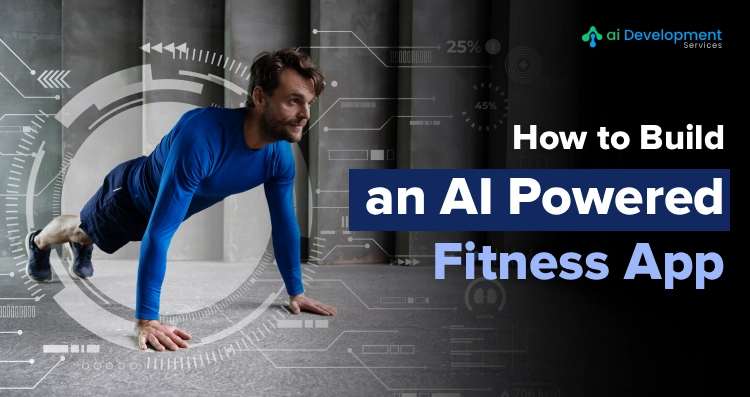
Using the smartphone camera and computer vision models, the app analyzes a user's movement during exercise and provides real-time feedback on form and technique. This feature is technically demanding but enormously valuable, poor form is the leading cause of gym injuries, and most people work out without a coach present. Pose estimation models like MediaPipe or custom-trained convolutional neural networks are commonly used here.
Adaptive Progress Tracking
A static goal set on day one rarely reflects reality on day thirty. An AI fitness app should continuously reassess a user's progress and adjust targets, intensity, and workout structure accordingly. If a user has been consistently overperforming their targets, the system should increase the challenge. If recovery metrics suggest fatigue or stress, it should dial things back. This kind of adaptive AI development is what separates a truly intelligent platform from one that merely calls itself smart.
Nutrition Guidance and Meal Planning
Many leading apps have expanded beyond exercise into nutrition. AI models can analyze dietary patterns, suggest macro targets based on training load, and even use image recognition to let users log meals by photographing their food. Integrating nutrition with fitness data creates a much more holistic view of the user's health journey.
Natural Language Coaching Interface
Conversational AI allows users to interact with their fitness coach the same way they'd text a friend. They can ask questions, report how they're feeling, explain schedule constraints, and receive adjusted recommendations, all through a chat interface. Large language models, particularly those available through APIs, have made this kind of interaction impressively natural and genuinely useful.
Wearable and Health Platform Integration
Your app doesn't exist in isolation. Users already have data on Apple Health, Google Fit, Garmin, Fitbit, Whoop, and similar platforms. Integrating with these ecosystems gives your AI models richer data to work with and reduces the friction of manual input. HealthKit and Google Health Connect are your primary integration points on iOS and Android respectively.
Step-by-Step Process for Building an AI Fitness App
Building an AI-powered fitness app is a multi-phase process that requires careful planning, the right technical architecture, and a clear understanding of your target user. Here's how a well-run development process typically unfolds.
Step 1: Define Your Niche and User Persona
The fitness market is crowded. Before building anything, you need to know exactly who you're building for. Are you targeting recreational gym-goers, serious athletes, post-rehabilitation patients, or busy professionals with 20 minutes a day? Your niche determines your feature set, your data model, and your monetization strategy. The more specific you are at this stage, the more cohesive your product will be.
Step 2: Map Out the Feature Set and Data Strategy
With your audience defined, build a prioritized feature list. Separate your must-haves (the features your app cannot launch without) from your nice-to-haves (capabilities you'll add post-launch). Equally important is your data strategy. Decide early what data you'll collect, how you'll store it, how you'll handle privacy and consent, and how you'll use it to train and improve your models over time.
Step 3: Choose Your Technology Stack
Your tech stack needs to support both the mobile application layer and the AI/ML infrastructure behind it. For mobile, React Native or Flutter are popular choices for cross-platform development. For your AI backend, Python is the dominant language, with TensorFlow, PyTorch, and scikit-learn covering most modeling needs. Cloud infrastructure from AWS, Google Cloud, or Azure will handle model training, storage, and serving.
Step 4: Build the Core Application
Development typically begins with the user-facing application- authentication, onboarding, profile setup, and core workout features before layering in AI capabilities. This approach allows you to test the product experience early and gather real user data that can be used to train and validate your models. Build with APIs from the start so that your AI services remain modular and replaceable as your models improve.
Step 5: Develop and Integrate AI Models
This is where the real technical work happens. Depending on your feature set, you may be training custom models, fine-tuning existing ones, or integrating pre-built AI services via API. For form analysis, you'll likely work with pre-trained pose estimation models and fine-tune them on fitness-specific movement data. For personalization, collaborative filtering and reinforcement learning approaches have shown strong results. For conversational coaching, integrating a large language model via API combined with a well-designed prompt architecture is typically faster than building from scratch.
Step 6: Test, Iterate, and Launch
AI systems require more rigorous testing than conventional software because their outputs are probabilistic rather than deterministic. Build robust evaluation pipelines for your models and test extensively with real users before launch. Pay close attention to edge cases, unusual body types, uncommon exercises, atypical usage patterns, because these are exactly where AI models tend to break down. After launch, treat model improvement as an ongoing process, not a one-time effort.
AI Technologies Used in Building Fitness Apps
Understanding the specific technologies involved helps you make informed architectural decisions and evaluate the capabilities of potential development partners.
Machine learning is the foundational layer. Supervised learning models trained on labeled fitness data handle personalization and recommendation. Reinforcement learning is increasingly used for adaptive planning, where the model learns from the outcomes of the plans it recommends. Unsupervised learning helps identify patterns in user behavior that might not be obvious from labeled data alone.
Computer vision powers form analysis and gesture recognition. Convolutional neural networks (CNNs) are the standard architecture for image-based movement analysis, while models like MoveNet and BlazePose offer lightweight real-time pose estimation suitable for mobile deployment.
Natural language processing enables the conversational coaching interfaces and voice command features that increasingly define premium fitness apps. The emergence of generative AI development has dramatically lowered the barrier to building sophisticated coaching interactions. Developers can now integrate powerful LLM APIs and build context-aware fitness chatbots in a fraction of the time it would have taken even two years ago.
Predictive analytics models synthesize data across workouts, recovery, nutrition, and biometrics to forecast outcomes and flag risks such as overtraining, injury likelihood, or motivational decline before they become problems.
Data, Personalization, and User Experience
AI is only as good as the data it learns from, and in fitness applications, data quality is both a technical and an ethical challenge. Users need to feel comfortable sharing sensitive health information, which means your data practices need to be transparent, secure, and compliant with applicable regulations. HIPAA in the United States, GDPR in Europe, and equivalent frameworks elsewhere.
Personalization is the payoff of getting data right. When a user opens your app and finds a workout that accounts for the fact that they slept poorly last night, completed an intense session two days ago, and had only 30 minutes available this morning, that's when AI stops being a buzzword and becomes a genuine product differentiator. Achieving that level of personalization requires not just good models but thoughtful UX design that makes the experience feel intuitive rather than surveillance-like.
The onboarding experience deserves particular attention. Users who understand why the app is asking for data, and who see immediate personalization as a result of providing it, are significantly more likely to continue sharing data over time. Design your onboarding to demonstrate value quickly, ideally within the first session.
Cost to Build an AI Fitness App
The mobile app development cost of an AI fitness product varies considerably based on scope, platform, and team composition. A basic MVP with limited AI features built by an offshore team might come in between $40,000 and $80,000. A more comprehensive product with custom computer vision, adaptive planning, and a conversational coaching interface built by an experienced team in North America or Western Europe will typically run between $150,000 and $400,000 or more.
The main cost drivers are the complexity of your AI models (custom-trained models cost significantly more than API integrations), platform coverage (native iOS and Android double front-end development effort compared to a cross-platform approach), the level of third-party integrations required, and the ongoing cost of cloud infrastructure for model training and serving.
It's also worth factoring in post-launch costs. AI models require continuous retraining as new data accumulates, and performance monitoring for ML systems is more demanding than for conventional software. Budget for this ongoing investment from the start rather than treating it as an afterthought.
Challenges in Developing AI Fitness Apps
Building AI into a fitness product isn't without its complications, and going in with a clear-eyed view of the challenges will help you navigate them more effectively.
Data scarcity at launch is one of the most common early obstacles. Your personalization models need data to work well, but new users have no data history. Solving the cold start problem delivers a good experience to first-time users before you know much about them typically requires a combination of smart onboarding questionnaires, population-level defaults, and rapid early learning from initial sessions.
Model accuracy and safety are particularly important in fitness contexts because the recommendations your app makes have direct physical consequences. A workout plan that's too aggressive can cause injury. Nutrition advice that's poorly calibrated can have health implications. Your models need to be validated not just for prediction accuracy but for the real-world impact of their outputs.
User trust and engagement present another layer of complexity. Many users are skeptical of AI-generated advice, particularly when it contradicts what they've been told by human coaches. Designing your product to explain its recommendations and why the AI is suggesting a lighter session today, for example, builds the transparency that turns skeptics into believers.
Future Trends in AI Fitness Technology
The trajectory of AI in fitness points toward increasingly integrated, predictive, and proactive systems. Several developments are worth watching closely as you plan your product roadmap.
Emotion-aware fitness coaching is emerging as a serious capability. Combining biometric data with natural language inputs, future systems will recognize when a user is stressed, fatigued, or demotivated and adapt not just the workout but the entire coaching tone and approach accordingly.
Augmented reality is beginning to intersect with AI fitness, enabling real-time overlays that guide users through movements with visual cues superimposed on their environment. As AR hardware matures, particularly with the arrival of lightweight smart glasses, this capability will move from novelty to mainstream.
Longitudinal health intelligence represents perhaps the most significant long-term opportunity. As fitness apps accumulate years of detailed health and activity data, they become capable of identifying patterns that predict health events far in advance, flagging early signs of cardiovascular risk, metabolic decline, or injury vulnerability months before they become clinical problems. The apps that earn user trust and data access today are building the foundation for that capability tomorrow.
Choosing the Right AI Development Partner
The quality of your AI development partner has an outsized impact on the outcome of an AI fitness project. AI development is a specialized discipline that requires expertise not just in mobile development but in machine learning engineering, data science, and the specific compliance requirements of health tech.
When evaluating partners, look for demonstrated experience with production AI systems, not just prototypes, and ask specifically about their approach to model evaluation, data privacy architecture, and post-launch model maintenance. Teams that have shipped AI products to regulated industries tend to bring a rigor to the process that generalist shops often lack. Platforms like AI Development Service offer specialized AI implementation support that can be particularly valuable for startups navigating this complexity for the first time.
Ready to Launch the Next Big AI Fitness App?
Frequently Asked Questions
Q1. What makes a fitness app "AI-powered" rather than just a regular fitness app?
Ans. A truly AI-powered fitness app uses machine learning models to personalize the user experience based on individual data rather than serving static, one-size-fits-all content. This includes adaptive workout planning, real-time form feedback, predictive analytics, and intelligent coaching that improves as it learns more about the user.
Q2. How long does it typically take to build an AI fitness app?
Ans. A focused MVP with core AI personalization features typically takes between four and nine months to develop, depending on team size, technical complexity, and the depth of AI integration. More comprehensive products with custom computer vision or advanced predictive modeling can take twelve to eighteen months from initial scoping to launch.
Q3. What does it cost to build an AI fitness app?
Ans. Costs range from roughly $40,000 for a basic MVP with limited AI features built by an offshore team, to $400,000 or more for a full-featured product with custom AI models, multi-platform support, and extensive third-party integrations. Ongoing costs for cloud infrastructure, model retraining, and maintenance typically add 15–25% of the initial build cost annually.
Q4. What AI technologies are most commonly used in fitness apps?
Ans. The most commonly used technologies include machine learning frameworks like TensorFlow and PyTorch for personalization and prediction models, computer vision libraries such as MediaPipe and MoveNet for movement analysis, large language model APIs for conversational coaching features, and cloud ML platforms from AWS, Google, or Azure for model training and serving.
Q5. How do AI fitness apps handle user data privacy?
Ans. Responsible AI fitness apps handle data privacy through a combination of technical and legal safeguards. On the technical side, this typically includes end-to-end encryption, on-device processing where possible to minimize data transmission, and strict access controls on stored health data. On the legal side, compliance with HIPAA (for US-based health data), GDPR (for EU users), and equivalent regional regulations is essential.