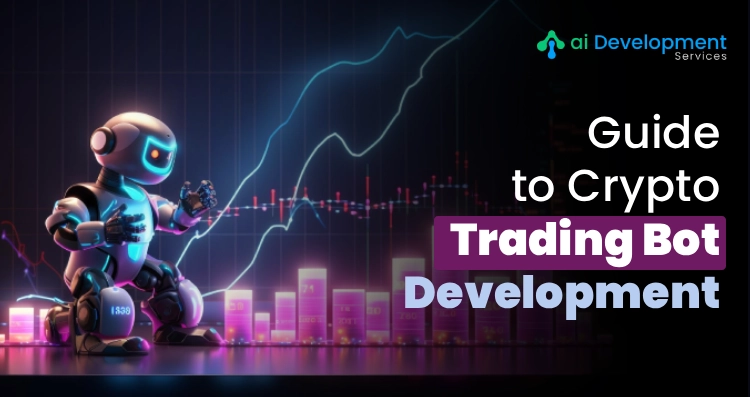
Cryptocurrency markets don't take breaks, and neither should your trading strategy. While traditional traders sleep, crypto trading bots work continuously, capturing opportunities in real-time. The numbers tell the story: Market Research Intellect values the AI Crypto Trading Bot Market at USD 1.5 billion in 2024, with projections to hit USD 5.42 billion by 2032—a 22.3% annual growth rate.
Whether you're a developer or trader seeking automation, this guide covers everything you need to know about crypto trading bot development.
What is a Crypto Trading Bot?
A crypto trading bot is software that automatically executes trades on cryptocurrency exchanges based on predefined strategies. These bots analyze market data, identify opportunities, and execute trades without human intervention, operating 24/7 to remove emotional decision-making.
The primary types include Arbitrage Bots that exploit price differences across exchanges, Market-Making Bots that provide liquidity and profit from bid-ask spreads, Trend-Following Bots using technical indicators to ride market momentum, and Grid Trading Bots that place multiple orders at intervals to profit from volatility.
Why Build Your Own Crypto Trading Bot?
The convenience of off-the-shelf bots is attractive, but there are benefits to developing your own. You will have complete control over your trading system and be able to implement your own strategies that will give you a competitive advantage. The cost of commercial bots is high, as you will have to pay every month, whereas you will only have to pay for development and hosting charges for your own bot.
Custom bots protect your proprietary strategies. When you use popular commercial bots, you share similar strategies with thousands of other traders, potentially reducing their effectiveness. Your custom bot keeps your approach confidential.
Security improves with customs development. You control where your API keys are stored and how your bot handles sensitive data. This eliminates the risk of trusting third-party platforms with access to your exchange accounts. For businesses exploring stock trading app development, the same principles of customization and security apply across financial technology solutions.
Start Automated Trading with a Custom-Built Bot
Essential Technology Stack for Crypto Trading Bot Development
Python leads the way in crypto bot development because of the rich set of libraries and ease of use. The library offers a unified API to more than 100 exchanges, while TA-Lib provides technical analysis capabilities. Pandas and NumPy libraries are used for efficient data manipulation.
JavaScript with Node.js works well for web-focused developers. For high-frequency trading, C++ or Go provide the necessary speed. Cloud platforms like AWS or Google Cloud offer scalability. PostgreSQL handles relational data, while Redis provides fast caching for real-time data.When considering the cost of developing AI trading solutions, the technology stack significantly impacts both development time and operational expenses.
Core Components of a Crypto Trading Bot
A well-architected trading bot consists of several modules. The exchange API integration layer connects to exchanges, handling authentication and rate limits. The data collection module gathers real-time prices and historical information for analysis.
The trading strategy engine processes market data through technical indicators, generating signals based on predetermined rules. The risk management system enforces position sizing, stop-losses, and take-profit orders to protect capital.
The execution module translates signals into actual orders, managing order types and tracking status. Logging and monitoring systems record all activities for debugging and performance analysis.
Step-by-Step Development Process - Crypto Trading Bot Development
Step One: Strategy Definition
Start with a trading plan. Do you want to trade trends, ranges, or arbitrage? Specify entry criteria. For instance, "enter long when the 50-day moving average crosses above the 200-day moving average." Specify exit rules and position sizing rules. Get all this down before you start coding.
Step Two: Build and Backtest
Implement your strategy in code, starting with the simplest version. Connect to historical data and simulate your strategy's performance over past market conditions. Backtesting reveals how your strategy would have performed, helping you identify weaknesses before risking real money.
Avoid the trap of overfitting. When you optimize parameters until your backtest shows perfect results, you've likely created a strategy that works only on historical data. Test across different time periods and market conditions. If your strategy only works in bull markets, it will fail when conditions change.
Step Three: Security Implementation
Security cannot be an afterthought. Store API keys in environment variables, never in your code. Encrypt sensitive data at rest and in transit. Enable two-factor authentication on your exchange accounts. Whitelist your server's IP address on the exchange, preventing unauthorized access even if API keys are compromised.
Implement withdrawal address approving on exchanges. Even if an attacker gains access to your bot, they cannot withdraw funds to unauthorized addresses. Regular security audits catch vulnerabilities before they're exploited.
Step Four: Paper Trading
Before deploying real capital, run your bot in simulation mode. Many exchanges offer testnet environments that mirror real markets without financial risk. Paper trading reveals bugs, timing issues, and unexpected edge cases. Monitor your bot continuously during this phase, fixing issues as they arise.
Track the same metrics you'll use in live trading: total returns, win rate, average profit per trade, maximum drawdown, and Sharpe ratio. If paper trading results don't meet your expectations, return to strategy refinement.
Step Five: Live Deployment
Begin with a small amount of capital that you can afford to lose. This is the real-money testing phase, and it will show you the psychological and practical differences between simulation and real-money trading. Your bot may trade differently in a real market environment where slippage and exchange latency are factors. Keep a close eye on its performance for the first few weeks. Create alerts for any unusual activity. Slowly increase your capital allocation as your confidence in your bot grows. Never risk your entire trading capital at once.
Integrating AI and Machine Learning
Artificial intelligence transforms bots from rule-based systems into adaptive learning machines. Machine learning development enables predictive analytics that forecast price movements based on historical patterns.
Sentiment analysis processes news and social media to gauge market mood. Natural language processing identifies bullish or bearish sentiment, providing additional signals. Neural networks
Reinforcement learning is the trading AI frontier. Such learning agents discover optimal strategies by trial and error, with rewards for profits and penalties for losses. Adaptive AI development is the process of building bots that adapt to markets over time, changing risk parameters according to market volatility.
Common Challenges and Solutions faced while Crypto Trading Bot Development
- Market volatility is both an opportunity and a risk. Crypto markets are known to have sudden and dramatic price movements that can activate multiple stop-losses consecutively. Use dynamic risk management that changes position sizes according to the prevailing volatility. When markets turn chaotic, your bot needs to trade smaller positions or halt trading altogether.
- Exchanges undergo maintenance, experience outages, or temporarily disable API access during extreme market conditions. Build redundancy by integrating multiple exchanges. If your primary exchange goes down, your bot should automatically switch to a backup.
- Slippage occurs when your order executes at a different price than expected. In fast-moving markets, the price can shift significantly between signal generation and order execution. Use limit orders instead of market orders when possible, and account for expected slippage in your profit calculations.
- If your bot is running on a home computer on the other side of the world from the exchange servers, latency will be a disadvantage. For strategies that are latency-sensitive, locate your bot in the same region as the exchange or use the cloud services of the exchange.
- Profitable strategies attract copycats, reducing their effectiveness over time. Market conditions evolve, rendering previously successful approaches obsolete. Continuously monitor performance metrics and be prepared to update your strategies. What worked last year might not work today.
Why Choose AI Development Service for Crypto Trading Bot Development?
Building sophisticated crypto trading bots requires expertise beyond coding—it demands deep knowledge of financial markets, security, and scalable architecture. AI Development Service delivers proven custom trading solutions across cryptocurrency and traditional markets. We understand crypto's unique challenges: extreme volatility, 24/7 operations, and rapidly evolving APIs. Our experience produces robust bots that perform reliably under real conditions.
Security-First Approach: Industry-leading API key management, encryption, and access control protect your capital and strategies through multi-layered security.
AI-Powered Solutions: Our machine learning models adapt to market changes, while sentiment analysis from multiple sources provides edges static bots can't match.
Custom Development: We build your exact strategy—not generic solutions. From strategy design through backtesting, deployment, and optimization, we provide complete support with proper monitoring, alerting, and cloud-based infrastructure.
Ready to Build Your Custom Crypto Trading Bot?
Conclusion
Crypto trading bot development is an intersection of financial markets, software development, and AI. Creating a trading bot yourself provides you with control, security, and an edge over others through your own strategies. It requires proper planning, testing, and optimization. Every decision, from the technology to use to the integration of AI, impacts your trading bot.
Ready to build a custom crypto trading bot? Contact AI Development Service today to turn your trading vision into reality.
Frequently Asked Questions
Q1. How much does it cost to develop a custom crypto trading bot?
Ans. Development costs vary based on complexity and features. A basic bot with simple strategies might cost between $5,000 and $15,000, while sophisticated AI-powered bots with advanced features can range from $25,000 to $100,000 or more. The cost includes strategy design, development, testing, and initial deployment. Consider ongoing hosting and maintenance costs as well.
Q2. How long does it take to develop a trading bot?
Ans. The timeline depends on complexity. A simple rule-based bot might take 4-6 weeks from concept to deployment. More sophisticated bots with machine learning capabilities typically require 3-6 months. This includes strategy development, coding, extensive backtesting, paper trading, and refinement based on results.
Q3. Can I use my trading bot on multiple exchanges?
Ans. Yes, well-designed bots support multiple exchanges through standardized libraries like ccxt. This provides diversification and enables arbitrage strategies. However, each exchange has unique API quirks and requirements, so thorough testing across all intended platforms is essential.
Q4. What programming language is best for trading bot development?
Ans. Python leads most applications due to its extensive libraries, readability, and rapid development. JavaScript works well for developers familiar with web technologies. For high-frequency trading requiring maximum speed, C++ or Go are better choices. The best language depends on your specific requirements and existing expertise.
Q5. Do I need to keep my computer running for the bot to work?
Ans. No, trading bots should be hosted on cloud servers that run around the clock. There are services such as AWS, Google Cloud, or DigitalOcean that offer hosting. Hosting on the cloud ensures that your bot is trading even when your personal computer is turned off.
Related Posts:
1. How to Build an AI Blockchain App in 20262. How to Create a Stock Trading App
3. Top 7 AI Trading Software Development Companies in the USA 2026