Get a Free Quote

How to Develop a Fintech App: Complete Guide 2026

Table of contents

By AI Development Service

February 16, 2026

How to Develop a Fintech App: Complete Guide 2026

Key Takeaways:

  • Fintech app development must balance seamless user experience with strong security measures like end-to-end encryption, biometric authentication, and compliance with PCI DSS and GDPR.
  • The process usually takes 4–9 months, covering 10 key stages from market research and MVP planning to regulatory approval and ongoing maintenance.
  • Modern fintech apps use advanced technologies such as adaptive AI for personalized insights, blockchain for secure transactions, and cloud infrastructure for scalability.
  • Regulatory compliance is mandatory, requiring adherence to banking laws, data protection regulations, and region-specific industry standards.
  • The global fintech market is expected to reach $324 billion by 2026, growing at a 23.58% CAGR due to rising smartphone use and demand for digital financial services.

The financial services landscape has undergone a seismic shift. Traditional banking institutions that once dominated the industry now compete with nimble fintech startups offering superior user experiences, instant transactions, and personalized financial management.

If you're an entrepreneur with a vision to disrupt financial services or an established institution seeking digital transformation, understanding how to develop a fintech app is essential. This guide walks you through the entire development journey, from initial concept validation to post-launch optimization, equipping you with the knowledge to build a fintech application that users trust with their money.

What is Fintech App Development?

Fintech app development encompasses the creation of software applications that deliver financial services through digital platforms, primarily mobile devices. These applications leverage technology to make financial services more accessible, efficient, and user-friendly than traditional banking methods. The goal isn't simply digitizing existing processes but reimagining how people interact with their money.

Modern fintech development increasingly incorporates cutting-edge technologies. Adaptive AI enables applications to learn from user behavior and deliver increasingly personalized financial recommendations, fraud detection, and spending predictions. AI financial app development powers intelligent chatbots that answer customer queries, robo-advisors that manage investment portfolios, and credit-scoring algorithms that assess risk more accurately than traditional methods.

Key Features of a Successful Fintech App

Building a fintech app that users love and trust requires implementing features that balance convenience with security. Here's what separates exceptional fintech applications from mediocre ones.

Core Features Every Fintech App Needs

User Registration and KYC Verification form the foundation of any fintech application. Your onboarding process must collect necessary user information while complying with Know Your Customer regulations. Implement multi-step verification, including email and phone confirmation, government-issued ID verification through document scanning, facial recognition for identity matching, and address verification.

Secure Payment Gateway Integration enables the actual financial transactions that define your app's purpose. Whether processing credit card payments, bank transfers, or cryptocurrency transactions, your payment infrastructure must be rock-solid. Integration with established payment processors like Stripe, PayPal, Plaid, or Dwolla provides the secure foundation while you focus on user experience.

Transaction History and Analytics give users visibility into their financial activity. Display comprehensive transaction records with search and filtering capabilities, visual spending analytics through charts and graphs, categorized expense tracking, downloadable statements, and year-over-year comparison views.

Multi-Currency Support has become essential in our globalized economy. If your target market includes international users or travelers, support multiple currencies with real-time exchange rates, transparent conversion fees, currency switching without additional accounts, and historical exchange rate data.

Advanced Features That Create Competitive Advantage

AI-Powered Financial Insights transform raw transaction data into actionable intelligence. Machine-learning algorithms can identify spending patterns and suggest optimizations, predict upcoming expenses based on historical data, detect subscription services users may have forgotten, recommend personalized savings goals, and flag potentially fraudulent transactions before they complete.

Biometric Authentication provides security that's both stronger and more convenient than passwords. Implement fingerprint scanning for quick access, facial recognition as an alternative biometric option, and voice recognition for phone-based authentication. These technologies reduce friction while increasing security—a rare combination in fintech.

Intelligent Chatbot Support, powered by natural language processing, handles customer inquiries 24/7 without human intervention. A well-designed chatbot answers common questions about account features, guides users through transactions, provides balance and transaction information, escalates complex issues to human agents, and learns from interactions to improve responses over time.

Budgeting and Goal-Setting Tools help users take control of their financial future. It provides customizable budget categories with spending limits, visual progress tracking toward savings goals, automated savings features that round up purchases, debt payoff calculators and strategies, and financial health scores that motivate improvement.

Virtual Card Management gives users complete control over their payment methods. Enables instant virtual card generation for online shopping, temporary card numbers for untrusted merchants, spending limits and merchant restrictions on specific cards, and the ability to freeze or delete cards instantly when security concerns arise.

Turn Your Fintech Vision Into Reality

Fintech App Development Process: Step-by-Step

Successful fintech applications don't happen by accident—they're the result of methodical planning and execution. Here's the proven process that fintech app development companies follow to deliver secure, scalable, and user-friendly financial applications.

Step 1: Market Research and Idea Validation

Before writing a single line of code, validate that your fintech concept solves a real problem people will pay to solve. Identify your target audience's specific pain points with current financial services, analyze competitor offerings to find gaps and opportunities, assess the regulatory landscape in your target markets, and determine your unique value proposition.

Step 2: Define Core Functionality and MVP

Resist the temptation to build every conceivable feature immediately. Instead, define your Minimum Viable Product—the simplest version that delivers core value. Prioritize essential features that directly address your primary use case, create detailed user personas representing your target customers, map user journeys for critical workflows, and document functional requirements with clear acceptance criteria.

Step 3: Choose the Right Technology Stack

Your technology choices impact everything from development speed to long-term scalability. For frontend development, React Native and Flutter enable cross-platform apps with native performance from a single codebase, while Swift (iOS) and Kotlin (Android) provide optimal performance for platform-specific development. For backend infrastructure, Node.js offers excellent performance for real-time applications, Python provides robust libraries for data processing and AI integration, and Java delivers enterprise-grade reliability for complex systems.

Step 4: Design User Experience and Interface

In fintech, user experience directly impacts trust and adoption. Design intuitive navigation that requires a minimal learning curve, embrace minimalist design principles that reduce cognitive load, ensure accessibility for users with disabilities, and create consistent brand identity across all touchpoints. Use familiar financial metaphors and icons, provide clear explanations for complex processes, and design for one-handed mobile use since most interactions happen on smartphones.

Step 5: Development and Integration

Adopt an Agile development methodology with 2-3 week sprints that deliver incremental progress. Build your backend infrastructure with robust API architecture, integrate payment gateways and banking APIs with thorough testing, implement third-party services for SMS verification, email, and analytics, and establish continuous integration/continuous deployment pipelines for reliable updates.

Maintain close collaboration between frontend and backend teams to ensure seamless integration. Document your APIs comprehensively for future maintenance and potential third-party integrations.

Step 6: Security Implementation

Security isn't a feature you add later—it's foundational to fintech development. Implement end-to-end encryption for data in transit and at rest, multi-factor authentication requiring at least two verification methods, fraud detection systems using machine learning to identify suspicious patterns, and regular security audits by independent experts. Follow OWASP guidelines for secure coding, implement rate limiting to prevent brute force attacks, and maintain detailed audit logs of all system access and transactions.

Step 7: Testing and Quality Assurance

Comprehensive testing prevents catastrophic failures after launch. Conduct functional testing to verify every feature works as specified, security penetration testing by ethical hackers attempting to breach your system, performance and load testing simulating thousands of concurrent users, compatibility testing across devices, operating systems, and screen sizes, and user acceptance testing with real users providing feedback before public launch.

Financial applications demand near-perfect reliability—even small bugs can result in financial losses and destroy trust. Budget adequate time for thorough testing.

Step 8: Compliance and Regulatory Approval

Navigating financial regulations is complex but non-negotiable. Achieve PCI DSS compliance for processing payment card information, implement GDPR or equivalent data protection measures for user privacy, comply with region-specific regulations like the US Bank Secrecy Act or EU's PSD2 directive, and establish partnerships with licensed banking institutions if providing banking services without your own license.

Consider hiring regulatory consultants who specialize in fintech compliance—their expertise prevents costly mistakes and delays.

Step 9: Launch and Deployment

Plan your launch strategy carefully. Decide between soft launch to limited users for final real-world testing versus full public launch with marketing support. Submit your app to iOS App Store and Google Play Store, allowing several days for review. Prepare customer support infrastructure to handle launch-day inquiries. Implement analytics to track user behavior, feature adoption, and technical performance from day one.

Create comprehensive marketing materials explaining your value proposition, and consider launch promotions to incentivize early adoption.

Step 10: Post-Launch Maintenance and Updates

Launch is the beginning, not the end. Monitor performance metrics including app crashes, response times, and error rates. Collect and analyze user feedback through in-app surveys, app store reviews, and support tickets. Release regular updates with bug fixes, security patches, and minor improvements. Plan major feature releases based on user requests and market opportunities. Maintain infrastructure with scaling resources as your user base grows.

Budget 15-20% of initial development costs annually for ongoing maintenance and updates.

Essential Technologies for Fintech App Development

Modern fintech applications leverage a sophisticated technology stack that balances performance, security, and user experience.

Programming languages form the foundation—Swift for native iOS development, Kotlin for native Android apps, JavaScript/TypeScript for cross-platform solutions, Python for backend services and AI integration, and Solidity for blockchain-based financial applications.

Development frameworks accelerate development—React Native and Flutter enable beautiful cross-platform apps, Node.js powers real-time backend services, Django provides secure Python web frameworks, and Spring Boot delivers enterprise Java applications.

Payment processing APIs handle financial transactions—Stripe offers developer-friendly payment processing, Plaid connects to thousands of banks for account verification and transactions, Square provides point-of-sale and payment solutions, and PayPal enables digital wallet transactions globally.

Cloud infrastructure provides scalability—AWS offers comprehensive cloud services with financial-grade security, Google Cloud Platform excels in data analytics and AI capabilities, and Microsoft Azure integrates seamlessly with enterprise systems.

Security protocols protect sensitive data—SSL/TLS encryption secures data transmission, tokenization replaces sensitive data with non-sensitive equivalents, OAuth 2.0 provides secure authorization, and AES-256 encrypts stored data.

AI and machine learning enhance capabilities—TensorFlow and PyTorch power fraud detection models, natural language processing enables chatbot interactions, and predictive analytics forecast spending patterns and financial risks.

Security Best Practices for Fintech Apps

Security breaches in financial applications don't just damage reputation—they destroy businesses overnight. Implement these non-negotiable security practices.

Data encryption must be comprehensive. Encrypt all data in transit using TLS 1.3 or higher, encrypt data at rest using the AES-256 standard, implement end-to-end encryption for sensitive communications, and never store unencrypted sensitive data even temporarily.

Authentication methods should be multi-layered. Require strong password policies with complexity requirements, implement two-factor authentication as standard, offer biometric authentication for convenience, and use device fingerprinting to detect unusual access patterns.

Regular security audits identify vulnerabilities before attackers do. Conduct quarterly penetration testing by certified ethical hackers, perform code reviews focused on security, maintain updated dependency scanning for vulnerable libraries, and implement bug bounty programs rewarding security researchers.

Compliance with financial regulations is protected legally. Maintain PCI DSS compliance for card data handling, implement GDPR-compliant data processing and storage, follow regional banking regulations for financial services, and document all compliance measures thoroughly.

Fraud detection and prevention stops attacks in real-time. Use machine learning to identify unusual transaction patterns, implement velocity checks limiting transaction frequency, require additional verification for high-value transactions, and provide users with instant transaction alerts.

Secure APIs and integrations prevent third-party vulnerabilities. Use API keys with limited permissions, implement rate limiting to prevent abuse, validate all inputs to prevent injection attacks, and regularly audit third-party integrations for security updates.

Data backup and disaster recovery ensure business continuity. Maintain automated daily backups of all critical data, store backups in geographically distributed locations, test disaster recovery procedures quarterly, and implement redundant systems for critical services.

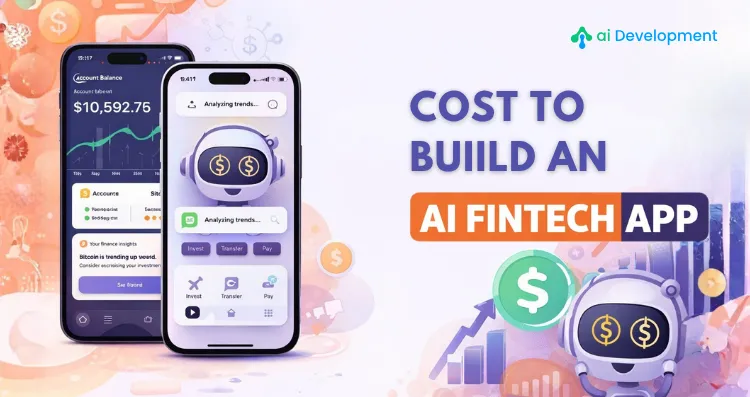
Cost to Develop a Fintech App

Understanding fintech app development costs helps you budget realistically and make informed decisions about features and functionality. Here's what you can expect to invest:

Simple Fintech App ($30,000 - $60,000): Basic payment or money transfer functionality, single platform (iOS or Android), standard UI design, essential security features, 3-4 months development time. Suitable for MVPs and straightforward use cases.

Medium Complexity App ($60,000 - $120,000): Multiple feature sets like payments plus budgeting, both iOS and Android platforms, custom UI/UX design, advanced security implementation, AI-powered features, 5-7 months' development time. Appropriate for most startup fintech applications.

Complex Enterprise Solution ($120,000 - $300,000+): Comprehensive feature suite, full banking functionality, custom backend infrastructure, blockchain integration, advanced AI and analytics, 8-12+ months' development time. Necessary for full-service digital banking or investment platforms.

Ongoing costs continue after launch. Plans for maintenance consume 15-20% of the initial development costs annually, cloud hosting scaling with users from $500-5,000+ monthly, payment gateway fees are typically 2-3% of transaction volume plus per-transaction fees, and compliance costs including audits, certifications, and legal reviews ranging from $10,000-50,000 annually.

Common Challenges in Fintech App Development

Even experienced app development teams face significant challenges when building fintech applications. Anticipating these obstacles helps you navigate them successfully.

Regulatory compliance complexity overwhelms many fintech startups. Financial services face stricter regulations than almost any other industry, with requirements varying dramatically by country and region. The rules constantly evolve as regulators respond to new technologies.

Security vulnerabilities represent existential threats. Financial apps are prime targets for sophisticated attackers, with new attack vectors emerging constantly. A single breach can destroy user trust irreparably.

User trust and adoption prove difficult to establish. Users entrust fintech apps with their money—the highest-stakes trust relationship in consumer technology. Competing against established banks with decades of trust-building compounds this challenge.

Integration with legacy banking systems creates technical headaches. Traditional banking infrastructure often runs on decades-old technology with poor documentation and limited API access.

Scalability issues emerge as user bases grow. Financial applications experience unpredictable usage spikes—imagine if a popular influencer suddenly promotes your app. Infrastructure that works for 1,000 users may collapse by under 100,000.

Competition in saturated markets makes differentiation challenging. Countless fintech startups pursue similar opportunities, while established financial institutions develop competitive digital offerings.

Keeping pace with technological changes demands constant learning. Blockchain, AI, biometric authentication, and other technologies are evolving rapidly. What's cutting-edge today becomes standard tomorrow.

Why Choose Professional Fintech App Development Companies?

Building a fintech application in-house seems appealing but rarely proves cost-effective. Professional fintech app development companies bring specialized expertise that dramatically increases your chances of success.

Experienced firms understand the regulatory landscape across jurisdictions, knowing which compliance requirements apply to your specific use case and how to architect systems that satisfy regulators. They've built the security infrastructure that protects financial data, implementing proven patterns rather than inventing solutions from scratch. Their teams include specialists in payment processing, fraud detection, and financial workflows—knowledge that takes years to develop internally.

Professional developers have established relationships with payment processors, banking API providers, and other essential partners, expediting integrations that might take in-house teams months to negotiate. They follow development best practices that prevent technical debt, creating maintainable codebases rather than prototypes that become unmaintainable as they scale.

Start Your Fintech Journey Today

Final Thoughts

Developing a fintech app represents an exciting opportunity to reshape how people interact with their finances. The market continues to expand rapidly, with traditional financial institutions struggling to match the user experience and innovation that purpose-built fintech applications deliver.

Whether you're building a simple payment app or a comprehensive digital banking platform, success requires balancing three critical elements: exceptional user experience that makes financial management intuitive, uncompromising security that protects user data and transactions, and thorough regulatory compliance that builds trust and prevents legal complications.

FAQs: Fintech App Development

Q1: How long does it take to develop a fintech app?

Ans. Development timelines vary based on complexity. A simple MVP with core payment functionality typically takes 4-6 months. Medium-complexity apps with multiple features like banking and budgeting require 6-9 months. Complex enterprise solutions with comprehensive functionality may take 12+ months. Factor in additional time for regulatory approval, which can be added 2-4 months, depending on your jurisdiction and services offered.

Q2: What are the must-have security features for a fintech app?

Ans. Essential security features include end-to-end encryption for all data transmission and storage, two-factor authentication requiring multiple verification methods, biometric authentication (fingerprint/facial recognition), fraud detection systems using machine learning, secure API connections with established financial institutions, PCI DSS compliance for payment processing, and regular security audits by independent experts. Never compromise on security—it's the foundation of user trust.

Q3: Do I need a banking license to launch a fintech app?

Ans. It depends on the services you offer. Simple payment or budgeting apps typically don't require banking licenses. However, if you're holding customer funds, offering interest-bearing accounts, or providing lending services, you may need specific licenses. Many fintech startups partner with licensed banking institutions rather than obtaining their own licenses, using "Banking-as-a-Service" providers that handle regulatory compliance while you focus on user experience.

Q4: What's the difference between native and cross-platform fintech app development?

Ans. Native development builds separate apps for iOS (using Swift) and Android (using Kotlin), delivering optimal performance and access to platform-specific features but requiring two development teams and codebases. Cross-platform development uses frameworks like React Native or Flutter to build one codebase running on both platforms, reducing costs and development time while achieving near-native performance. For most fintech startups, cross-platform development offers the best balance of quality and cost-efficiency.

Q5: How do fintech apps generate revenue?

Ans. Fintech apps monetize through various models: transaction fees (charging small percentages or flat fees per transaction), subscription models (monthly/annual fees for premium features), interest spreads (earning difference between interest paid and charged on deposits/loans), interchange fees (earning from debit card usage), premium feature tiers (free basic service with paid advanced features), and data insights (selling anonymized financial trends to researchers or institutions). Most successful fintech apps combine multiple revenue streams rather than relying on a single monetization method.

Related Posts:

 1. How to Build an AI-Powered Financial Assistant App

 2. How to Build an AI Blockchain App in 2026

 3. Cost to Develop an AI Investment App

 4. How to Create a Stock Trading App