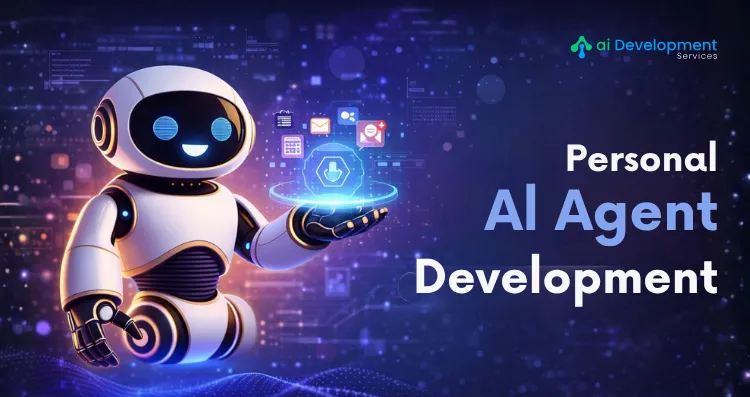
The trend of adopting an automated and intelligent system worldwide has increased the adoption rate of AI-based assistants in different sectors. Industries are adopting Personal AI Agent Development to develop an AI-based system capable of operating independently. Based on market trends, the adoption rate of AI agents in different sectors is likely to increase significantly in the coming days. This is because organizations are looking to implement AI agents in different sectors, such as customer services and financial advisory. A good Personal AI Agent Development Company helps an organization develop a solution based on changing technological needs, which enables an organization to develop a personal AI agent for business automation.
Understanding Personal AI Agent
A personal AI agent is an intelligent software program designed to carry out tasks, interact with people, and make decisions on its own. This is different from other automated programs in that they learn from their experiences.
While trying to Build Personal AI Agent for Business, businesses are trying to develop intelligent programs that analyze data, interpret user intent, and respond with real-time output. They can handle schedules, automate tasks, and assist in sophisticated decision-making processes.
In today’s technology, intelligent programs are developed with sophisticated algorithms that enable them to learn and improve over time, ensuring they stay relevant and useful in a changing environment, making them vital to businesses looking for intelligent technology solutions.
Build Your Personal AI Agent Today
How Personal AI Agents Are Redefining Digital Interactions
Personal AI Agents are revolutionizing user experiences in interacting with digital platforms, as they offer a more natural, intuitive, and intelligent form of communication. No longer are users limited to communicating with static interfaces, but they are now able to interact with intelligent interfaces that comprehend their context and respond to their individual preferences.
With the help of Adaptive AI Development, businesses are now able to design and develop AI Agents that enable seamless interactions with various platforms, such as mobile, web, and voice-based interfaces.
The ability to process data in real-time enables AI Agents to offer immediate and accurate responses, which is revolutionizing user experiences and setting a new standard in digital ecosystems.
Core Technologies Behind Personal AI Agent Development
| Technology | Description |
| Machine Learning | Enables AI agents to learn from data and improve performance over time |
| Natural Language Processing (NLP) | Facilitates human-like communication and understanding of user inputs |
| Deep Learning | Processes complex data patterns for advanced decision-making |
| Reinforcement Learning | Allows agents to optimize actions based on feedback and outcomes |
| Cloud Computing | Provides scalable infrastructure for data storage and processing |
| Edge AI | Ensures real-time processing with minimal latency |
| Predictive Analytics | Helps anticipate user needs and generate proactive responses |
| Adaptive AI Development | Enables continuous evolution and learning based on new data |
Key Use Cases of Personal AI Agents Across Industries
Personal AI agents are being widely adopted across industries to streamline operations and enhance user engagement.
- Personal AI Agents for Customer Support are used to handle customer queries, manage interactions, and provide consistent responses across platforms. These agents ensure smooth communication and efficient resolution of user requests.
- Personal AI Agents for Sales Automation assist businesses in managing leads, analyzing customer behavior, and optimizing sales strategies. They enable data-driven decision-making and improve overall sales processes.
- In healthcare, Personal AI Agents AI Agents for Healthcare support patient management, assist in diagnostics, and enhance communication between healthcare providers and patients.
- Financial institutions leverage Personal AI Agents AI Agents for Finance & Fintech to analyze market trends, manage financial data, and provide personalized insights to users.
- E-commerce platforms utilize Personal AI Agents AI Agents for E-commerce to enhance user experiences by analyzing purchasing behavior, managing product recommendations, and optimizing operations.
Data Processing and Personalization in AI Agents
Data processing is another essential feature of personal AI agents. In order to work effectively, AI agents use large volumes of structured and unstructured data. Data is collected from different sources, including user information, transactions, and external sources.
Advanced analytics tools are also used to process and interpret the data. This feature enables AI agents to generate meaningful information. Personalization is another feature of AI agents. This feature enables AI agents to provide users with tailored information. This feature is achieved by processing user information and behavior.
The integration of machine learning algorithms enables AI agents to refine their results based on the availability of data. This feature is essential for businesses that want to create a personal AI agent for business automation.
Integration of Personal AI Agents with Existing Platforms
Seamless integration with existing infrastructure is a key requirement for the success of personal AI agents. This implies that personal AI agents need to integrate with existing platforms such as CRM, enterprise software, and communication platforms.
APIs and middleware play a critical role in ensuring seamless integration between platforms. Enterprise Personal AI Agent Development emphasizes the development of scalable architectures that support integration with multiple platforms.
This ensures that businesses achieve seamless integration, which enables them to maintain consistency in operations. Moreover, it ensures that AI agents can work within existing infrastructure without causing disruptions.
Cost Estimation for Personal AI Agent Development
| Development Stage | Estimated Cost Range |
| Research & Planning | $5,000 – $15,000 |
| AI Model Development | $20,000 – $30,000 |
| Data Collection & Processing | $10,000 – $25,000 |
| UI/UX Design | $5,000 – $20,000 |
| Integration & APIs | $10,000 – $15,000 |
| Testing & Deployment | $8,000 – $10,000 |
| Maintenance & Updates | $5,000 – $10,000 annually |
The total cost of development depends on the complexity of the platform, data requirements, and level of customization. Businesses often start with a prototype before scaling to full deployment.
Future Trends in Personal AI Agent Development
The personal AI agents' future is influenced by the development in artificial intelligence and the growing need for intelligent automation. The AI agents are also expected to be more autonomous and capable of performing complex operations without human intervention.
Adoption of Adaptive AI Development will also continue to rise, allowing systems to be capable of learning and evolving in real time. The integration with new technologies such as IoT and blockchain will also improve the personal AI agents' abilities.
Enterprises engaging in Enterprise Personal AI Agent Development are likely to be focused on creating systems that are capable of operating in multiple domains.
Request a Custom AI Agent Demo
Conclusion
Personal AI agents are revolutionizing the digital space, particularly through intelligent automation. This technology is transforming various industries, including customer support, healthcare, and finance. By choosing a Personal AI Agent Development Company, businesses can build a personal AI agent that suits their needs. This will be a great opportunity to build a personal AI agent that suits a business’s needs, particularly when considering future growth. As businesses continue to build personal AI agents for business, there will be a need to build agents that are adaptable, scalable, and capable of learning. This will be achieved through incorporating emerging technologies, ensuring personal AI agents are relevant in an ever-changing digital space. The future of personal AI agent development lies in innovation. By adopting personal AI agents, businesses will be able to realize the full benefits of artificial intelligence in the coming years.
FAQs
Q1. How do personal AI agents handle multi-domain decision-making?
They use advanced machine learning models combined with contextual data to process inputs and generate accurate outputs across multiple domains.
Q2. What role does reinforcement learning play in AI agents?
It enables agents to optimize decisions by learning from feedback and continuously improving performance through iterative training.
Q3. How is data privacy maintained in personal AI agents?
Through encryption, access controls, and compliance with data protection regulations, ensuring secure handling of sensitive information.
Q4. Can personal AI agents operate in real-time environments?
Yes, with edge computing and real-time data processing, they can analyze inputs instantly and deliver immediate responses.
Q5. How do AI agents integrate with enterprise systems?
They use APIs and middleware to connect with existing platforms, ensuring seamless data exchange and operational consistency.
Q6. What makes adaptive AI essential for personal AI agents?
Adaptive AI enables continuous learning and evolution, allowing agents to remain effective in dynamic and changing environments.