The way people plan and structure their days is changing fast. With rising awareness around neurodiversity, ADHD, autism, and executive function challenges, there is a growing demand for planning tools that go beyond simple to-do lists. Tiimo is one app that has carved out a powerful niche in this space, offering a visually driven, AI-powered daily planner designed specifically for people who think and process information differently.
If you are an entrepreneur, product company, or startup looking to build an AI Visual Planner app like Tiimo, this guide covers everything you need to know, from core features and tech stack to the development process and monetization strategies.
What Is Tiimo and Why Is It So Popular?
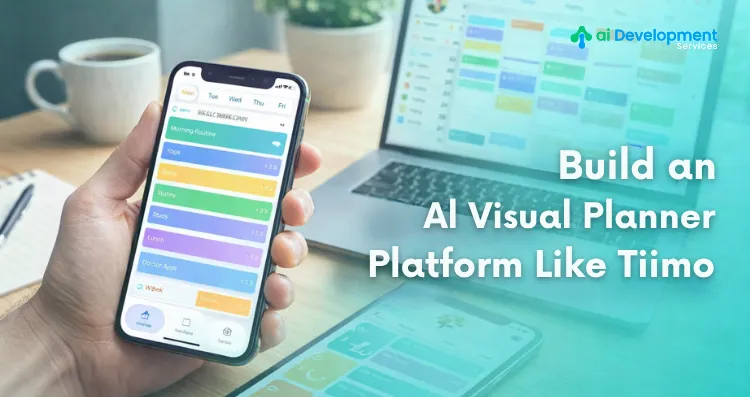
Tiimo is a productivity and planning app originally built for individuals with ADHD, autism, and other cognitive differences. What sets it apart from traditional productivity apps is its deep visual interface. Instead of presenting a wall of text-based tasks, Tiimo uses color coding, countdown timers, icons, and gentle reminders to guide users through their day in a calm, structured way.
The app has gained significant traction globally, not just among neurodiverse users but also among anyone looking for a more visual, less overwhelming approach to daily planning. Its success shows a clear market gap for AI-powered planning tools that prioritize clarity, visual engagement, and personalization over complexity.
Building a Tiimo clone or a similar AI Visual Planner Platform like Tiimo requires a deep understanding of both design psychology and intelligent automation. At AI Development Service, this is exactly the type of product we specialize in building from the ground up.
Market Opportunity Behind an AI Visual Planner App Development
Before diving into the development process, it helps to understand the market landscape. The global productivity app market is expected to surpass $100 billion by 2026, and within that space, tools designed for neurodiverse users represent a rapidly growing segment. Approximately 1 in 7 people worldwide is considered neurodiverse, and millions more simply prefer visual learning and planning over text-heavy systems.
Apps that combine AI personalization with visual design are winning a loyal, high-retention user base. This is a strong business case for launching an AI Visual Planner app like Tiimo, especially if the product is built with thoughtful UX, smart scheduling intelligence, and accessibility at its core.
Core Features to Build in a Tiimo Like AI Visual Planner Platform
When we approach development of a platform, we begin by mapping the essential features that drive user retention and daily engagement.
Visual Daily Timeline: The centerpiece of any Tiimo-like platform is an interactive visual timeline. Unlike traditional calendar grids, this presents the user's day as a flowing, color-coded visual strip. Each task has its own color, icon, and time block, making the day easy to parse at a glance without reading dense text.
AI-Powered Schedule Suggestions: This is where the intelligence layer becomes critical. Using machine learning, the platform analyzes a user's historical behavior, energy patterns, task completion rates, and preferences to suggest optimal scheduling. Over time, the AI learns when a user is most productive and automatically recommends task sequences accordingly. If you are curious about how machine learning models are trained and deployed for apps like this, our detailed machine learning app development guide walks through the entire process, from data strategy to real-time deployment.
Customizable Visual Themes and Icons: Personalization is not just aesthetic here. For neurodiverse users especially, visual consistency and personal familiarity reduce cognitive load significantly. The platform should allow users to assign specific colors, emojis, or icons to different task categories so their planner feels like an extension of their personal thinking style.
Countdown Timers and Transition Alerts: Tiimo's signature feature is the countdown timer that shows exactly how much time remains for each activity. This provides a concrete, visual sense of time, which is especially helpful for individuals with time blindness. Building this into a platform requires precise notification scheduling and background task management.
Routine Builder with AI Adaptation: Users should be able to create recurring daily routines, morning rituals, work blocks, and wind-down sequences. The AI layer monitors completion patterns and suggests small adjustments, such as shifting a task earlier or breaking a long block into shorter ones, based on what actually works for the individual user.
Focus Mode: A distraction-free mode that highlights only the current task, blocking out the rest of the day temporarily, helps users stay present without feeling overwhelmed by everything on their agenda.
Caregiver and Team Collaboration Tools: For users with support networks, such as parents of children with ADHD or workplace coaches, a shared view feature allows trusted individuals to monitor schedules, add tasks, or leave visual cues without taking over the user's experience.
Cross-Platform Sync: The app must run seamlessly across iOS, Android, and web, with real-time sync so users can manage their schedule from any device.
Technology Stack used for AI Visual Planner Platform
Building an AI Visual Planner Platform like Tiimo requires a well-architected tech stack that balances performance, scalability, and intelligent personalization.
- For the frontend, we use React Native for cross-platform mobile development alongside React.js for the web interface. These frameworks allow us to build highly interactive visual components, such as the animated timeline and countdown elements, that feel smooth and responsive on all screen sizes.
- On the backend, we work with Node.js and Python. Python handles all AI and machine learning workloads, including the recommendation engine, behavioral analysis models, and smart scheduling logic. Node.js manages API communication, real-time notifications, and data synchronization across devices.
- For the AI engine, we build and train custom models using TensorFlow and PyTorch. These models handle pattern recognition in user behavior, task duration predictions, and routine optimization. For natural language inputs (such as voice-based task creation), we integrate NLP capabilities using transformer-based models.
- The database layer uses a combination of PostgreSQL for structured user data and Redis for caching real-time session data and notification queues. Cloud infrastructure is built on AWS or Google Cloud, depending on client preference, with auto-scaling enabled to handle usage spikes.
- For push notifications and background task management, we integrate Firebase Cloud Messaging on mobile and use worker queues on the server side to ensure timers and reminders fire accurately even when the app is not in the foreground.
Development Process of AI Visual Planner Platform
Every AI Visual Planner Platform we build follows a structured, iterative process designed to reduce risk and maximize product-market fit.
Discovery and Requirements Mapping: We begin with a deep-dive session to understand the target user personas, the problem being solved, and the competitive landscape. This is where we define MVP scope, identify which AI features are essential at launch, and map out user journeys for different use cases.
UI/UX Design for Neurodiversity: Visual planner apps have very specific design requirements. We work with accessibility-first design principles, ensuring sufficient color contrast, icon clarity, readable typography, and reduced visual noise. Our designers prototype the timeline view, task creation flow, and routine builder before a single line of code is written.
AI Model Development: This runs in parallel with frontend development. Our data science team builds the behavioral learning engine, trains it on synthesized and anonymized sample data, and establishes the feedback loop mechanism that allows the model to improve as real users interact with the platform.
Backend and API Development: Our engineers build the core backend services, including user authentication, schedule management APIs, notification systems, and the data pipeline that feeds the AI engine with usage signals.
Integration and Testing: Once all components are ready, we integrate the AI recommendations into the UI, test cross-platform behavior, and conduct accessibility audits. We also run performance testing to ensure the countdown timers and real-time sync work without lag.
Launch and Continuous Optimization: Post-launch, we monitor model performance, user retention signals, and feature adoption. The AI continues to improve with each interaction, making the planner smarter and more personally relevant over time.
Monetization Strategies for an AI Visual Planner App
A sustainable business model is as important as the product itself. Here are the approaches we recommend when building a Tiimo clone or a similar platform.
The freemium model works best in this category. Offer core visual planning features for free with a limited number of routines or AI suggestions, then offer advanced features such as unlimited routines, detailed analytics, and caregiver sharing behind a subscription. Monthly and annual subscription tiers are standard, with annual plans offered at a discount to drive long-term retention.
Institutional licensing is a strong revenue stream for this type of app. Schools, special education programs, therapy clinics, and corporate wellness teams are willing to pay for group licenses that allow them to roll out the platform to students, clients, or employees at scale. This B2B layer can significantly increase average revenue per account.
Marketplace add-ons, such as premium icon packs, visual theme bundles, or expert-designed routine templates, can generate additional transaction-based revenue from users who want to personalize their experience further.
Why AI Personalization Is the Core Differentiator?
Standard planning apps organize tasks. An AI Visual Planner Platform like Tiimo does something fundamentally different: it learns how a specific person operates and adapts the planning experience around them. This is the difference between a static tool and an intelligent system.
Building this level of personalization requires more than simple rule-based logic. It demands properly trained machine learning models, clean behavioral data pipelines, and a feedback mechanism that closes the loop between user actions and model updates. This is the kind of complex, adaptive AI development that requires genuine technical expertise to get right.
It also shares some architectural DNA with other AI-powered learning tools. For instance, an AI study tool that personalizes learning sequences based on retention patterns is conceptually similar to how a visual planner adapts scheduling recommendations based on behavior data. The underlying AI principle, learning individual user patterns and adapting the experience accordingly, is the same.
Challenges in Building an AI Visual Planner Platform and How We Solve Them
Several technical and product challenges arise in this type of development, and being prepared for them is critical.
- Ensuring AI recommendations feel helpful rather than intrusive is a delicate balance. If the system changes a user's schedule too aggressively, it creates frustration. Our approach is to make all AI suggestions optional and clearly labeled, giving users full control over whether to apply them.
- Accessibility compliance is non-negotiable for an app targeting neurodiverse users. We build to WCAG 2.1 AA standards and conduct usability testing with actual neurodiverse users during the design phase to catch issues that standard QA would miss.
- Data privacy is critical since the app collects sensitive behavioral data. We implement end-to-end encryption, clear data policies, and GDPR-compliant user controls so that users always know what data is being collected and can delete it at any time.
- Model accuracy in the early stages is another challenge, since new users have limited behavioral history. We solve this by seeding the recommendation engine with onboarding data, such as user-selected preferences, daily schedule templates, and self-reported productivity patterns, so the AI starts with a reasonable baseline before behavioral data accumulates.
Why Partner with AI Development Service for Building an AI Visual Planner Platform?
Building an AI Visual Planner app like Tiimo sits at the intersection of intelligent machine learning, accessibility-focused design, and complex real-time mobile engineering. It is not a standard app build.
Here is why businesses choose aidevelopmentservice.com for this type of platform:
- Full-Stack AI Expertise: We handle AI model development, training, and deployment in-house, meaning your recommendation engine and behavioral learning system are built by specialists, not outsourced or bolted on as an afterthought.
- Cross-Platform Mobile and Web Development: We build simultaneously for iOS, Android, and web using React Native and React.js, so your platform reaches users on every device with a consistent, high-quality experience.
- Experience Across Productivity, Healthcare, and EdTech Verticals: We have built AI-powered platforms in adjacent spaces, giving us proven frameworks and architectural patterns that reduce development risk and accelerate time to market.
- Scalable Architecture from Day One: We build platforms that are ready to scale, with cloud infrastructure, auto-scaling, and modular AI pipelines designed to grow alongside your user base without requiring a full rebuild.
- Transparent Process and Milestone-Based Delivery: You get regular updates, clear timelines, and defined milestones at every stage, so there are no surprises and you always know exactly where your product stands.
Frequently Asked Questions
1. How long does it take to build an AI Visual Planner app like Tiimo?
Ans. A well-scoped MVP typically takes between 4 and 6 months to develop, covering core visual planning features, basic AI scheduling, and cross-platform deployment. A fully featured platform with advanced AI personalization, caregiver tools, and institutional licensing can take 9 to 12 months depending on complexity.
2. How much does it cost to develop a Tiimo clone?
Ans. Development costs vary based on feature scope, team size, and platform requirements. An MVP for an AI Visual Planner Platform like Tiimo generally ranges from $1,000 to $40,000, while a comprehensive platform with a robust AI engine, multi-platform support, and admin dashboards can range from $20,000 to $50,000 or more.
3. What makes an AI planner different from a regular scheduling app?
Ans. A regular scheduling app is static. An AI planner learns from user behavior over time, identifies patterns, and actively adapts its suggestions to help users plan in a way that suits their personal rhythm. This continuous learning loop is what makes platforms like Tiimo genuinely useful for long-term daily use rather than being abandoned after a few weeks.
4. Can AI Development Service build a fully custom AI Visual Planner Platform from scratch?
Ans. Yes, AI Development Service specializes in building custom AI-powered platforms from the ground up. Our team covers the full development lifecycle including AI model training, mobile and web development, UX design, and post-launch optimization. You can reach out directly through aidevelopmentservice.com to discuss your project requirements and get a detailed proposal.
5. Does AI Development Service provide ongoing support after the platform launches?
Ans. Absolutely, post-launch support is a core part of every engagement at AI Development Service. This includes AI model monitoring and retraining, performance optimization, bug fixes, and feature additions as the product grows and the user base scales. We build platforms designed to evolve, not just ship once.