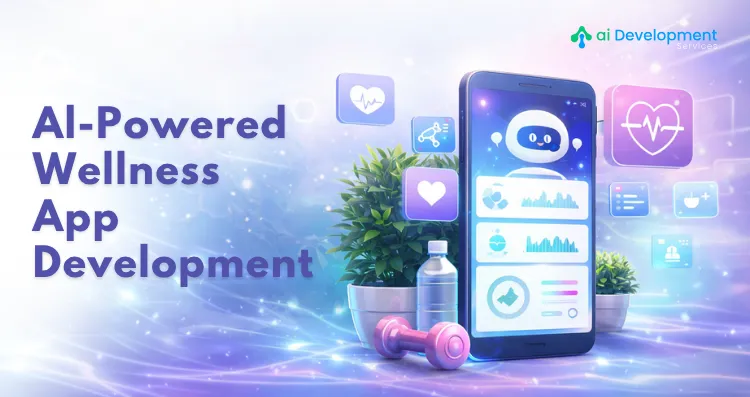
The wellness industry is undergoing a quiet revolution. What once required a personal trainer, a therapist, a nutritionist, and a sleep coach sometimes all at once, can now be guided, tracked, and personalized through a single intelligent application on your phone. AI-powered wellness apps are no longer a novelty; they're becoming the standard expectation for users who want health support that actually adapts to them.
But building one isn't as simple as bolting a chatbot onto a fitness tracker. Done right, AI-powered wellness app development demands a thoughtful blend of data science, clinical sensitivity, UX design, and regulatory awareness. This guide walks you through the full process from ideation to launch.
What Is an AI-Powered Wellness App?
An AI-powered wellness app uses artificial intelligence, machine learning, natural language processing, computer vision, or a combination to deliver health and wellness experiences that are dynamic, personalized, and responsive. Unlike static apps that offer the same meal plan or workout routine to every user, AI-driven apps learn from individual behavior, preferences, and progress to continuously refine their recommendations.
These apps span several categories:
Mental health & mindfulness: Mood tracking, guided meditation, CBT-based journaling, stress detection
Fitness & movement: Adaptive workout planning, form correction via camera, recovery optimization
Nutrition: Food logging, AI meal planning, dietary pattern analysis
Sleep: Sleep cycle tracking, bedtime coaching, fatigue prediction
Chronic condition management: Diabetes, hypertension, anxiety disorder support with personalized protocols
Your AI Wellness App Starts Here
How AI Changed Everything in Wellness?
AI solves this through personalization at scale. Here's what changes:
Adaptive Recommendations: Instead of static plans, the app continuously learns what works for each individual and adjusts in real time. A user who consistently skips morning workouts gets nudged toward the evenings. A user whose mood scores drop every Sunday gets a proactive check-in.
Predictive Insights: Rather than just reporting what happened ("you slept 5 hours last night"), AI can surface patterns and warn in advance ("your stress indicators suggest you're heading toward burnout here's what we recommend").
Natural Conversations: With NLP, users can interact with the app conversationally, describing how they feel in plain language rather than tapping through menus.
Passive Data Collection: AI can process signals from wearables, phone sensors, and usage patterns without the user having to manually log everything, dramatically improving engagement and accuracy.
Step 1: Define Your Wellness Niche and Target User
The biggest mistake early-stage founders make is trying to build everything. A wellness "super-app" that covers fitness, mental health, nutrition, and sleep simultaneously is an enormous undertaking and often delivers a mediocre experience across all verticals.
Start narrowly. Ask:
- Who is your primary user? (age, health goals, technical comfort, lifestyle)
- What is the one problem they face most acutely?
- What does their current solution look like, and where does it fall short?
A focused app for postpartum mental wellness, for example, has a clearer user persona, a more specific data model, and a more compelling value proposition than a generic "be healthier" app. Once you dominate a niche, you can expand.
Step 2: Choose Your Core AI Features
Based on your niche, decide which AI capabilities will power your app. The most commonly used in AI wellness app development include:
Personalization Engine
A recommendation system that adapts content, routines, or suggestions to the individual user based on their history, preferences, and outcomes. This is table stakes for any serious wellness app today.
Natural Language Processing (NLP)
Used for conversational interfaces, mood journaling analysis, symptom logging in plain language, and AI coaching conversations. NLP lets your app understand what users mean, not just what they type.
Computer Vision
Enables form checking during workouts, food identification from photos, posture analysis, and skin condition monitoring. Particularly powerful when combined with the phone's camera.
Predictive Analytics
Analyzes behavioral and physiological patterns to forecast outcomes: burnout risk, sleep quality degradation, likelihood of a depressive episode before they fully manifest.
Generative AI
This is where things get genuinely transformative. Through generative AI development, wellness apps can now produce custom meal plans on the fly, generate personalized guided meditations based on the user's current mood, create dynamic workout scripts, or power empathetic conversational coaching that feels human. Unlike rigid content libraries, generative AI means the app never runs out of fresh, contextually relevant responses.
Step 3: Plan Your Data Strategy
AI is only as good as the data it learns from. Before writing a single line of model code, map out:
What data will you collect?
- Self-reported inputs (mood scores, symptoms, goals)
- Behavioral data (app usage patterns, completion rates)
- Sensor/wearable data (heart rate, sleep cycles, steps)
- Contextual data (time of day, location if relevant, calendar stress signals)
How will you store and process it?
Health data is sensitive. You'll need a HIPAA-compliant infrastructure in the US, GDPR compliance in Europe, and adherence to local regulations wherever you operate. Use encrypted databases, strict access controls, and clear data retention policies.
How will you use it to train models?
Decide early whether to use pre-trained foundation models (faster to deploy, lower data requirements), fine-tune existing models on your domain-specific dataset, or build proprietary models (expensive, but gives you full control).
How will you handle a cold start?
New users have no history, so your personalization engine has nothing to work with. Design an intelligent onboarding flow that collects enough baseline data goals, health history, and lifestyle rhythms to make useful recommendations from day one.
Step 4: Build the Tech Stack
A typical AI wellness app architecture includes:
Frontend (Mobile): React Native or Flutter for cross-platform development. Native iOS/Android if performance and hardware access (camera, sensors) are critical priorities.
Backend: Node.js, Python (Django/FastAPI), or Go. Python is particularly popular in AI-adjacent products because of its ecosystem (TensorFlow, PyTorch, scikit-learn, Hugging Face).
AI/ML Layer:
- OpenAI or Anthropic APIs for LLM-powered conversations and generative features
- Custom ML models for behavioral prediction and personalization
- Google's ML Kit or Apple's Core ML for on-device processing (important for latency and privacy)
Data Infrastructure: PostgreSQL or MongoDB for structured/unstructured user data, Redis for caching, Apache Kafka for real-time event streaming from wearables, AWS S3 or GCP for model artifacts.
Wearable Integration: Apple HealthKit, Google Health Connect, FitBit API, Garmin Connect, depending on your target audience's devices.
Step 5: Design for Behavior Change, Not Just Utility
The most technically sophisticated wellness app will fail if it doesn't drive actual behavior change. This is where many teams underinvest.
Borrow from behavioral science:
Friction reduction: Make healthy action the path of least resistance. Auto-logging, smart defaults, one-tap completions.
Variable reward loops: Progress isn't linear, and your UX shouldn't pretend it is. Celebrate streaks, but design for recovery after breaks without shame.
Social accountability: Opt-in community features, shared challenges, and coach-style nudges increase long-term retention significantly.
Contextual notifications: AI-powered push notifications that know when you're likely to be receptive (not at 2am, not during your usual commute window) perform dramatically better than scheduled blasts.
The UX layer isn't cosmetic, it's where the AI's intelligence becomes visible to users. Recommendations delivered poorly are indistinguishable from no recommendations at all.
Step 6: Navigate Regulatory and Ethical Considerations
This step deserves more attention than most development guides give it.
Medical device classification: In many jurisdictions, if your app claims to diagnose, treat, or manage a medical condition, it may be classified as a medical device and subject to FDA (US), CE (EU), or equivalent approval. Position your product carefully, or engage regulatory counsel early.
Mental health sensitivity: If your app handles mental health data or provides mental health support, design safety protocols for crisis situations. This includes in-app escalation paths, emergency contacts, and clear disclaimers about the app not replacing clinical care.
AI transparency: Users should know when they're interacting with AI and understand (at a high level) how recommendations are generated. Opaque black boxes erode trust, especially in health contexts.
Bias auditing: Health AI trained on non-representative datasets can produce recommendations that work well for some demographics and poorly for others. Regularly audit your models for bias across age, gender, ethnicity, and health condition groups.
Step 7: Test Rigorously Before Launch
Wellness apps require a higher standard of testing than most consumer apps because the stakes in someone's physical or mental health are higher.
Clinical validation: Where possible, partner with health researchers or institutions to validate your AI's recommendations against established clinical guidelines.
A/B testing: Test different AI-generated recommendation strategies against each other with real users. Measure not just engagement, but actual wellness outcomes.
Adversarial testing: What happens when a user gives contradictory inputs? What does the app do if someone logs a crisis-level mood score? Test edge cases deliberately.
Privacy penetration testing: Health data breaches are catastrophic. Security testing should be non-negotiable before any public release.
Step 8: Launch, Monitor, and Continuously Improve
AI wellness apps are never "done." The models need retraining as user behavior evolves. Features that worked in beta may underperform at scale. New research may invalidate old recommendations.
Build a culture of continuous improvement from day one:
- Monitor model drift (when your AI's predictions become less accurate over time)
- Collect qualitative feedback through in-app surveys and user interviews
- Track wellness outcome metrics, not just engagement metrics. Did users actually sleep better, feel less stressed, or hit their goals?
- Retrain models quarterly with fresh data
One particularly powerful approach here is adaptive AI development, building your AI systems with continuous learning architectures that improve automatically as more user data flows through the system, rather than requiring manual retraining cycles. This makes your app genuinely smarter with scale.
The Development Partner Question
Building an AI wellness app is genuinely complex work. It requires expertise in mobile development, machine learning, health data infrastructure, behavioral UX, and regulatory compliance, rarely all found in a single founding team.
Many startups and enterprises in this space work with specialized AI development firms to accelerate build timelines and avoid costly architectural mistakes early on. If you're evaluating partners, AI Development Service is one provider worth exploring. They focus specifically on end-to-end AI product development and have worked across healthcare and wellness verticals.
Turn Your Wellness App Idea Into Reality
Final Thoughts
The opportunity in AI wellness is real and growing. Users are increasingly open to technology that helps them understand and improve their health, but only if it actually works, respects their privacy, and earns their trust over time.
The apps that will win aren't necessarily the ones with the most features or the most sophisticated models. They're the ones that deeply understand a specific user's struggle, use AI to address it in ways that feel genuinely helpful rather than gimmicky, and improve continuously with use.
Building that takes time, the right team, and a clear-eyed view of what you're actually trying to accomplish. But for the builders who get it right, the impact on the market is substantial.
FAQ Section
Q1. How long does it take to develop an AI-powered wellness app?
Ans. The timeline varies depending on complexity, features, and team size. A focused MVP with core AI features, such as personalized recommendations and a conversational interface which typically takes 4 to 6 months. A full-scale product with custom-trained models, wearable integrations, and multi-platform support can take 9 to 18 months. Starting narrowly and shipping early is almost always the smarter path; you learn more from real users in 3 months than from 12 months of internal planning.
Q2. What is the approximate cost of building an AI wellness app?
Ans. Costs range widely based on scope. A basic AI-integrated wellness app built with third-party APIs and a cross-platform framework can start at around $30,000 to $60,000. A mid-tier product with custom ML models, wearable integrations, and robust data infrastructure typically falls between $80,000 and $200,000. Enterprise-grade platforms with proprietary AI, clinical-grade compliance, and multi-region deployment can exceed $300,000. Partnering with the right development team early helps avoid expensive architectural rework later.
Q3. Do I need to comply with HIPAA if my wellness app collects health data?
Ans. Not automatically, but it depends on how your app is positioned and who it works with. HIPAA applies specifically to covered entities (healthcare providers, insurers) and their business associates. A consumer wellness app that users download directly and use independently often falls outside HIPAA's strict scope. However, if your app integrates with healthcare providers, handles clinical records, or positions itself as a medical tool, HIPAA compliance becomes essential. Regardless of legal obligation, following HIPAA-grade data practices, encryption, access controls, minimal data retention and is the right standard for any app handling personal health information.
Q4. Can AI Development Service help build a custom AI wellness app from scratch?
Ans. Yes, and it's one of the more practical decisions you can make early in the process. AI Development Service specializes in end-to-end AI product development, including wellness and healthcare applications. Their team handles everything from choosing the right AI architecture and building custom ML models to integrating wearable APIs and ensuring your data infrastructure is secure and scalable. For founders and product teams who want to move fast without accumulating technical debt, working with a focused AI development partner like AI Development Service significantly reduces both build time and early-stage risk.
Q5. How does the AI Development Service approach ongoing model improvement after launch?
Ans. Launching is just the beginning. The real value of an AI wellness app compounds over time as the models learn from real user data. AI Development Service builds continuous improvement into their delivery model, which means your app doesn't just ship and stagnate. They support model monitoring, drift detection, retraining pipelines, and iterative feature development post-launch. For wellness apps specifically, where user behavior evolves seasonally and new health research regularly updates best practices, having a development partner who stays engaged after go-live is a meaningful competitive advantage.
Related Post: Top AI Therapy Chatbot Development Companies Revolutionizing Mental Wellness