The fashion industry is undergoing a quiet revolution and it's being powered by algorithms, not runway trends. AI fashion assistant apps are quickly becoming a must-have tool for retailers, stylists, and everyday shoppers alike. Whether it's offering outfit suggestions based on body type, predicting seasonal trends, or enabling virtual try-ons with augmented reality, these apps are redefining what personalized shopping looks like.
If you're a startup founder, fashion brand, or tech entrepreneur wondering how to build one, this guide breaks down everything; the must-have features, the right tech stack, the development process, and realistic cost expectations.
What Is an AI Fashion Assistant App?
An AI fashion assistant app is a digital tool that uses artificial intelligence, machine learning, and computer vision to provide users with personalized outfit recommendations, virtual styling advice, and curated shopping experiences. It learns from a user's style preferences, body measurements, past purchases, and browsing behavior to offer tailored suggestions, much like a personal stylist in your pocket.
Popular apps in this space include platforms like Acloset, Alta, and Pronti, all of which blend AI-driven outfit planning with smart wardrobe management. The market backing these solutions is substantial: the global AI fashion assistant market is expected to grow from over USD 2.92 billion in 2025 to USD 89.41 billion by 2035, a trajectory that reflects just how rapidly consumer demand is shifting toward intelligent, personalized experiences.
Get Expert Help With AI Fashion Assistant App Development
Why Are Businesses Investing in AI Fashion Apps?
Before diving into the development process, it's worth understanding why AI fashion assistant app development has become such a compelling business opportunity.
Hyper-personalization at scale: Traditional styling services can't scale. AI can. By analyzing thousands of data points, purchase history, browsing patterns, style quizzes, even weather data, an AI assistant delivers boutique-quality recommendations to every single user simultaneously.
Reduced return rates: With augmented reality-powered virtual try-ons, users can see how an outfit fits before they buy. This dramatically reduces hesitation and return rates, two of the most persistent pain points in e-commerce.
Trend forecasting: AI can analyze social media signals, fashion week data, and search behavior to predict what styles will trend next, giving brands a significant inventory advantage.
24/7 engagement: AI-powered chatbots and virtual stylists keep users engaged around the clock, answering questions, suggesting outfits, and guiding purchases without human staffing overhead.
User retention: Features like saved outfit boards, virtual closets, and occasion-based planning give users reasons to return to the app regularly, boosting long-term loyalty.
Key Features of an AI Fashion Assistant App
The features you include will depend on your target audience and business model, but the following represent the core capabilities that make these apps genuinely useful.
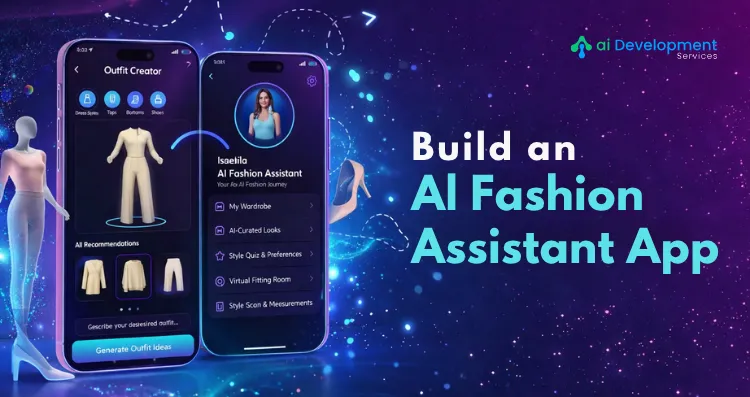
Personalized Outfit Recommendations: The cornerstone feature. Using machine learning, the app analyzes a user's style profile preferences, body shape, color choices, occasion type and surface outfits and products that match. This goes far beyond basic filtering; the recommendations evolve as the app learns more about the user over time.
Virtual Try-On with AR: Powered by ARKit (iOS), ARCore (Android), or WebAR frameworks, this feature lets users see how clothing looks on their body in real time. It's one of the most engagement-driving features in fashion apps and a strong differentiator for retail brands.
Virtual Wardrobe and Closet Management: Users upload photos of their existing clothing, and the AI categorizes items by type, color, and style. The app then suggests new outfit combinations from existing pieces, promoting sustainable fashion while deepening user engagement.
AI-Powered Chatbot / Virtual Stylist: Using natural language processing (NLP), the app enables conversational styling assistance. Users can describe an occasion, ask for color pairing advice, or request trend insights and receive coherent, contextual responses from an AI stylist.
Trend Forecasting Engine: Machine learning models trained on social media data, runway feeds, and historical buying patterns surface emerging trends and seasonal must-haves, keeping the app's content fresh and commercially relevant.
Occasion-Based Outfit Planning: Users can input upcoming events, job interviews, weddings, beach vacations and the app curates specific outfit suggestions tailored to the context.
Shopping Integration: Real-time product catalog access via integrations with e-commerce platforms like Shopify or Magento allows users to shop directly from their recommendations, closing the loop between discovery and purchase.
Style Quizzes and Onboarding: A structured onboarding flow helps the AI establish an accurate initial style profile before users have generated enough behavioral data for the recommendation engine to learn from.
Technology Stack for Building an AI Fashion Assistant App
Choosing the right technologies is critical for performance, scalability, and cost-efficiency. Here's a breakdown of what a modern AI fashion app typically requires.
Frontend: React Native or Flutter for cross-platform mobile development (iOS + Android with a single codebase). React or Angular for responsive web interfaces.
Backend: Node.js or Django for API management, user authentication, and data processing. Both are well-suited for handling the real-time requests that a recommendation engine generates.
AI/ML Frameworks: TensorFlow and PyTorch for training custom computer vision and recommendation models. OpenAI API or similar LLM providers for conversational AI and NLP features.
Computer Vision: Used for garment detection, color recognition, texture analysis, and virtual try-ons. Models are typically trained on large fashion image datasets.
AR Integration: ARKit (Apple), ARCore (Google), or 8th Wall for WebAR experiences that enable virtual try-ons without requiring a native app install.
Database: PostgreSQL or MongoDB for user profiles and product catalogs; Redis for caching frequent recommendation queries.
Cloud Infrastructure: AWS, Google Cloud, or Azure for scalable model hosting, storage, and real-time API performance.
E-commerce Integration: Shopify, Magento, or custom API bridges to connect product catalogs for in-app shopping.
Our Step-by-Step Development Process for AI Fashion Assistant App
Building a fashion AI app is a structured process. Rushing any phase tends to result in a product that either underperforms technically or fails to resonate with users.
Step 1: Define Your Audience and Use Case
Are you building for everyday shoppers, professional stylists, or fashion retailers? Your audience shapes everything from the features you prioritize to the UX tone and the AI models you train. Defining this clearly at the start prevents expensive pivots later.
Step 2: Feature Scoping and Architecture Planning
Based on your audience, map out your MVP feature set. For a first version, personalized recommendations, a virtual wardrobe, and basic AR try-ons usually deliver the strongest value with manageable development complexity.
Step 3: Data Collection and Preparation
AI is only as good as its training data. Fashion datasets need to be large, diverse, and well-labeled, covering garment types, colors, textures, body types, and style categories. Public datasets exist (e.g., DeepFashion), but many production apps supplement these with proprietary data collected from user interactions. This is also the phase where you establish data privacy policies and GDPR/compliance frameworks.
Step 4: AI Model Development
This is where the core intelligence is built. Your team will train models for garment recognition, style recommendation, NLP-based styling assistance, and trend forecasting. Pre-trained foundation models can accelerate this significantly by fine-tuning an existing vision model is far faster than training from scratch. Teams leveraging generative AI development capabilities at this stage can create recommendation engines that produce novel outfit combinations rather than just retrieving pre-existing matches, adding genuine creative value to the user experience.
Step 5: UI/UX Design
A fashion app lives or dies by how it looks and feels. The UI needs to be visually compelling, intuitive to navigate, and designed around the moments that matter: browsing recommendations, saving outfits, and exploring trends. Virtual closets, mood boards, and swipe-based style preference capture are all interaction patterns that have proven popular.
Step 6: AR and NLP Integration
Adding AR try-on and conversational styling features requires careful integration work. AR frameworks need to be calibrated for body tracking accuracy, and NLP pipelines need testing across a wide range of user inputs and phrasings.
Step 7: Backend Development and E-commerce Integration
Build the infrastructure that powers the app API layers, database architecture, recommendation engine pipelines, and connections to product catalogs. If you're building a retail brand, integrating with their existing e-commerce stack (Shopify, Magento, custom ERP) is essential at this stage.
Step 8: Testing and Quality Assurance
Test recommendation quality with real users, check AR accuracy across different device types, and stress-test the backend under simulated load. AI-specific testing includes evaluating model fairness (do recommendations work equally well across different body types and skin tones?) and output relevance.
Step 9: Launch and Continuous Improvement
Post-launch, the AI improves as it accumulates more user interaction data. Establishing a feedback loop for user ratings on recommendations, outfit saves, and purchase conversions are all strong training signals. Regular model retraining keeps the app relevant as fashion trends evolve.
Estimated Cost to Build an AI Fashion Assistant App
Development costs vary significantly depending on feature scope, AI complexity, team location, and whether you're building an MVP or a fully-featured production app. Here's a general breakdown:
| Development Phase | Estimated Cost |
| Discovery & Planning | $3,000 – $8,000 |
| UI/UX Design | $8,000 – $18,000 |
| AI Model Development | $15,000 – $40,000 |
| Frontend Development | $10,000 – $20,000 |
| Backend & Integrations | $12,000 – $25,000 |
| AR Try-On Feature | $8,000 – $15,000 |
| QA & Testing | $5,000 – $10,000 |
| Total (MVP) | $54,000 – $120,000+ |
Key factors that move the needle on cost include the complexity of your recommendation models, how many third-party integrations you need, the quality tier of UI/UX design, and whether you're building for a single platform or cross-platform from day one.
For brands looking to include advanced capabilities like real-time trend forecasting, adaptive AI development approaches where the models continuously learn and self-improve from user behavior can add significant value but also require higher initial investment in model architecture and ongoing infrastructure.
Challenges to Anticipate in AI Fashion Assistant App Development
Data quality and diversity: Fashion datasets often underrepresent certain body types, skin tones, and cultural aesthetics. Building a recommendation engine that works well for a diverse user base requires deliberate effort in dataset curation.
AR accuracy: Virtual try-ons sound impressive, but accurate body tracking across different phone cameras, lighting conditions, and postures is technically demanding. Expect iteration.
Cold-start problem: New users have no behavioral history for the recommendation engine to learn from. Style quizzes, preference-based onboarding, and content-based filtering help bridge this gap until enough interaction data accumulates.
Privacy and data compliance: Style preferences, body measurements, and purchase behavior are sensitive data. GDPR, CCPA, and regional equivalents impose real obligations on how you collect, store, and use this information.
Model drift: Fashion trends move fast. A model trained on last year's data may surface outdated recommendations. Building a continuous retraining pipeline from day one prevents this from becoming a serious UX problem.
Monetization Models for AI Fashion Assistant App
There's no single right answer here. It is the best monetization strategy depending on your positioning and audience.
Subscription tiers (free recommendations + premium styling, AR try-on, or unlimited wardrobe items) work well for direct-to-consumer apps.
Affiliate commissions from fashion brands and retailers when users purchase via in-app recommendations are a popular and scalable model.
B2B licensing white-labeling your AI styling engine to fashion retailers who want to embed it in their own apps can deliver strong unit economics at scale.
In-app purchases for premium features, virtual styling sessions, or exclusive trend reports round out a diversified revenue stack.
Choosing the Right Development Partner for AI Fashion Assistant App Development
Building an AI fashion app is a genuinely complex technical undertaking. The intersection of machine learning, computer vision, augmented reality, and e-commerce integration means that generalist app developers often struggle with the AI-specific components.
When evaluating development partners, look for demonstrated experience with fashion tech or e-commerce AI, a portfolio that includes recommendation engines and computer vision work, and a clear approach to model training and ongoing improvement post-launch.
For teams exploring the full development lifecycle from model training to mobile deployment. AI Development Service brings specialized expertise across the AI stack, with a particular focus on building scalable, production-ready AI applications. Their AI agent development and autonomous systems reflect depth in the kind of intelligent, decision-making architectures that power strong fashion recommendation engines.
Start Your AI Fashion Assistant App Development
The Future of AI in Fashion
The next wave of AI fashion assistants will go considerably further than today's apps. Several trends are already in motion:
Generative outfit creation: Rather than recommending existing products, future apps will generate novel outfit concepts that don't yet exist in any catalog, functioning as genuine creative collaborators for users and designers alike.
Metaverse integration: As digital fashion spaces mature, AI stylists will extend into virtual environments, helping users dress their avatars as naturally as they dress themselves.
Voice-activated styling: Integration with voice assistants will let users ask for outfit advice as naturally as they ask for directions, blurring the line between ambient computing and personal styling.
Sustainability intelligence: AI will increasingly help users make more sustainable fashion choices, flagging the environmental footprint of recommended items, surfacing secondhand alternatives, and optimizing existing wardrobes rather than encouraging new purchases.
For brands and startups willing to invest in building AI fashion assistant apps now, the combination of a rapidly growing market, improving AI tooling, and rising consumer demand for personalization creates a compelling window of opportunity.
Final Thoughts
Building an AI fashion assistant app is not a single project, it's an evolving platform that gets smarter over time. The development effort required is real, but so is the upside: deeper user engagement, higher conversion rates, lower return rates, and a genuine competitive differentiation in a crowded fashion market.
The key is to start with a focused MVP that proves the core recommendation value, then iterate outward, adding AR try-on, trend forecasting, and conversational styling as the user base grows and the models improve.
Whether you're a fashion startup building from scratch or an established retailer looking to add intelligent personalization to your digital experience, the technology to build something genuinely useful is available today. The question is whether you build it thoughtfully.
FAQ Section - How to Build an AI Fashion Assistant App
Q1. How long does it take to build an AI fashion assistant app?
A basic MVP typically takes 3–5 months. A fully-featured app with AR try-on, trend forecasting, and a trained recommendation engine can take 6–10 months depending on complexity and the team you partner with.
Q2. Do I need a large dataset to train the AI models?
Not necessarily from day one. Many development teams start with publicly available fashion datasets like DeepFashion and fine-tune pre-trained models. As your app gains users, the data flywheel kicks in and your models improve continuously.
Q3. Can AI Development Service build a custom AI fashion assistant app for my brand?
Yes, AI Development Service specializes in end-to-end AI app development, from model training and computer vision integration to mobile deployment. They work with fashion brands and retail startups to build scalable, production-ready AI products tailored to specific business goals.
Q4. What is the minimum budget to get started?
A focused MVP covering personalized recommendations, a virtual wardrobe, and core AI features that typically start around $50,000–$70,000. The final number depends on feature scope, AI model complexity, and platform requirements (iOS, Android, or both).
Q5. Does AI Development Service offer post-launch support and model retraining?
Yes, fashion trends evolve fast, and so should your AI. AI Development Service provides ongoing model monitoring, retraining pipelines, and feature updates which ensure your app stays accurate and relevant well beyond the initial launch.
Q6. How does the AI learn a user's style preferences?
Through a combination of onboarding style quizzes, behavioral signals (items saved, outfits liked, purchases made), and explicit feedback. The more a user interacts with the app, the sharper and more personalized the recommendations become.
Q7. Can this app integrate with my existing e-commerce store?
Absolutely. AI fashion assistant apps can be integrated with platforms like Shopify, Magento, WooCommerce, or custom-built catalogs that allow users to shop recommended items directly within the app without leaving the experience.
Related Posts:
1. How to Build an AI Assistant App
2. How to Develop an AI Assistant Platform Like OpenClaw
3. How to Develop an Enterprise AI Assistant Like Kore.ai