Video is no longer optional for businesses and it is the primary language of digital communication. Yet most companies still struggle with the time, cost, and skill gaps that traditional video production demands. That is exactly the gap a text to video app fills. Type a prompt, get a video. It sounds simple, and increasingly, it is.
At AI Development Services, we specialize in building intelligent, production-ready text to video platforms for businesses across industries. This guide walks you through everything you need to know, from how these apps work to what it takes to build one that scales.
What Is a Text to Video App?
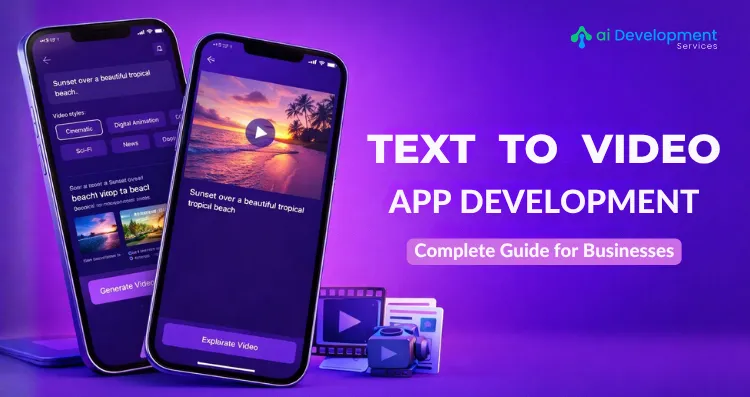
A text to video app is an AI-powered application that converts written prompts or scripts into fully generated video content, complete with visuals, transitions, voiceovers, and background audio. Users describe what they want, and the system produces a finished or near-finished video in minutes.
Tools like OpenAI's Sora, Runway Gen-4, HeyGen, and Synthesia have shown the world just how powerful this technology has become. But these are commercial consumer products. Businesses with specific use cases: employee training, product marketing, e-learning, and multilingual content need custom-built platforms tailored to their workflows, data, and brand.
📊 Market Stat: According to Grand View Research, the global AI video generator market was estimated at USD 788.5 million in 2025 and is projected to reach USD 3,441.6 million by 2033, growing at a CAGR of 20.3%.
The demand for an AI app to create video from text is not speculative and it is a measurable, accelerating business opportunity.
Why are Businesses Building Custom Text to Video Platforms?
Off-the-shelf tools have their limits. When companies come to us at AI Development Service for text to video app development, they typically need one or more of the following:
Content at scale: Marketing teams need dozens of video variations from a single script for A/B testing, regional campaigns, or product launches without proportional increases in production cost or headcount.
Cost efficiency: Traditional video production budgets range from thousands to hundreds of thousands of dollars per project. AI-generated video cuts those costs dramatically, especially for explainer videos, onboarding content, and social media assets.
Deep brand control: Businesses need their brand voice, colors, fonts, and tone baked into the generation engine, something generic tools cannot offer.
Proprietary data and security: Industries like healthcare, finance, and legal cannot feed sensitive content into third-party AI platforms. A custom-built text to video platform keeps data within a controlled, secure environment.
Just as businesses have invested in machine learning to automate complex decisions, text to video is now following the same path, moving from novelty to a core business function.
Get a Custom Text to Video App Built for Your Business
Core Features We Build Into Every Text to Video App
When our team at AI Development Service scopes a text to video app project, feature planning is the first and most critical step. The right feature set determines whether your platform becomes a tool people use daily or an expensive experiment.
Text Prompt Engine: The central input mechanism where users describe scenes, tone, and context. Quality natural language understanding here determines how accurately the AI interprets user intent.
AI Video Generation Pipeline: The engine that synthesizes video from text, typically built on diffusion models or transformer-based architectures, either through integrated APIs (Runway ML, Stable Diffusion Video) or proprietary models we develop and train.
Scene and Style Customization: Users can choose aspect ratios, visual styles (cinematic, animated, corporate), pacing, and transitions. Pre-built templates accelerate production for non-technical users.
AI Voiceover and Audio Sync: Text-to-speech integration with lip-sync support for avatar-based videos, multilingual voice options, and custom voice cloning for brand consistency.
Multi-Format Export: MP4, MOV, GIF across resolutions from 720p to 4K, ensuring the app serves every channel from YouTube to LinkedIn to internal platforms.
Collaboration and Brand Kits: Team workspaces, approval workflows, and brand asset libraries are essential for B2B platforms where multiple stakeholders are involved in content creation.
Subscription and Credit Management: Most text-to-video platforms operate on credit-based or tiered subscription models. We build the billing infrastructure directly into the platform, not as an afterthought.
Content Moderation Layer: Input filtering and output review pipelines to prevent misuse and protect platform integrity.
Our Technology Stack for Text to Video App Development
Here is the technology stack our team at AI Development Service typically uses when building a custom text to video platform:
| Layer | Technologies | Purpose |
| AI / ML | PyTorch, TensorFlow, Stable Diffusion Video, CogVideoX | Core video generation model development and training |
| LLM / NLP | OpenAI GPT-4, Custom LLMs, Hugging Face Transformers | Prompt understanding, enrichment, and intent parsing |
| Text-to-Speech | ElevenLabs, Google TTS, Azure Neural TTS | Voiceover generation and lip-sync support |
| Video APIs | Runway ML, DeepAI, Synthesia API | Third-party video synthesis for rapid integration |
| Backend | Python, FastAPI, Django, Node.js | Server-side logic, API layer, rendering pipeline |
| Job Queue | Celery, Redis, AWS SQS | Asynchronous video rendering task management |
| Frontend | React, Next.js, Flutter, React Native | Web and cross-platform mobile interface |
| Cloud / GPU | AWS (A100/H100), Google Cloud, Azure | GPU-intensive video rendering and auto-scaling |
| Storage & CDN | AWS S3, Google Cloud Storage, Cloudflare CDN | Video storage and fast global delivery |
| Database | PostgreSQL, MongoDB, Firebase Firestore | User data, metadata, and real-time sync |
| Authentication | Auth0, Firebase Auth | Secure user authentication and access management |
| DevOps | Docker, Kubernetes, GitHub Actions, Jenkins | Containerization, orchestration, and CI/CD pipeline |
| Monitoring | Sentry, LogRocket, Google Analytics, Mixpanel | Performance tracking, error monitoring, user analytics |
| Testing | Appium, BrowserStack, Jest, Mocha | Mobile and unit/integration testing |
Our Text to Video App Development Process
At AI Development Service, we follow a structured, milestone-driven process for text to video app development and one that is built around reducing risk, maintaining quality, and getting to market efficiently.
Phase 1: Discovery and Architecture
We begin by defining your specific use case, target audience, and success metrics. We select the right AI models, map third-party integrations, and design the technical architecture before a single line of code is written. This phase prevents costly pivots later.
Phase 2: UI/UX Design
Our designers create user interfaces that balance creative flexibility with simplicity, a critical challenge in video creation tools. We prototype and validate with real users before moving to development.
Phase 3: Core Development
This is where we build the prompt engine, integrate the video generation pipeline, develop the frontend editor, configure the rendering infrastructure, and implement billing and user management systems. We use agile sprints so you see working functionality regularly, not just at the end.
Phase 4: AI Model Integration and Training
We integrate the selected AI models into the application backend, ensure seamless communication between the AI modules and app features, and where custom models are required and conduct training on curated datasets relevant to your content domain.
Phase 5: Testing and Optimization
We conduct load testing on the rendering pipeline, prompt quality testing, cross-device UI testing, and a full security review. Generative AI output quality is tested with the same rigor as the code itself.
Phase 6: Launch and Ongoing Iteration
We handle deployment to app stores and cloud infrastructure, then monitor performance post-launch. Most successful text to video platforms launch with a focused MVP and expand features based on real user feedback and we support that iteration through long-term partnerships.
Typical total timeline: 4–6 months for a production-ready platform depending on feature scope and whether custom AI model training is involved.
Estimated Cost to Build a Text to Video App
Any AI App Development Cost depends on complexity, AI model depth, and the features you need at launch:
MVP / Starter Platform (using third-party AI APIs, core editor, basic subscription billing): $30,000 – $60,000
Mid-Tier Platform (custom video generation pipeline, collaboration features, multi-language support, advanced billing): $80,000 – $150,000
Enterprise Platform (proprietary AI models, white-label capability, advanced analytics, on-premise or private cloud deployment): $200,000+
Beyond development, factor in ongoing GPU compute costs, model hosting, and API usage fees. These are manageable and largely offset by usage-based billing models but they need to be planned for from day one.
Challenges We Help You Anticipate While Text to Video App Development
Text to video app development comes with specific technical and product challenges. Teams we've worked with consistently face these and we build solutions from the start rather than retrofitting them later.
Rendering latency: Video generation is compute-intensive. Users accustomed to instant responses find 30–120 second wait times frustrating. We solve this through intelligent queue management, async delivery UX, and progress indicators that keep users engaged during rendering.
Prompt sensitivity: Small changes in input text can produce dramatically different video outputs. We build a prompt enhancement layer that refines and standardizes user inputs before they reach the generation model, significantly improving output consistency.
Content moderation: Platforms without guardrails invite misuse. We implement input filtering, output review pipelines, and clear usage policies as standard components of every build.
Copyright and IP risk: Generated content that resembles protected material creates legal exposure. This is an evolving legal area, and we help clients build both technical safeguards and review workflows to manage them.
Model drift: Generative AI models degrade in quality if not maintained. We build feedback collection, user ratings, re-generation rates, and edit frequency into the platform, enabling continuous model improvement over time. This is the kind of adaptive AI thinking that separates platforms that get better from platforms that get stale. Businesses familiar with how we approach generative AI will recognize this as a core principle in everything we build.
Monetization Models to Consider
How you charge for your text to video platform matters as much as how you build it. The most common and proven models include:
Freemium: Free access to limited features, with premium features behind a paywall. Effective for user acquisition.
Subscription tiers: Basic, Pro, and Enterprise plans with different video generation limits, quality levels, and team features.
Credit-based / Pay-per-use: Users buy credits and spend them per video generated or per premium feature used. Works well for infrequent or high-volume enterprise users.
In-app purchases: Selling premium templates, custom AI voices, extended cloud storage, or watermark removal as add-ons.
Enterprise licensing and API access: Offering a white-label version of the platform or API access for businesses to embed text to video functionality into their own systems and a high-value revenue stream for B2B-focused platforms.
Let's Build Your Text to Video App
Frequently Asked Questions
1. How long does it take to build a text to video app?
Ans. A production-ready platform typically takes 4–6 months depending on feature scope, the depth of AI model customization required, and team size. An MVP using third-party AI APIs can be built in 3–4 months.
2. Do I need to train my own AI model, or can I use existing APIs?
Ans. Most businesses start with integrated third-party APIs (Runway ML, Stable Diffusion, Synthesia) for faster time to market. Custom model training makes sense when you need proprietary output style, domain-specific accuracy, or full data privacy. We guide clients through this decision based on their use case and budget.
3. What is the difference between a text to video app and a text to video platform?
Ans. A text to video app is typically a standalone product for end users, individuals or teams creating videos. A text to video platform is broader in scope, often including API access, white-label capabilities, admin dashboards, and multi-tenant architecture for B2B or SaaS deployment. We build both.
4. Can AI Development Service build a custom text to video app for my business?
Ans. Yes, AI Development Service has end-to-end expertise in AI-powered product development, from architecture and model integration to frontend design and cloud deployment. Whether you need an MVP to validate your idea or a full-scale enterprise platform, we can scope, build, and launch it. Contact our team for a free consultation.
5. What industries benefit most from text to video app development?
Ans. Marketing and advertising, e-learning and corporate training, e-commerce, real estate, social media content creation, and healthcare communication are among the highest-adoption verticals. If your business produces high volumes of video content or struggles with video production costs, there is a strong case for a custom text to video solution.
Related Posts:
1. AI App Development Vs Traditional App Development
2. How to Successfully Plan an App Development Roadmap